Exploring "The Main Street of America"
Q&A with Filmmaker John Paget on Returning to Route 66
The Route 66 National Historic Trail Designation Act would establish the Route 66 National Historic Trail and help preserve Route 66 for future generations. Urge your Members of Congress to cosponsor and support H.R. 5470 and S. 2887.
Send LettersIn the early 1990s, John Paget took a road trip on Route 66. While he had no direct connection to the highway, he could see the beginning of a comeback story like nothing he’d ever seen before. He met people all along the road that embraced their history and celebrated the underdog story that is Route 66 in the Interstate era.
“As a filmmaker, those were the stories that pulled me in. For me, Route 66 was never really a road to reminisce about. It was a road of resilience.”
It inspired him to make the documentary Route 66: An American Odyssey, which shared those stories with the world. As the Centennial approached, John felt that the stories of the road were more important than ever; not just to study where we’ve been, but to see where we were going. He wanted to show people that the old highway still matters.
On the eve of the release of his new film Route 66: The Main Street of America, Paget sat down with the National Trust for Historic Preservation to talk about what led him back to the Mother Road and what he found along the two-lane today.
Beginning in September 2026, The Main Street of America Roadshow (a rolling premiere of the film) will travel all eight Route 66 states, with more than 40 screening events from Chicago to Santa Monica. Find your screening today.
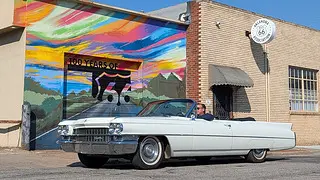
photo by: John Paget
John Paget in front of the Oklahoma Route 66 Association offices as he traveled the historic highway for his new film.
What brought you back to the road three decades later?
The Centennial definitely had something to do with it. But more than that, I felt there was an important story on Route 66 that America needed to hear right now.
Route 66 is our heritage highway, but in some ways I think it also points toward our future. The things that have kept this road alive are things I think we need more of as a country: local businesses, communities that know their history and are proud of it, and places where people still slow down long enough to encounter one another.
That’s what brought me back. I didn’t just want to make a film about a road turning 100. I wanted to make a film about why this road still matters.
At this milestone, it’s natural to ask, “Will Route 66 survive another hundred years?”
My answer is: it must.
Because Route 66 is not just an old highway. It is one of America’s most powerful reminders that local identity, human connection, and a sense of place are worth preserving.
What surprised you about your return visit?
It probably shouldn’t have surprised me, but Route 66 truly is a road of endless stories.
It’s one of the reasons this project kept growing. I originally set out to make a feature-length documentary. Before long, I realized there were simply too many extraordinary stories for one film, and it expanded into an episodic series. Even then, we’re still only scratching the surface.
There’s a new generation of remarkable people restoring, reinventing, and giving new life to historic places—and they often aren’t the people you might expect.
In Albuquerque, we met Dr. Sharmin Dharas, a surgeon who was born and raised in a Route 66 motel that was operated by her parents after they fled Idi Amin’s regime in Uganda. Decades later, Dr. Dharas returned and transformed the old University Lodge into the award-winning Hotel Zazz.
One block from the original western terminus of Route 66 in downtown Los Angeles, the magnificent Los Angeles Theatre—built in the early 1930s to be the grand dame of all movie palaces—was saved from demolition by Ezat Delijani, an immigrant from Iran. They still show movies there—in fact, we’ll be screening our documentary there on November 7!
And in Seligman, the Aztec Motel across the street from the famous Snow Cap Drive-In was in ruins when I first filmed Route 66 in the 1990s. Today, it’s been restored and reimagined into a “motel and creative space” by Sebastiaan de Boorder, who came to Route 66 from the Netherlands.
Those stories have really stayed with me. Because they show how Route 66 is not simply about looking backward. The people preserving the road today are writing its next chapter.

photo by: John Paget
Is Route 66's appeal simply nostalgia or is it something more?
Even if it were simply nostalgia, nostalgia is not so simple. It is memory.
It is a way of understanding where we came from and reconnecting with the people, places, and experiences that shaped us.
According to Angel Delgadillo, that yearning for connection sparked the rebirth of Route 66. After Seligman was bypassed by the interstate and nearly turned into a ghost town, travelers would still wander into his barber shop and say, “This must be the road my mother and father took to California. This must be the highway.”
And Angel asked himself, “What are these people looking for?” That’s how the Historic Route 66 movement began: “This must be the highway…” That desire to touch the past is powerful.
But today, the appeal of Route 66 has expanded far beyond that. People come from all over the world to take their dream vacation on this road. Generations born long after Route 66 was decommissioned are driving it.
That tells you something important: they are not returning to their own memories. They are coming in search of an experience.
I say it in the film: “The road we built a hundred years ago to get us to the Promised Land—today, that road is the Promised Land.”
Route 66 is not just an old highway. It is one of America’s most powerful reminders that local identity, human connection, and a sense of place are worth preserving.
What do you see as the biggest obstacle to preservation along the corridor?
I think the biggest obstacle is that we sometimes value the idea of Route 66 more than the actual places that make it real.
Having traveled Route 66 extensively in the years leading up to—and now during—the Centennial, I’ve noticed a great irony: we can sometimes find the money to build something new that celebrates the history of the road, but not the money to save the history itself.
Seligman, Arizona is a huge Route 66 success story, but they still lost their historic Harvey House in 2008.
Springfield, Missouri, is hailed as the Birthplace of Route 66. Yet in less than a year, the city lost two historic Route 66 motels: the Rancho Court in October 2025 and the Shamrock Court in August 2026—even as the city was celebrating the highway’s Centennial.
The list goes on and the contradiction is hard to ignore. At the very moment we are spending enormous energy and money celebrating Route 66 history, we are still allowing pieces of the real thing to disappear.
Once an original motel, café, gas station, theater, bridge, or neon sign is gone, we can build something that evokes it or hang photographs in a museum. But we can never replace the experience of the real thing.
Commemorating what used to be there isn’t enough. We have to save the authentic places while we still have them.
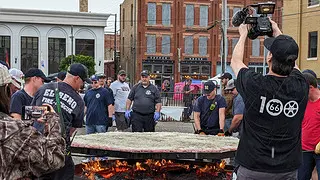
photo by: Rhys Martin
The first day of filming "The Main Street of America" in El Reno, Oklahoma.
What do you think the future of Route 66 looks like?
Route 66 has already proven that it can outlive the reason it was built.
Route 66’s real heyday as America’s primary cross-country highway was actually pretty brief. It was established in 1926, and by 1956, Eisenhower had signed its death warrant: the Interstate Highway Act that would render it obsolete. So in a sense, Route 66 had only about thirty years before the beginning of its decline.
What’s remarkable is that its life as a historic road has now lasted far longer than that original era. Route 66 has spent decades being rediscovered, restored, reinvented, and passed from one generation to the next, and it will never stop.
Because it has become something entirely different than its original purpose.
It has become irreplaceable.
What do you want audiences to take away from your new film?
So many of the stories in the film are about people who found purpose in saving an old place and bringing it back to life. Again and again, they told us that when they first took on some abandoned motel, theater, gas station, or roadside landmark, people thought they were crazy. These are the everyday heroes we wanted to spotlight. I hope the film inspires all of us to be a little more crazy—to care enough about a place, an idea, or a community to fight for it even when everyone else has given up on it.
Save Historic Places That Tell Our Full American Story
When you join the National Trust, you help save historic and culturally significant places nationwide.