Go Behind the Scenes with Route 66 Rewind
A Q&A about the role of AI in a new experiment from Google Arts & Culture.
Have you ever wanted to travel back in time? Now you can with Route 66 Rewind, an experiment from Google Arts & Culture.
In October 2025, the National Trust for Historic Preservation partnered with Google Arts & Culture to launch “A Culture Trip Down Route 66” a new theme page as part of its work to preserve Route 66. Developed in collaboration with over 20 additional partner organizations resulting in over 130 stories, this theme page takes you across all eight states on the Mother Road.
One piece of this project is Route 66 Rewind, an immersive road trip that uses elements of Artificial Intelligence (AI) to imagine what key locations along Route 66 might have looked like in the past. Visitors travel down the Mother Road in a classic Cadillac or a motorcycle (depending on if you are using the desktop or mobile experience) to see key stops along the road. The interactive features let users see the sights, sounds, and stories of each stop.
Here at the National Trust we know that AI is rapidly becoming intertwined in many aspects of our lives, and so when this experiment went live we knew that it was important to “pull back the curtain” and see the how Route 66 Rewind came to be—including how to approach the many complexities and challenges of the use of AI in historic preservation.
We asked the team at Google Arts & Culture a few questions to learn more.
What inspired you to build Route 66 Rewind? How did your team conceptualize this experiment?
We were inspired to create "Route 66 Rewind" by imagining how Veo might be able to bring the past to life and offer a more immersive look at the history of the Mother Road. Building on past successes of animating historical archives with Veo, Google Arts & Culture envisioned the Route 66 Rewind experiment as a way for audiences to connect more immediately to the history of the road using AI image generation technology to animate historical images. Christine Sugrue, an artist in residence at Google Arts & Culture Lab, used her creative expertise to bring this vision to life in close collaboration with the National Trust for Historic Preservation.
The experiment includes a few different elements of AI—can you walk us through them? How are the “rewind” pieces different for those based off of archival images?
There are three ways we utilized Google AI in this experience: the “rewind” videos, the audio guides, and the music.
“Rewind" Videos: To allow users to "step back in time," we used Google’s advanced video generation model, Veo, to create historically-inspired footage that we hope gives you the feeling of what the place looked like at a moment in the past. For 11 of the featured locations, this video generation was informed by archival imagery provided by The National Trust for Historic Preservation. For those images, the footage generated is tied to a specific location and atmosphere. This process informed how the video for the remaining 22 locations was generated. For these locations, we used open access historic imagery for the locations to inform the video generation and worked closely with The National Trust to make sure they felt historically-inspired.
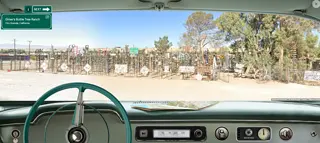
photo by: Google Arts & Culture
Screen capture of a stop on the Route 66 Rewind experiment. This stop shows the Google Streetview of Bottle Tree Ranch in California.
Audio Guides: Each location is accompanied by audio guides sharing the history and significance of each site that is generated with Google Gemini and also utilises Text-to Speech. The audio guides also feature both a version geared towards adults and another geared towards kids. This feature increases accessibility while telling the stories behind each stop, emphasizing that what makes the road special is the stories and communities behind each location.
Music: A radio dial feature allows users to listen to "era-inspired music generated with Lyria," a Google music generation model. Listening to the radio and to upbeat music is an iconic part of the American roadtrip, which is embodied especially by a journey down Route 66. This is why we created this playful radio dial feature to give the experiment that extra dimension and closely simulate the roadtrip experience.
Stay connected with us via email. Sign up today.
There are concerns about using AI manipulation around images, or replacing human voices for ones generated by AI. Are there parameters or rules that you abide by when choosing what to deploy as AI and when not to?
Google Arts & Culture focuses on projects that augment human creativity rather than replace it. In this experiment, AI serves as a storytelling tool, allowing us to reimagine specific moments in time along the "Mother Road" through an immersive digital experience.
That’s why it was important for us to work with the National Trust on this experiment to make sure their expertise shaped the project.
The Route 66 Rewind experiment is part of a larger collaboration with the National Trust for Historic Preservation and 22 cultural partners celebrating the Route 66 centennial in 2026. In Route 66 Rewind, we curated 33 featured locations in partnership with The National Trust where AI-generated "rewind" videos bring history to life. To ensure historical accuracy, we prioritized locations where we could find high-quality source images to guide the AI video generation.
For 11 of these locations, the National Trust provided archival imagery and their historical expertise to ensure the AI-generated videos remained faithful to the era. This framework also guided our creation of the remaining 22 videos, which utilize open-access historic imagery. All AI-video content was pre-generated and vetted by the National Trust for accuracy.
What excites you and what challenges you about the use of AI in this way?
By using AI to enhance immersive storytelling, we can provide a much deeper sense of place. These tools allow users to 'time travel,' exploring different eras with a deeper level of detail.
Google Arts & Culture focuses on projects that augment human creativity rather than replace it.
What do you want users of the Google experiment to take away from the experience?
We hope users are inspired by the depth and breadth of culture across Route 66, and feel a little closer to the route’s history, whether fostering nostalgia for past travelers or bringing new audiences to Route 66 who might not be able to explore in person.
Save Historic Places That Tell Our Full American Story
When you join the National Trust, you help save historic and culturally significant places nationwide.