Solving the Mystery of a Drayton Hall Mirror
The stories of Drayton Hall’s past lie preserved in its walls. The National Trust acquired the Charleston, South Carolina, property in 1974 from the Drayton family and found it remarkably unchanged. So striking was the main house’s untouched condition that the National Trust determined it should remain preserved as is, the 1740s house being “the largest artifact in Drayton Hall’s collection,” says Trish Lowe Smith, the site’s director of preservation and archives. Recently, Smith and her colleagues unraveled the mystery of the house’s missing 18th-century pier mirror and commissioned a magnificent replica for visitors to enjoy.
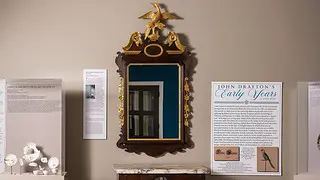
photo by: Katie Charlotte
The mirror on display in a gallery space at Drayton Hall.
For decades, Drayton Hall staff had suspected that a large, decorative pier mirror had hung between two windows in the drawing room. The mirror apparently didn’t quite fit, and the molding around the two windows had been partially carved out to accommodate it. A 2014 paint analysis dated the installation of the missing mirror to the 1740s. Chris Swan, a furniture conservator with Colonial Williamsburg, began reverse-engineering what this object may have looked like by hand-tracing the carve-outs.
Replicating the mirror remained a dream until the site received a grant from frame restorers Eli Wilner & Company in 2024. The Wilner team, Drayton Hall staff, and Swan reviewed 18th-century examples of pier mirrors to create a vision for the replica. After months of work, the hand-carved walnut, basswood, and parcel-gilt mirror now hangs in Drayton Hall’s Stephen F. and Laura D. Gates Gallery, where items that need modern climate control are displayed.
In the house itself, visitors can still see the clues that led to this journey of discovery. It isn’t the last mystery to solve there, says Smith. “One of the great joys of working in Drayton Hall is that we are constantly discovering new things.”