9 Tips On Planting Your Garden from Experts at Historic Sites
In early spring, as temperatures fluctuate between the cold snaps of winter and the first real warmth of spring (at least here on the East Coast), I start to get a little antsy. I wander my little community garden plot or stare at the planter boxes on my balcony, eager to begin sinking my hands into the earth—even though I know it’s not quite the right time. So instead, I do what any restless new gardener does, I look for advice.
Naturally, I turn to the experts, gardeners and horticulturalists at our National Trust Historic Sites and members of the Historic Artists’ Homes and Studios program. These are the people who tend the flora that brings historic places to life and who understand how landscapes shape the stories told there.
To learn from their experience, we asked 9 gardeners for tips as well as what they love about the landscape of the historic places they tend.
Get to Know Your Space (Edith Farnsworth House | Plano, Illinois)
Heather Prince, Horticulturalist
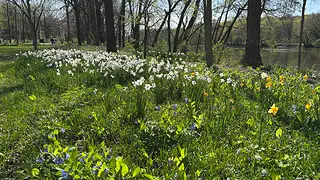
photo by: Heather Prince
Drifts of Virginia bluebells have naturalized among sweeps of daffodils planted along the Fox River.
After a long cold winter, we’re all itching to get into our gardens in spring. Before you rip open that seed packet or sharpen the shovel, take some time to really get to know the space where you’re planting. Consider the sun, soil, and moisture. Measure. Maybe do a little sketch. A little bit of planning can really make for a smoother planting plan and productive season.
My Favorite Spot:
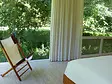
At the Edith Farnsworth House, the site is constantly responding to the quixotic moods of the Fox River. The long low lines of the steel and glass architecture are in constant conversation with the rippling waters. Then layer in the shifting light of sun through mature trees and swathes of wildflowers all serenaded by myriad birds. There’s a very special peace found just by sitting on the terrace.
Start Small (Sam and Alfreda Maloof Foundation for Arts and Crafts | Rancho Cucamonga, California)
Seth, Gardener
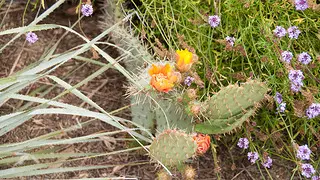
photo by: Sam and Alfreda Maloof Foundation for Arts and Crafts
Native plants are a key part of the Beverly Garden at the Maloof Foundation.
As the volunteer gardener at the Sam and Alfreda Maloof Foundation for Arts and Crafts for over twenty years, I encourage gardeners to have a vision and plan but to start small. Little by little over the years the flourishing garden will fill in, so you don't overplant.
My Favorite Spot:
We have eight distinct regions, each showcasing a different theme and selection of plants that reflect the Southern California climate. This was designed by Beverly Wingate Maloof & Rick Fisher over 25 years ago. I love this variety in the garden, and it's very hard to pick a favorite. If I must, pick a favorite it would be the California native plantings. They are the most sustainable water-wise plants and require the least maintenance.
Think Native Plants (Grace Hudson Museum and Sun House | Ukiah, California)
Andrea Davis, Museum Gardener
The Wild Gardens at Grace Hudson Museum feature local California native plants that have evolved in our Mediterranean climate. A Mediterranean climate is characterized by cool, wet winters and hot, dry summers with periods of prolonged drought. Our native plants have often adapted to our climate by becoming at least partially dormant during the summer. As a consequence, they grow best when they are planted in the fall, after the weather becomes cooler and the rains begin.
My Favorite Spot:
Two perennial favorites in our garden are our Salmon Stream water feature (no real salmon) and our centuries old Grandmother Valley Oak. Last week I was serenaded by Pacific Chorus Frogs while I worked in the garden and they became my favorite feature of the week. When you create a garden featuring native plants you create habitat and the wildlife present will also change with the seasons. Some species are present throughout the year, but our bird and insect populations will vary, and are always a source of beauty, wonder, and delight.
Our garden is unique in that it was created to provide plants that are used for traditional Pomo cultural practices.
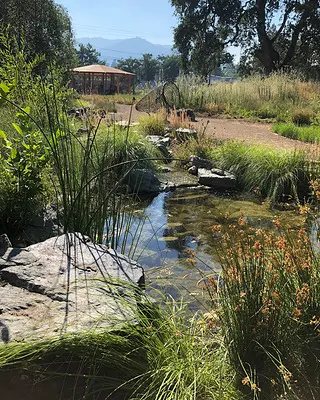
photo by: Grace Hudson Museum
Located in the garden of the Grace Hudson Museum, the Salmon Stream water feature presents a variety of both plant and animal life to those who visit.
Plant for your Climate Zone (Albin Polasek Museum & Sculpture Gardens | Winter Park, Florida)
Byron Walker, Facilities Director
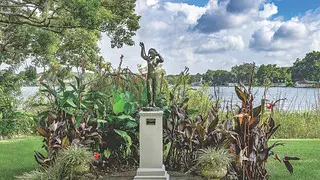
photo by: Albin Polasek Museum & Sculpture Gardens
With a shoreline that runs along Lake Osceola, the plant life at the Albin Polasek Museum provides visitors with a strong sense of place.
Use plant material that will grow in your climate zone, not just because you like them. For example, you may have grown beautiful hydrangeas in Atlanta but at your new home in Orlando, they don’t grow as easily.
Want more inspiration for your garden? Check out
What's Your Zone? 23 Native Plants to Fill Your Garden.
My Favorite Spot:
Whether you’re experiencing the view from the water or the land, our shoreline of Lake Osceola is an amazing mix of native and introduced plant life. From our signature majestic bald cypress to a variety of palm trees and seasonal color, the visitor experience is an ever changing kaleidoscope of beauty.
Don’t Fall for Fads (T.C. Steele State Historic Site | Nashville, Indiana)
Laura Anne Willis, Regional Landscape Manager
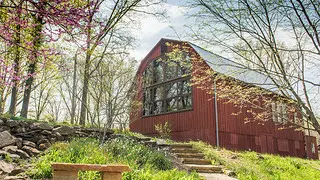
photo by: Amy Payne
The home of painter T.C. Steele and his wife Selma—who created several acres of gardens and landscaped the surrounding area—provided ample inspiration for his impressionist works.
Be careful of fads in the garden. This year there seems to be a lot of talk about color. For example, a moody garden or gothic, bringing in a lot of dark foliage—what growers might call black. This sounds interesting, but a lot of these new varieties haven't been out in the garden for a long enough growing season to understand their hardiness or longevity. I would stick with the tried-and-true varieties.
My Favorite Spot:
Before coming to this historic site I worked at a landscaping company that was all about newest, biggest, best plant material. What I love about a time period design is it becomes about these wonderful survival plants and shrubs, yes, some might seem invasive. But that’s where true gardening comes in, controlled but natural. Strolling through the gardens here is a walkthrough time. It makes me feel great to know Selma and Theodor would be pleased.
Build Relationships (Pope’s Museum | Ochlocknee, Georgia)
Michelle Dean, Executive Director and lead project manager for garden designs, expansions and maintenance
Build relationships—with neighbors, local gardeners, and the broader horticultural community. The knowledge you gain from those connections is invaluable, and often irreplaceable. At Pope's Museum, we have been fortunate to receive heirloom bulbs and seeds from generous individuals, along with hard-won wisdom that has saved us from costly mistakes. I was ready to plant azaleas along the border until a more experienced gardener warned me that deer are particularly fond of them—and with over 800 acres of forest surrounding us, the deer population is significant. Those azaleas would not have stood a chance! Seek out the people who know your land, your region, and your plants, and listen carefully.
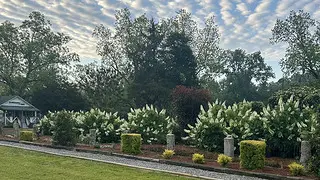
photo by: Pope’s Museum
Surrounded by acres of forest, the Pope’s Museum also includes some magnificent foliage and plantings that thrive in the region.
My Favorite Spot:
Without question, the Japanese Magnolias. Known also as Tulip Trees, these magnificent trees typically reach about 20 feet in a garden setting, but the ones flanking the entranceway at Pope's Museum soar to over 40 feet—a testament to the age and continuity of care that defines a historic landscape. In summer, their canopy offers welcome shade, but their true moment of glory comes in early February, when they burst into bloom. They never fail to stop visitors in their tracks, and honestly, they stop me too.
Use Your Imagination (Ann Norton Sculpture Gardens | West Palm Beach, Florida)
CJ McCartney, Master Gardener in Residence
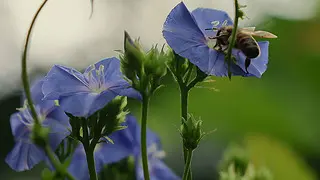
photo by: CJ McCartney
This close-up view of the Jacquemontia penthantos is just one of the many endangered plantings at the Ann Norton Sculpture Garden.
Imagination is the heart of every gardener's vision. Spring is an opportunity to expand your garden by adding a bench under a tree, creating a new wildflower bed and planting a new colorful blooming shrub to attract butterflies and bees all summer long.
My Favorite Spot:
My favorite feature of our meadow and pollinator garden is that by focusing on rare and critically imperiled native shrubs (such as the endangered Jacquemontia penthantos and threatened Simpson Stopper, Myrcianthes fragrans) and trees, we attract a wide variety of pollinators and butterflies that our community may not see on a regular basis. People are always surprised by the volume and variety of butterflies that are flying around as they wander our paths admiring how many of our trees are also sculptural masterpieces that live alongside Ann's Sculptures. All are Florida native plants.
Be Flexible and Appreciate Success (Burchfield Homestead Society | Salem, Ohio)
Cheryl Mattevi, Volunteer Gardener
One plant that seemed necessary for our garden was the sunflower that figured so prominently in Burchfield's paintings. We started optimistically. It should be easy to have a whole row of sunflowers, their seeds are so big and the plants so sturdy, so we planted a whole row along the fence, just as in the paintings. We did not count on the plethora of chipmunks.
Our seeds sprouted, and the first leaves were big and healthy, we were joyful. The next day they were gone, vanished with only a trace of the stem.
Plant again, cover with mulch for protection. Same story.
Plant again, cover each seed with a protective cylinder. No luck.
Plant again, in pots in a protected area.
Did you know sunflowers do not transplant well? Only a few puny plants made it through. Now we rely on just a few potted clumps, which are carefully nourished off site and brought in for special occasions.
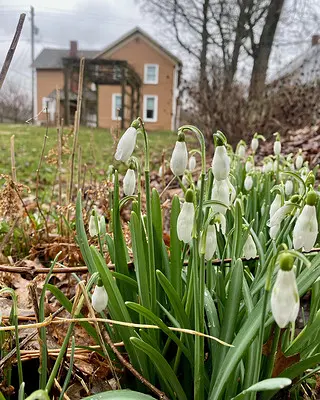
photo by: Burchfield
Wildflowers are in regular bloom at Burchfield. Every spring these blooms, like the Snow Drops pictured here, burst into life.
My Favorite Spot:
Charles Burchfield loved wildflowers, as do I, and writes in his journals about his walks in the woods where he gathered plants like bloodroot and violets to transplant under the grape arbor. We were able to go to the exact locations in the still-open areas around Salem that Burchfield meandered and successfully transplant what I am certain are third cousin ten times removed of his prizes.
Now in spring they bloom and while tending the garden I can imagine Burchfield carefully nurturing his plants, just as I now do their relatives. The garden buzzes with life, just like his paintings
Don’t be Afraid of Failure (Kykuit, The Rockefeller Home at Pocantico | Tarrytown, New York)
Clare Levy Strom, Curator of Gardens, Greenrock
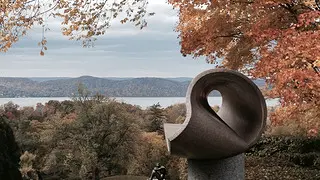
photo by: Clare Levy Strom
Nelson Rockefeller took advantage of the view with his sculpture placement. Max Bill’s sculpture "Triangular Surface in Space" directs your attention to the same spot each time you view it, highlighting the constant change in light and texture of the hills beyond.
Don’t be afraid of “failure.” Try things out, see what works for you, learn from your mistakes. When a plant fails, get curious. What are the soil conditions? How much sunlight? An unsuccessful composition? Maybe the textures don’t work together. Or maybe the bloom timing is off. Perhaps you just need to wait and let the plants grow some more. Remember that as soon as a garden is planted, it begins to change. A happy gardener will learn to endure and perhaps relish some of this loss of control. Even the “weeds” that pop up can tell you something about the conditions in your garden. Look at the challenges that arise as information. Your garden is talking to you, and it’s your job to listen.
My Favorite Spot:
My favorite feature of the landscape changes, but the first thing that comes to mind today is also, most likely, the reason the Rockefeller Family chose this spot to build their home in the first place: the view. This landscape was designed with glorious views of the majestic Hudson River in mind. The land to the west was terraced to enhance the feeling that the landscape reaches all the way to the river’s edge. Visitors imagine a long stroll or carriage ride west could be rewarded by dipping your toes in the river. In some areas the view is purposefully obscured to heighten the excitement of the reveal around the corner or just past a hedge.
Save Historic Places That Tell Our Full American Story
When you join the National Trust, you help save historic and culturally significant places nationwide.