Six Places Where George Washington Went (And You Can Too)
Up and down the Eastern Seaboard, historic property owners love to claim that “George Washington slept here.” The hard-to-prove assertion is so common that it’s become a bit of a joke, said with a wink. But among all of the dubious links to the first president, there are many places where he actually did sleep, or at least did something historically significant. We’ve selected six sites where Washington’s historical presence provides a path to a more expansive view of the nation’s history—presented in new events, activities, and exhibits—as we commemorate its 250th anniversary.
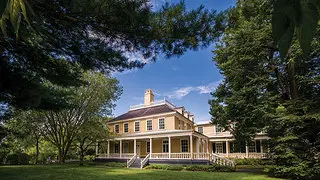
photo by: National Park Service
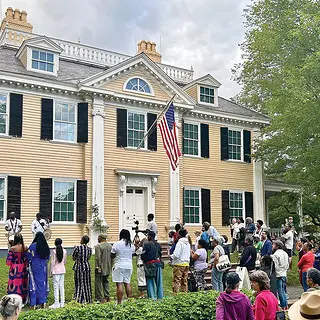
The East Lawn of Longfellow House-Washington's Headquarters in Cambridge, Massachusetts. Shown at top of story: A Juneteenth gathering in 2023, part of the site’s Summer Arts Festival that year.
Longfellow House-Washington’s Headquarters National Historic Site
The generously sized clapboard house at 105 Brattle Street in Cambridge, Massachusetts, would merit attention for its 18th-century Georgian architecture alone. But it also housed two giants of American history, several decades apart. George Washington lived there for nine months during the Siege of Boston, the period from 1775 to 1776 when American revolutionaries successfully blocked the British Army from moving around the area by land. And poet Henry Wadsworth Longfellow lived in the residence from 1837 until his death in 1882, writing classic poems like Paul Revere’s Ride and The Courtship of Miles Standish within its walls.
These days Longfellow House-Washington’s Headquarters is a National Park Service site that honors the history of its two famous inhabitants, plus the many others who lived and worked there. Events inspired by the nation’s 250th anniversary started in 2024 and have included speaker series, scholar talks, and community programs. The site also premiered two powerful short films in 2025: an overview with commentary from scholars, poets, and historians, and a separate production focused on the lives of people enslaved at the house by its original owner, John Vassall Jr., conveyed through the perspectives of their descendants.
Stay connected with us via email. Sign up today.
This summer, the Longfellow House will continue the 250th anniversary programming through its annual Summer Arts Festival, which features outdoor concerts and poetry readings. It will also offer deep-dive tours centered on Washington’s time at the house and the legacy of the Revolutionary War. Onsite naturalization ceremonies for new United States citizens are planned for the spring and fall, and this year they’ll be framed through a semiquincentennial lens. The National Park Service has been working to prepare the house and grounds for the visitation it will receive this year—repainting the exterior its distinctive butter yellow, restoring Longfellow’s study, and conserving furniture and books, among other projects.
In the overview film, historian and academic Kerri Greenidge sums up the place’s unique appeal: “The story of Longfellow House and George Washington, the Vassall family, means that the country, from its birth, has these complications within it. That complexity is actually a wonderful way to engage with understanding the past. That’s the beauty of having a site like this site.”
Cliveden
When the Continental Army fought the Battle of Germantown in 1777, much of the action took place at Cliveden, now a National Trust Historic Site in Philadelphia. Though Washington’s troops lost, their performance helped convince the French military to join their cause. Washington returned to Germantown in early September 1781 with French Royal Army officer Rochambeau, and their retinue stopped by Cliveden that afternoon.
This May through November, the site will host six art installations as part of the larger Radical Americana series of exhibitions taking place throughout the city. Artists such as Janna Gregonis, Jacintha Kruc, and Samara Weaver will use the year 1776 and subsequent anniversaries in 1876, 1926, and 1976 as jumping-off points for works that engage the present and future. Cliveden is also reinstalling its first floor and an upstairs hallway to the period of 1763–79, in place of its previous interpretation. The new look will debut in May.
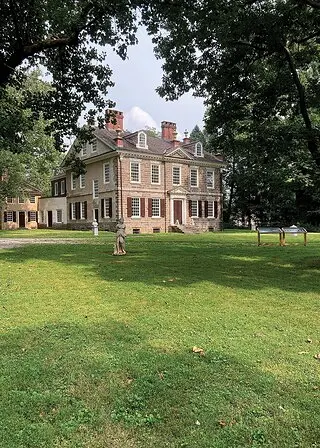
photo by: Cliveden of the National Trust
Cliveden, in Philadelphia’s Germantown neighborhood, dates to 1767. It will open for the 2026 season in May.
Over the summer, an exhibition called “Transcending Thresholds” will open throughout the site, including components in the kitchen, colonnade, and barn. According to Education Director Carolyn Wallace, it will “look at the environment [of the property] through the lens of servitude and enslavement.” And on October 3, Cliveden and other historic sites in the city’s Germantown neighborhood will host the annual Revolutionary Germantown Festival, replete with living history interpreters and other interactive programming.
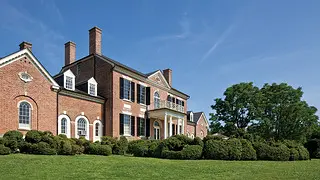
photo by: Gordon Beall
Woodlawn’s main house was built between 1800 and 1805, mostly by enslaved people.
Woodlawn
Before George Washington’s death in 1799, his Mount Vernon estate consisted of five farms. He bequeathed one of these Alexandria, Virginia, properties to his step-granddaughter and her husband, and it eventually became known as Woodlawn. This National Trust Historic Site will open an exhibit in June called “Friends Gather Here: A Legacy of Two Communities at Woodlawn.”
The exhibit dissects an often overlooked piece of the site’s history: its central role in a Quaker-led effort to show that slavery wasn’t needed for a successful agricultural operation in the South. Two Quaker families from Pennsylvania and New Jersey purchased Woodlawn in 1846 and joined with members of a local free Black community to farm the land. (Many in this latter group had been or were descended from people enslaved at Mount Vernon.) “Friends Gather Here” will explore the connections between the two communities and the effects of their bold experiment.
Related 2026 programming includes an April talk by historian John Garrison Marks about his new book, Thy Will Be Done: George Washington’s Legacy of Slavery and the Fight for American Memory, and a September Grandparents’ Day celebration that will explore the stories of the different generations linked to Woodlawn. For the September event, “we’ll have genealogical workshops, getting people connected with their own families, and also it will hopefully [help us find] some more descendants related to the site,” says Elizabeth Reese, Woodlawn’s senior manager of public programs and interpretation.

photo by: Washington Crossing Park Association
Continental troops arriving in New Jersey in a December 2023 reenactment at Washington Crossing State Park in Titusville, New Jersey.
Washington Crossing State Park
On an icy Christmas night in 1776, Washington led a daring expedition across the Delaware River from Pennsylvania to New Jersey. The Continental Army’s ensuing victory at the Battle of Trenton provided a burst of energy that boosted the morale of war-weary soldiers. Washington Crossing State Park in Titusville, New Jersey, will debut a new visitors center this summer to better interpret the crossing and related events.
Designed by ikon.5 architects, the center will showcase a rediscovered and restored 1921 mural of the crossing by noted artist George Matthews Harding. In another space, visitors will be able to board a reproduction boat with audio and video projections creating an immersive environment. “You’ll be surrounded by the sights and sounds of crossing the Delaware,” says Annette Earling, executive director of the Washington Crossing Park Association.
Other park buildings, including the Johnson Ferry House—the only extant house within view of the expedition’s landing—have been restored. The crucial role of the Marbleheaders, a multiracial regiment of Black, Native American, and white mariners who manned and navigated the boats during the crossing, is highlighted in a reenactment each December. The state historical commission has recommended the park as a stop on the New Jersey Black Heritage Trail, and further interpretation of the Marbleheaders’ experience will take place as the trail is developed.
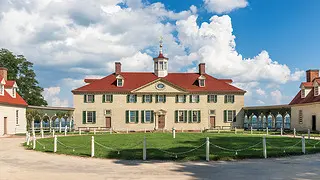
photo by: Mount Vernon Ladies' Association
The mansion at Mount Vernon.
George Washington’s Mount Vernon
No exploration of George Washington’s life would be complete without a stop at Mount Vernon in Fairfax County, Virginia. The National Historic Landmark belonged to Washington from 1761 until his death in 1799, and he designed multiple expansions of the original 1734 mansion. In 2024, current owner the Mount Vernon Ladies’ Association began a revitalization project on the house that entailed restoring the Washingtons’ Bedchamber, replacing old HVAC systems, improving lower-level drainage, and repairing sections of timber framing and masonry. The work was mostly completed by November 2025, when the mansion reopened to visitors.
As part of its semiquincentennial programming, Mount Vernon introduced a permanent exhibit in March 2026 called George Washington: A Revolutionary Life. It lives up to its title, while also highlighting people connected to Washington, such as his wife, Martha Washington; individuals he enslaved; and the Marquis de Lafayette, a key military ally.
A new, outdoor experience, the Patriots Path, re-creates a typical Revolutionary War encampment using canvas tents and replicas of period items such as maps, kitchen tools, and clothing. The site encourages visitors to handle these objects, and costumed interpreters are available throughout the encampment to explain and answer questions.
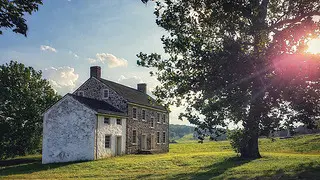
photo by: Judith A. Grubb
Valley Forge Park Alliance is currently converting the historic Maurice Stephens House into a multi-use building.
Valley Forge National Historical Park
If not for the determination of Anna Morris Holstein, Valley Forge National Historical Park might look very different. Holstein, a Union Army nurse during the Civil War, led efforts in the 1870s to purchase and restore Washington’s Headquarters at Valley Forge, Pennsylvania, the site of the Continental Army’s encampment during the winter and spring of 1777–78. The house and surrounding land, plus other key structures, served as a state park for decades before becoming a national historical park in 1976.
Washington’s Headquarters will be closed for renovations for much of this year, but there will be other ways to commemorate the semiquincentennial at Valley Forge. Working in conjunction with the park, the nonprofit Valley Forge Park Alliance (VFPA) is rehabilitating the circa-1816 Maurice Stephens House for use as its offices, a cafe, and interpretive space. The house will host readings of the Declaration of Independence on July 4th. Its new display panels will convey—among other things—the role of the Lenape people who lived on the land for thousands of years, and of Holstein and those who worked with her to set the stage for the park’s establishment.
The Maurice Stephens House sits within the Grand Parade, a vast meadow that served as the heart of the encampment. In 2017 VFPA hired landscape architect Jonathan Alderson to design a roughly 2-mile trail system through the meadow. “It’s a mown trail that makes a figure-eight through the Grand Parade,” says Molly Duffy, VFPA’s executive director. “We are telling the story of the transformation of the landscape.” Now the group is developing a program of guided walks along the trail system, training volunteers with the help of a National Trust grant. The guides will teach visitors about the site’s sweeping history, from its period of Lenape stewardship to its later industrial use and subsequent environmental cleanup.
The tours will also include details gleaned from the park’s 2023 research into the experiences of the more than 700 Black soldiers who served in the Continental Army at Valley Forge. (Some of these men also had Native American heritage.) The Patriots of African Descent Monument to them has stood on the edge of the Grand Parade since 1993, but the study yielded a trove of additional information. VFPA has used it to create and implement a fourth-grade school curriculum. “We’re also creating programming, not just for kids but also for adults, for park visitors generally, to tell those stories more,” Duffy says.
This year also happens to mark the 50th anniversary of the national historical park. Celebratory musket and cannon firings will take place onsite July 3–5. Other commemorative events will happen at Valley Forge’s National Memorial Arch, dedicated in 1917 and designed by architect Paul Philippe Cret. Naturally, the festivities will include an Anna Morris Holstein reenactor.
Editor's Note: For updates on progams and events at all of the places mentioned in this story, please check with the individual sites.
Save Historic Places That Tell Our Full American Story
When you join the National Trust, you help save historic and culturally significant places nationwide.
This page contains affiliate links. If you make a purchase through these links, the National Trust may earn a small commission. Check out other ways you can support preservation as you shop, travel, and play.