A New Book Reveals the Everyday Beauty of Chicago's Brick Buildings
Chicago is an architecture city, with locals and visitors alike flocking to landmarks by Frank Lloyd Wright, Daniel Burnham, Ludwig Mies van der Rohe, and many more. Yet, until recently, one of the most ubiquitous architectural elements wasn’t quite getting its due: brick. Will Quam started the Instagram account @brickofchicago in 2016, posting his own photos of brick structures from all around the city and its suburbs, and the account quickly accumulated tens of thousands of followers.
Ten years later, Quam has a new career as a writer, photographer, researcher, and tour guide, all stemming from building blocks made of clay. This spring marks the publication of his first book, Fire and Clay: How Bricks Reveal the Hidden History of Chicago, from The University of Chicago Press. He hopes it will spread the gospel of brick to more Chicagoans as well as architecturally curious folks elsewhere.
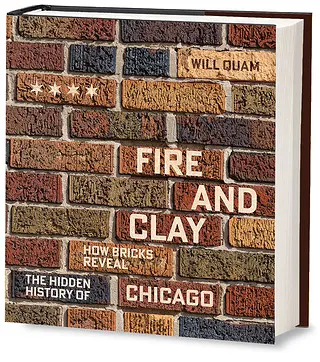
photo by: University of Chicago Press
“Brick is the oldest human-made building material and it’s been used so widely throughout history, so it’s easy to forget that brick is also an expressive, artistic material that has evolved over hundreds of years in the same way that art and fashion have,” Quam says.
Chicago is the ideal case study for a book about brick, because much of the city was rebuilt after the Great Chicago Fire of 1871. Mass production of brick had just taken off, so vast quantities of the material were available at reasonable prices. Much of it was produced locally, as nearby clay proved ideal for manufacturing common bricks, which are the workaday bricks that hold up a building. Face bricks, the aesthetically pleasing bricks used on facades, had to be imported from other cities with better clay. No other United States city, except maybe New York, was importing face bricks on Chicago’s scale.
After introducing readers to the material itself, the book moves chronologically, looking at different eras of brick style. “In the 1920s and early ’30s, people used colorful and textural bricks to make buildings feel old, like they’d been plucked out of the European countryside,” Quam says. “In the ’90s, bricks became almost cartoonish, and architects treated them almost like paint. Today, brick is typically sleek and modern, with dark, metallic tones, and it’s used in a lot of industrially inspired spaces.”
Quam interviewed architects, preservation experts, masons, architectural historians, and mortar and brick manufacturers. One of his favorite interviews was with architect Carol Ross Barney, who is well known for co-designing Chicago’s Riverwalk. “In the ’80s and ’90s, she designed these really fun, vibrant brick buildings, like the post office in suburban Glendale Heights that uses blue glazed bricks, along with red and buff bricks, [that] make the building look like an American flag,” Quam says. “She also designed several schools that use colorful brick in a very expressive way.”
Stay connected with us via email. Sign up today.
The architects Quam interviewed overwhelmingly agreed that The Monadnock Building downtown is the most significant brick structure in Chicago. The building was designed and built in two phases by two different architecture firms. The northern half, built in 1891 and designed by Burnham and Root, is one of the world’s tallest load-bearing commercial masonry buildings, at 16 stories. “It’s a testament to both the simplicity and the technology of brick,” Quam says. (The office of National Trust partner organization Main Street America is located in The Monadnock Building.)
Perhaps a more surprising part of the book is the section about famed Modernist architect Ludwig Mies van der Rohe, who is best known for his buildings made of steel and glass. “He loved brick,” Quam says. In fact, Mies trained as a mason, and he required his architecture students at the Illinois Institute of Technology (IIT) to design brick structures, painstakingly drawing each individual brick without the help of rulers or straightedges. For buildings he designed on the IIT campus, he had a custom brick created, and that type of brick is still made and used today.
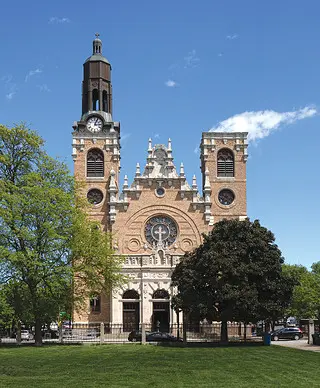
photo by: Will Quam
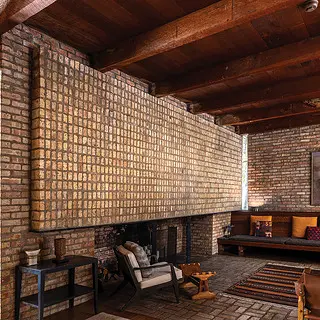
Architect Patrick Keely designed St. Stanislaus Kostka Church in Chicago, built in 1881 and clad in common brick. The photo at the top of this story shows The Schweikher House (1938), designed by architect Paul Schweikher in Schaumberg, Illinois.
The theme of historic preservation runs through the book. Quam says understanding mortar is particularly crucial, as typical modern-day mortar is denser and less permeable than historic mortar. “The [modern] mortar is stronger than the brick,” Quam says. This keeps the older brick from expanding and contracting with freeze-thaw cycles, which eventually leads to cracking. “I notice it all the time, and it’s really unfortunate,” he adds. The Norwegian Lutheran Memorial Church in Chicago’s Logan Square—“a beautiful redbrick, spiky, Gothic church,” Quam says—had its facade repointed in the 1990s with new mortar, which wreaked havoc on the building. Ultimately, helped by a grant from the city and funds raised from the congregation, the church underwent a successful restoration with the help of a preservation architect and a preservation mason, who designed a custom mortar that would work well with the existing brick.
Quam’s new, brick-paved career path isn’t too surprising if you dig into his life story. A St. Paul, Minnesota, native who moved to Chicago to teach theater in schools, Quam was always interested in architecture. His great-grandfather was John Entenza, a magazine editor who initiated the influential Case Study House program in the 1940s, commissioning designs from Richard Neutra, Charles and Ray Eames, and Eero Saarinen, among others. Quam’s father served in the Minnesota legislature, so he grew up visiting the Minnesota State Capitol, a revered Beaux-Arts–inspired structure designed by Cass Gilbert. Quam is the book’s main photographer, and it includes more than 100 images. He hopes it will reach both architecture nerds and people who don’t think brick is interesting at all.
“Brick is a unifying material across this enormous, diverse city,” he says. “You see it in wealthy neighborhoods and also in working-class ones. Looking at brick helps us pay more attention to our surroundings and the fabric of the city.”
Quam’s favorite brick structure in Chicago is a type of school designed by architect Dwight Perkins in the early 1900s; it was built several times. (One example is Alfred Nobel Dual Language School.) The schools are T-shaped, boxy buildings, with facades of rough yellow and gray bricks. The bricks alternate, with the gray ones set back in a way that makes the facade look as if it’s been outlined with decorative stitching. “It’s incredibly simple and also incredibly intricate,” Quam observes.
This page contains affiliate links. If you make a purchase through these links, the National Trust may earn a small commission. Check out other ways you can support preservation as you shop, travel, and play.
Save Historic Places That Tell Our Full American Story
When you join the National Trust, you help save historic and culturally significant places nationwide.