The Cerulean Effect: From High Design to Everyday Architecture
With the “Devil Wears Prada 2” hitting theatres, we can’t help but remember the iconic cerulean monologue delivered impeccably by Meryl Streep as the Anna Wintour-inspired Miranda Priestly in the first film.
Much like the fashion industry, trends in architectural design often originate from high-end designs but find their way into vernacular architecture. We asked our historic preservation experts what trends spring to their minds.
Cerulean Blue "The Devil Wears Prada" Clip
Linoleum
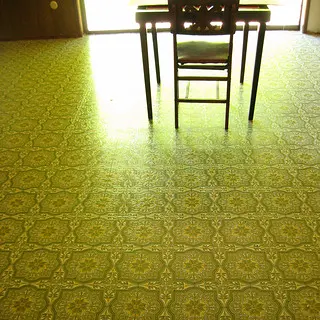
photo by: Kathleen O'Connor via Flickr/CC BY-NC-ND 2.0
Linoleum on the floor of a home in Portland, Oregon.
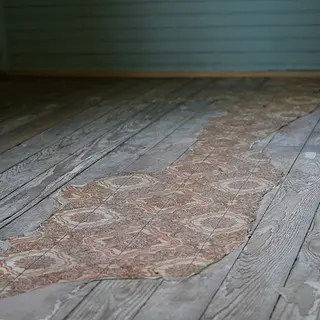
photo by: Morgan Forde
A fragment of linoleum on the floor of Nina Simone's Childhood Home in Tryon, North Carolina.
Flooring’s ugly duckling, linoleum, was once considered to be quite fashionable. Its creator Frederick Walton was inspired after forgetting to seal an oil paint jar and noticed the linseed oil congealing on top. He combined it with ground cork, sawdust, and pigments on a cotton cloth and named it linoleum, a combination of the Latin words for oil and flax. It was revolutionary in the flooring world as it was durable, easy to make, and touted as being antibacterial. It could also be made in a wide variety of beautiful patterns from geometrics to florals. It was considered the modern, refined choice of flooring in the late 1870s-1960s.
The Titanic’s floors were made of linoleum! By the 1950s, it was even more durable and cheaper to mass produce, which made it ubiquitous. It was perfect for high traffic areas like grocery stores or hospitals as it didn’t show wear and was easy to clean. The popularity and durability made it quickly fall out of fashion as it became seen as tacky and cheap.
Wallpaper
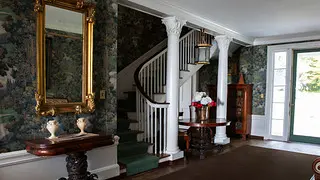
photo by: Don Freeman
Wallpaper at Chesterwood, a National Trust Historic Site in Stockbridge, Massachusetts.
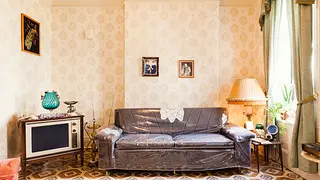
photo by: Travis Roozee
Wallpaper in one of the post-World War II stories at the Tenement Museum, a National Trust Historic Site in New York City.
Wallpaper began as a product that was only accessible to the elite. Wealthy people imported handpainted papers from China to decorate their rooms. When block printing became popular in the 18th century, wallpaper became more accessible to the middle classes. Then when surface printing wallpaper machines were invented in 1830 and wallcoverings could be mass produced, they became widespread, even gracing the walls of cheap hotels, like the one that Oscar Wilde was in during his untimely death in 1900 at the age of 46. Scholars have noted that details surrounding his death have produced many embellishments, possibly even including the quote: “My wallpaper and I are fighting a duel to the death. One or the other of us has to go.”
Want more wallpaper? Explore Give Your Home a Historic Touch with 7 Vintage-Inspired Wall Coverings.
Stay connected with us via email. Sign up today.
Sunburst Mirrors

photo by: National Gallery of Art (UK)/Creative Commons
The Arnolfini Portrait by Jan Van Eyck has a sunburst mirror in the background of the painting. Look closely and you can see a special reflection.
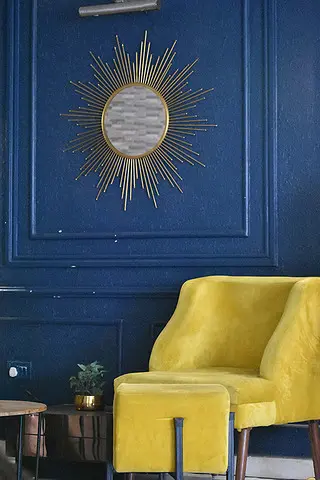
photo by: Unsplash/KomalG
An example of a sunburst style wall hanging in a modern apartment.
Sunbursts as a decorative object may have their roots in medieval religious arts. A rounded sun-shaped convex mirror in the background of a Jan van Eyck painting from the 15th century suggests that they have been a trendy piece for quite some time. In the 1930s during the Hollywood Regency heyday of decorative trends, glitzy opulence was everywhere. Iconic set designer Tony Duquette often used sunburst mirrors to catch a viewer’s eye. High-end auction houses saw overwhelming bids for decorative wall art, like these mirrors. Renowned French metalworker Gilbert Poillerat created gilded sunburst mirrors that were popular with the cafe society. In the 1960s, they became popular due to our national obsession with NASA’s Space Race. Today, you can find them at various big box retailers. There are even YouTube tutorials on how to make your own out of everyday materials like skewer sticks or toilet paper rolls.
Plasterwork to Decorative Tin Ceilings
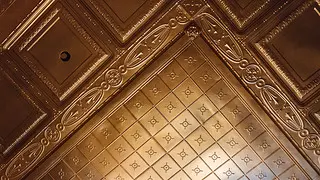
photo by: Trevor Huxham via Flickr CC BY-NC-ND 2.0
The Rosson House, a Victorian House in Phoenix, Arizona, has a pressed steel ceiling pictured here c. 2017.
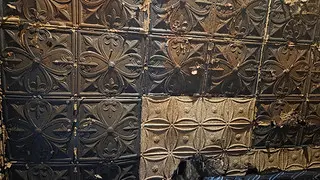
photo by: Priya Chhaya
A detailed view of a pressed metal ceiling at the Tenement Museum.
Inspired by manor houses, churches, and government buildings of England, Americans in the mid-19th century wanted ornate plasterwork ceilings, but it was out of reach for the up-and-coming middle class. An American invention: tin ceilings democratized decorative ceilings by making it accessible beyond the wealthy. The mass-produced tin designs were usually painted white to mimic the molded plaster. It appeared in parlors and dining rooms, but also made its way into stores, offices, and restaurants. However, when WWII broke out, metal was needed for the war, and it quickly went out of style.
Brackets
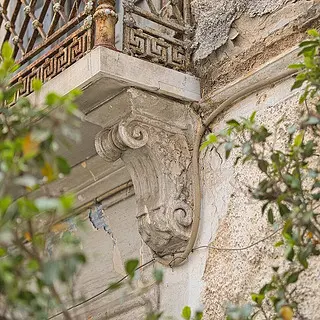
photo by: George E. Koronaios/Wikimedia
A photo of a bracket in an older building in Athens, Greece.
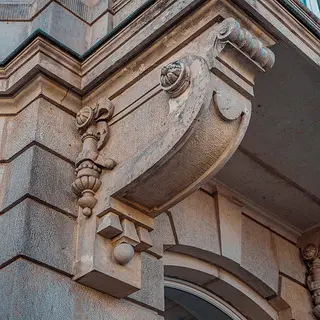
photo by: Unsplash/RubenHanssen
A more simplified bracket on an apartment building in Germany.
In the mid-19th century, nostalgia reigned in architectural styles. Italianate buildings were in vogue between the early 1840s-1880s. Derived from medieval Italian villas and farmhouses, they are recognizable through their belvederes, tall narrow windows, and overhanging eaves with substantial brackets. These brackets made their way into more American homes through kit houses. These mail-order prefabricated houses, available through companies like Sears and Roebuck & Co., allowed architectural designs to be accessible to the common person.
Biltmore Style

photo by: Abbie Myers/Wikimedia
Exterior of the Biltmore Mansion in Asheville, North Carolina.
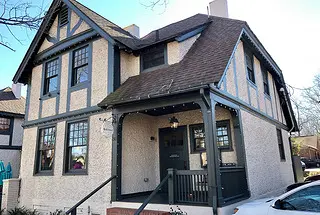
photo by: Warren LeMay/Wikimedia
A more vernacular building on the Biltmore Complex that takes elements from the larger mansion and incorporates it into this more modest structure.
By the 1890s, Asheville, North Carolina, was a burgeoning holiday destination for the wealthy elites of the Gilded Age. Charmed by the fresh mountain air and scenic beauty of the Blue Ridge Mountains, George W. Vanderbilt decided to build a “cottage” for himself, which he named Biltmore.
When Biltmore was under construction (1889-1895), hundreds of craftspeople moved to the city to help with the construction. Many of them stayed and made Asheville and the surrounding cities their home, including Rafael Guastavino (engineer and architect), Richard Sharp Smith (architect), and Samual Isacc Bean (mason). They soon spread the “Biltmore Style” throughout Asheville, these architectural features include:
- Pebbledashed walls
- Wood shingles on the upper floors
- Varied roof lines
- Steep roofs
- Truncated gables
- 10″ square porch posts with simple bracket
Amanda Moore, preservation architect, Ann Phillips, senior preservation architect, and Tisha Allen, associate director at the National Trust for Historic Preservation all contributed to this story.
Save Historic Places That Tell Our Full American Story
When you join the National Trust, you help save historic and culturally significant places nationwide.