11 Stories for the Summer: Road Trips, Gathering, Exploration, and Escape
Summer beckons.
For just a few months of the year we split our time between the everyday and the possibility of catching moments to just be. This is when we retreat—to the beach to catch a glimpse of gentle lapping waves, to the forest to steady ourselves beneath lush canopies, or even to our favorite corner of our own home. In a sense this is the season of hitting the open road, gathering with friends and family, exploring new places, and escaping the ordinary.
Here are eleven place-based books to let you embrace the summer no matter what path you take.
Want more reading suggestions? Explore our other reading lists.
Road Trips
Midnight Taxi by Yosha Gunasekera
For a fast-paced read that’s sprinkled with descriptions of sites in New York, consider picking up The Midnight Taxi. The story follows Siriwathi, a Sri Lankan American taxi driver whose life is turned upside down when she discovers that a passenger in her cab has been murdered. Siriwathi races to clear her name with one of her previous passengers, Amaya, a fellow Sri Lankan American and public defender. As she and Amaya investigate the murder case, they also reflect on their cultural roots and experiences living in New York. Siriwathi’s character is deeply attached to the built environment, and she frequently comments on the buildings, signs, and people around her. “I slow my car outside the courthouse,” she narrates at one point, “I find the Brutalist architectural style more suitable for a bomb shelter than a bastion of justice.” — Emma P., Public Affairs
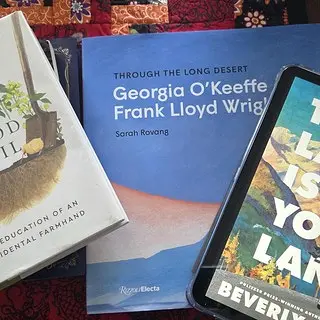
This Land is Your Land: A Road Trip Through U.S. History by Beverly Gage
Written by Pulitzer Prize winning historian Beverly Gage, This Land is Your Land provides a combination of travel diary and memoir alongside her thorough accounting of 250 years of U.S. history through a grand tour of nearly 300 historic sites across the country—many that you’d expect and some far off the beaten path. She revisits the escape of Ona Judge from the President’s House in Philadelphia, Indian Removal at The Sequoyah Birthplace Museum in Tennessee, the industrial era labor movement at the Pullman National Historical Park outside of Chicago, Japanese Internment at Manzanar War Relocation Center in California, and a trail through Civil Rights Movement history. Overall, Gage provides a hopeful outlook on where we’ve been and where we’ve yet to go. — Niya Bates, African American Cultural Heritage Action Fund
My Sister is Going to Kill Me by Nina Simon
When I first visited the Grand Canyon, I found myself giddy, startled by the immensity of this natural landscape. Nina Simon’s second mystery novel harnesses that sense of the sublime as we follow along with a rafting retreat for a wellness company that goes horribly wrong. For Liv and Mandy Chisholm, sister bonding turns them into investigators at their own peril, and over the course of the novel old family tensions surface as they realize there is more to this retreat than they signed up for. Amidst the backdrop of the mighty Colorado River, hiking trails, and stunning vistas we are swept into a tale of corporate espionage, family drama, and murder. —Priya C., Public Affairs
Note: This title will be published August 18, 2026. An arc of this book was provided by NetGalley
Gathering
The Martha's Vineyard Beach and Book Club by Martha Hall Kelly
Set on atmospheric Martha’s Vineyard, two spunky sisters and their close friend navigate life during World War II in their tight-knit community as they start a book club while trying to take care of a family farm. As Mari Starwood travels to the island in 2016 to learn more about her late mother, a local recluse shares the story of Cadence (age 19) and Briar (age 16) Smith, and their friend Bess in 1942. Told in flashbacks this novel is part mystery (think Nazi spies and deserters along with mysterious U-boat sightings), part history of the Armed Services Editions of famous novels, with a little romance sprinkled in. The result is a story that explores themes of resilience and perseverance, gathering and connection, friendship and family, and the power of reading. —Dana P., Historic Sites
Women’s Hotel by Daniel M. Lavery
The book follows the stories of several residents and employees of the Beidermeier, a women's hotel, in 1960s New York City. This type of residential hotel for working women was specific to a short period in New York City’s history, and the book touches on not only the ephemerality of businesses inhabiting the city’s streetscape but also the transitory nature of the hotel residents. Each character has ended up living at the Beidermeier for different reasons, whether drawn to it or escaping from something else. Together they form an ecosystem of communal living, even as residents come and go. Keep an eye out for preservation-related mentions throughout the book, including zoning and planning history and references to several historic New York City buildings! —Charlotte H., National Fund for Sacred Places
Exploration
The Westerners: Mythmaking and Belonging on the American Frontier by Megan Kate Nelson
In this sweeping history, Megan Kate Nelson pulls on a multi-strand narrative transporting us through our understanding of the American West while also expanding it. Through the stories of seven individuals—Sacagawea (as an explorer in her own right), Jim Beckwourth (a bi-racial fur trader whose contributions to expansion are wide and varied), Maria Gertrudis Barceló (a Latina gambling saloon owner in Santa Fe), Ovando Hollister (a solider, miner and newspaperman), Little Wolf (a Northern Cheynne Chief who fought for his people), Ella Watson (a Canadian immigrant turned rancher), and Polly Bemis (a Chinese immigrant who fought to live on her own terms in Idaho)—Nelson complicates the common understanding of the pioneer. The result is a detailed, dynamic, and clear-eyed view of the full history of the frontier and the myth that obscures it. —Priya C. Public Affairs
Good Soil: The Education of an Accidental Farmhand by Jeff Chu
This is a book about exploration, but not in the way you would expect. Jeff Chu’s memoir chronicles his life at a moment of truth, when he stepped away from a career in journalism to attend the Princeton Theological Seminary. While there he forged a connection to the earth at the Farminary—where “theological education is integrated with small-scale regenerative agriculture”—and through non-linear narrative grapples with his family’s connection to religion, his identity as a gay man, and the importance of place and history in building belonging. While the book is very much about faith, our readers will appreciate the interwoven threads of history, food, community, and conservation, reminding us how where we are often provides space to fully understand who we are in a deeply personal way. —Priya C. Public Affairs
Through the Long Desert: Georgia O’Keefe and Frank Lloyd Wright by Sarah Rovang
First off this is not a take-me-to-the-beach book but rather a sit-on-your-porch-and savor book. The work of Georgia O’Keefe and Frank Lloyd Wright is beloved by many, and this book seeks to forge a connection of these two creative minds. Two individuals who—while twenty years apart in age—were connected by inspiration and mutual admiration though they had only met a few times in person. Through an examination of the nearly two dozen letters between O’Keefe and Wright and deep archival research, Sarah Rovang reveals the different ways in which their artistic philosophies and physical work manifested from a deep appreciation to place. Through the Long Desert is not only visually spectacular with photography, narrative, and art side by side, but also a reminder of why the work of both artist and architect resonates beyond their lifetimes. —Priya C., Public Affairs
Escape
The Antidote by Karen Russell
Set in western Nebraska in 1935, the story begins with the real weather events of Black Sunday, a massive dust storm that further devastates an already struggling town. A handful of narrators navigate the present and harken back to how they all got here, featuring a memorable cast of characters (with many to love, and a few to despise). Russell excels at fashioning a memorable landscape – you can feel the dust in your eyes – and keeps the story barreling along to its finale. At its core, this is a story about what it means to remember, the danger of choosing to forget, and how freedom and creation can only come through truth. —Haley K., Development
Where the Wildflowers Grow by Terah Shelton Harris
This book starts with an ultimate escape: an inmate running to freedom after a prison transport bus crashes into a river; she is the sole survivor. She finds unexpected sanctuary at an Alabama flower farm. It’s a story about found family, overcoming trauma, reckoning with grief, and how nature can provide hope and healing. It’s also steeped in place: Harris’s lush prose transports the reader to c (where enslaved women and their descendants have created stunning geometric quilts) and to West Blocton, a small little town that hosts an annual festival celebrating the Cahaba lily. Haley S., Public Affairs
The Filling Station by Vanessa Miller
A century after a white supremacist mob led a massacre that destroyed Tulsa, Oklahoma’s Greenwood neighborhood, author Vanessa Miller visited archives to reclaim stories about the everyday people who survived the devastation and risked everything to rebuild. The Filling Station follows two fictional sisters, Margaret and Evelyn Justice, who escape the massacre and find refuge at Threatt Filling Station, a real-life landmark along what would become Route 66 that remains standing to this day. The book follows the sisters’ personal approaches to healing, both themselves and their community, and tells an early history of Black travel along what would become one of the most iconic highways in the United States.—Morgan Forde, African American Cultural Heritage Action Fund
This page contains affiliate links. If you make a purchase through these links, the National Trust may earn a small commission. Check out other ways you can support preservation as you shop, travel, and play.
Save Historic Places That Tell Our Full American Story
When you join the National Trust, you help save historic and culturally significant places nationwide.