Preserving the Japanese American Experience at Tule Lake
Support the Tule Lake Segregation Center. If you live in California or Washington, please use this form to send a letter to your Members of Congress asking them to support the Tule Lake Segregation Center and National Monument.
During World War II, following Japan’s attack on Pearl Harbor, the U.S. government forcibly removed approximately 126,000 Japanese Americans from their homes and incarcerated them in camps across the western U.S. Two-thirds of those incarcerated were American citizens. It stands as one of the most egregious violations of civil rights in the country’s history.
What would become the largest of the incarceration camps opened in May 1942 at Tule Lake, in northern California. Nearly 30,000 Japanese Americans were incarcerated there during its operation. Tule Lake was unique among the camps in that, in 1943, it was converted into a high-security segregation center for prisoners branded “disloyal” to the United States based largely on their responses — or refusal to respond — to a controversial government-issued questionnaire.
Tule Lake was named to the National Trust for Historic Preservation’s list of America’s 11 Most Endangered Historic Places for 2026 amid concerns over a proposed security fence around Tulelake Municipal Airport, an airfield within the former camp.
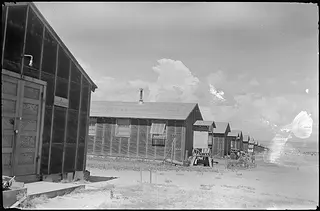
photo by: Public Domain
Tule Lake Segregation Center, between 1942-45.
The Federal Aviation Administration (FAA) and California’s Modoc County are considering constructing a three-mile-long fence, with a height of eight to 10 feet, around the airfield. Survivors and descendants of those incarcerated at Tule Lake, many of whom have long advocated for the airfield's removal, believe the fence would obstruct sightlines and further disrupt the site’s integrity.
Among those who oppose the fence is Barbara Takei, a Sansei (third-generation Japanese American) from Sacramento, California, whose mother and maternal relatives were incarcerated at Tule Lake during its first year of operation.
“The immediate goal is to prevent the fence from being erected, because that fence would desecrate the viewshed. It would desecrate the fabric of the site,” she said.
“Are you willing to serve in the armed forces of the United States on combat duty, wherever ordered?”
The Infamous Questionnaire
Typically, the National Trust solicits nominations for its America’s 11 Most Endangered Historic Places list through an open call. As the U.S. marks the 250th anniversary of its founding, the 2026 sites were chosen internally to “illuminate stories of remarkable individuals who fought to bring our country closer to its founding aspirations of equality.”
“We intentionally selected the 11 sites this year to focus on places connected to the founding-era principle that ‘all people are created equal,’” said Jennifer Sandy, senior director of preservation programs at the National Trust.
Tule Lake was included in the 2026 list because it tells the story of both race-based incarceration and the bravery of—and consequences faced by—those who chose to dissent. That history is closely tied to a controversial questionnaire introduced in 1943 by the War Relocation Authority and the War Department. It was designed to identify Japanese Americans who were eligible for military service and to assess loyalty to the United States. Two questions would come to loom large in the history of Tule Lake.
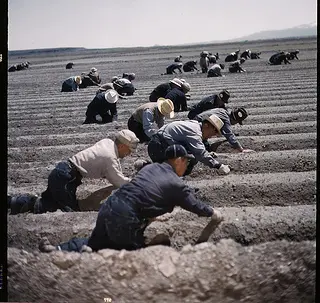
photo by: Library of Congress LC-DIG-fsac-1a35013
A group of incarcerated Japanese Americans in 1942 or 1943 farming at Tule Lake Incarceration Camp in Newell, California. They are working along different rows in a large field.
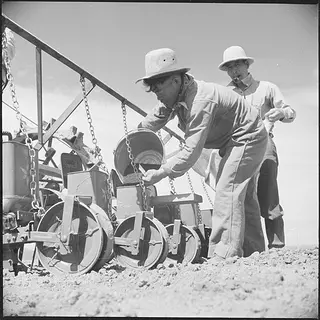
photo by: Public Domain
K. Kubo of California using an onion planter at Tule Lake Segregation Center, in a 1942 photo by the War Relocation Authority.
Question 27 asked, “Are you willing to serve in the armed forces of the United States on combat duty, wherever ordered?”
The following question, number 28, asked, “Will you swear unqualified allegiance to the United States and faithfully defend the United States from any or all attack by foreign or domestic forces, and forswear any form of allegiance or obedience to the Japanese emperor, or any other foreign government, power, or organization?”
Many Japanese Americans objected to the questions. Those who answered “no” to one or both—or who qualified their answers or outright refused to answer them in protest—were labeled disloyal and transferred to Tule Lake.
The camp became a maximum-security segregation center, with guard towers, fences and a heavy military police presence. Armored vehicles and machine guns were a common sight. There was also a notorious detention area, known as the Stockade, as well as a jail where organizers and leaders considered a threat to order were isolated.
“It [Tule Lake] was used to punish the people who expressed dissatisfaction or unhappiness or complained about the injustice of the mass incarceration,” said Takei, adding that that legacy of dissent is largely “why we have worked so hard to protect [the site], and to elevate its history.”
A Sacred Site
Takei, who was born in 1948, was about 10 when she first learned about Tule Lake and the incarceration of Japanese Americans during the war from a book gifted to her parents. Her family, she recalls, rarely discussed the humiliations of their World War II incarceration.
“It was just too painful, too enormous,” said Takei. “People didn't have the language to describe what that does to you, so there was a widespread community silence about the incarceration for many decades.”
Takei serves as chief financial officer for the Tule Lake Committee, a nonprofit dedicated to educating the public about the history of the site and advocating for its preservation. The Tule Lake Committee organizes biannual pilgrimages to the site for survivors and their descendants.
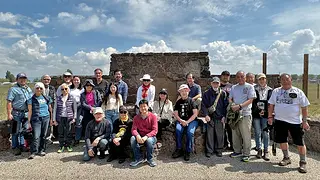
photo by: Tule Lake Committee
Tule Lake Committee and docents at the State Historic Landmark marker adjacent to the jail stockade, which is part of the Tule Lake National Monument. Tule Lake Segregation Center, Modoc County, California
As a place where generations of families experienced immense suffering, Tule Lake is a sacred site to many Japanese Americans. For those who return to remember and reflect, preserving access to the landscape is a central concern. Advocates argue that the proposed fence, which according to the FAA is intended to keep wildlife and trespassers away from the airfield, would restrict access to parts of the site that are central to its history.
“Visiting the site is a very emotional experience,” said Takei. “Many people cry. There's a deep sadness, the recognition of the loss, and I think that having a fence that makes the site inaccessible and creates a visual barrier is hurtful and traumatizing.”
Takei hopes inclusion on the National Trust’s 11 Most Endangered list will draw national attention to Tule Lake so that the lessons of this dark chapter in U.S. history are not forgotten.
“It elevates and helps validate our fight to preserve the site,” said Takei, adding, “[We’re] fighting to protect, preserve and interpret a site that tells the story of Japanese American resistance.”
Save Historic Places That Tell Our Full American Story
When you join the National Trust, you help save historic and culturally significant places nationwide.