A Path Forward: APIAHiP Launches the "Preservation Field Guide"
A Q&A with Asian & Pacific Islander Americans in Historic Preservation's Executive Director Huy Pham
“We build capacity. We share resources. We uplift the field. ”
Asian & Pacific Islander Americans in Historic Preservation
While Asian and Pacific Islander Americans (APIA) played a key role in the history of the United States, less than 1 percent of historic sites acknowledge that shared heritage. Today, Asian & Pacific Islander Americans in Historic Preservation (APIAHiP) is now the leading preservation organization dedicated to changing that number.
Over the last three years APIAHiP has expanded and grown from an all-volunteer organization to one, following the support of a Mellon Foundation’s Humanities in Place grant in 2023, with full-time paid staff members that are dedicated to supporting “a multi-generational, pan-ethnic and interdisciplinary community of preservationists” and individuals from allied fields.
In 2023, as part of that commitment to offer support to the community, APIAHiP launched the Preservation Pathways program which has become the primary way in which the organization provides technical services and support for their various communities. It acknowledges that no preservation project takes the same path to success and that APIAHiP is there as a resource to help communities navigate their way through.
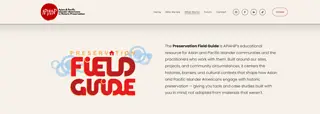
photo by: APIAHiP
Screenshot of the APIAHiP Preservation Field Guide website.
However, as the Pathways Program evolved, APIAHiP staff realized that something was missing. Often communities coming to the table would not have the shared language to ask for what they needed, let alone move their preservation project forward. The solution: the new Preservation Field Guide which has been built around APIA sites, projects, and community circumstances and centers with their lived experience and their histories already in mind.
To learn more about the new Preservation Field Guide we interviewed Huy Pham, executive director of APIAHiP
What led you to the development of the Preservation Field Guide (PFG)?
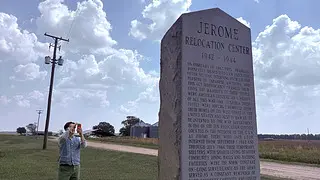
photo by: APIAHiP
APIAHiP Past Futures Fellow, Paul Kim, documenting Jerome Relocation Center Memorial in Dermott, Arkansas.
Since the launch of our Preservation Pathways program, we have realized that there is a gap in understanding about where communities can get started. Instead of conducting the same workshops [on repeat] or providing very specific resources just for one campaign, we wanted to create the tide that can lift all boats. That's when we knew we had to invest staff time and resources into a field guide that gives everyone that introductory level to historic preservation.
What were some of your inspirations as you developed the PFG?
We were inspired by the National Park Service Preservation Briefs, along with the online courses from the National Preservation Institute (NPI). More recently the Latinos in Heritage Conservation (LHC) released their preservation toolkit, a few years ago.
All of these are great resources, but they really are for specific audiences be those with a graduate degree in preservation, individuals looking to learn about how to apply the Secretary of Interior Standards, or tackling the technicalities of the Section 106 process. LHC’s Toolkit is very similar to what we're trying to do—which is to make preservation more approachable for our communities who have been historically excluded from it.
Stay connected with us via email. Sign up today.
For our PFG we wanted to feature Asian and Pacific Islander American communities and historic sites at the of this work. This meant including specifically APIA case studies and examples and applying some traditions, values, and just different perspectives to this work that a typical historic preservation ethic (that emphasizes white men’s architecture and history) might overlook.
What are some of the goals for the PFG?
[Our number one goal] is to make sure that these communities have a level playing field coming into preservation.
For instance, one community might be familiar with local, state or national register designation, while another might be documenting their historic site for the very first time and aren't even thinking about historic designation. Some communities are already working with landmarked property, but they want to know the first or next step to a rehabilitation project.
We want community members and advocates of APIA historic sites to be able to go to this field guide, find the specific lesson that is most relevant to where they're at in their preservation campaign, or just their own understanding of historic preservation and to review that first. Then if they have additional questions or can begin to think about how their specific situation is a little different, that's when they can still come back to APIAHiP and ask for additional specific support.
[The hope is] that we wouldn't start from scratch each time. If they have answered the worksheet questions, then we can expedite our path to a preservation success story.
In short, we want to make sure that preservation should be accessible to anyone, specifically for Asian Pacific Islander American communities or advocates who work with them. That historic preservation goals are achievable and that preservation policy, regulation, or even Secretary of Interior standards in the field aren't as intimidating as what we have made it out to be in the past 60 years since the National Historic Preservation Act was enabled.
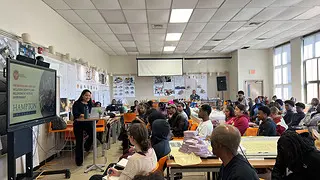
photo by: APIAHiP
APIAHiP Program Specialist, Zeta Atoigue, presenting a Preservation Pathways workshop to students at Hampton University.
Can you walk us through the field guide format?
[The Preservation Field Guide] will be housed on our website and of multiple lessons. We selected the first three because we wanted to make sure we were all on the same page. We wanted to focus on place-based public history work, and to help them understand how to document, so that we can recognize these sites and learn from them, but then also think about the next steps so we are able to preserve these sites for present and future generations.
So the first three lessons will be:
- What is Historic Preservation?
- Historic Designation
- Physical Site Preservation
Each lesson includes:
- A Video: Multi-media elements where the lessons are conveyed by people within the community, because we know that engagement with real people—especially someone who shares your background is important.
- Case Studies: While we didn’t have many to choose from, we wanted to make sure to focus on ones that are from the APIA community. For example, when we are talking about tax credits or design review, we want to focus on tax credit projects in Chinatowns, Little Saigon, or talk through why certain architectural features are more or less important to that community and context. Like why we would advocate for a gateway arch or new ping pong tables in a Chinatown that might be different than what we’re reviewing at a regular city park or traditional Main Street community – or when we say, we want to preserve this 1980s strip mall, what elements actually signify Asian American presence?
- A Downloadable Worksheet or Brochure: This includes the key takeaways from the lesson, maybe a glossary for acronyms and technical words, and a set of questions to help you answer and apply the lesson materials directly to the campaign that the community or individual might be working on. We imagine it's something that you can pull out on your phone or printed out when you're in the field. The set of questions are designed for the community member standing in front of their building, stack of archival documents, or at a community meeting and thinking: “what do I need to do next?” Mobility is important to us because we want community members to access the materials at their own pace and convenience.
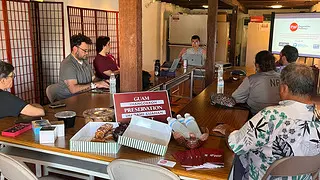
photo by: APIAHiP
APIAHiP Executive Director, Huy Pham, presenting a Preservation Pathways workshop in Guam.
What’s next for the PFG after the initial launch?
After the first three are put out in May 2026, and we have the next three scheduled from there. Our goal is to identify reoccurring needs and questions from our communities. Just like with the NPS briefs that come out sporadically, we will continue to develop it as a resource when we see common themes that keep coming back up. We really want community members to tell us what they need, such as are you more interested in “how to photo document your site for the first time?” or “How to leverage state resources for mitigation during Section 106 consultation?” or somewhere in between.
“Instead of regurgitating the same workshops [on repeat] or providing very specific resources just for one campaign, we wanted to create the tide that can lift all boats.”
Huy Pham
Finally can you give us an update on the overall work of APIAHiP?
In our first three years of operation the Mellon Foundation Humanities in Place Grant allowed us to provide a stable foundation for our work. Now we're asking questions like, do we put on workshops, or give out grants, or create a revolving fund? Should we do advocacy, a most endangered places list, or a preservation award program? Do we write national register nominations, provide tax credit consultation, or put on heritage trades workshop? Do we create our own archives and database or do we cross train preservationist with technologists? And so on. Many of these are not new ideas, but often they are new to APIA communities, so each year we answer a few more of those questions through program development.
Earlier this year, the Mellon Foundation gave us a second round of funding the [result of which is the] Placekeepers Fund, for which the application will launch later this month. This is a grant program specifically for Asian Pacific Islander historic sites and preservation projects. To get more communities to get to the brick-and-mortar physical place preservation, we’re also backfilling the gap in documentation and designation and acknowledgement that Asian Pacific Islander Americans have contributed to history of this country before it was even called the United States. So, the grant program has two tracks: one for designation and planning, and the other for on-site physical projects.
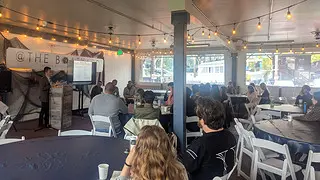
photo by: APIAHiP
Huy Pham presenting at Washington Trust for Historic Preservation's PLACES conference in Gig Harbor, Washington.
Save Historic Places That Tell Our Full American Story
When you join the National Trust, you help save historic and culturally significant places nationwide.