Keeping the Pieces of the Virgil Cantini Mosaic Together
Section 106 Success Story: Cantini Mosaics (Pittsburgh, Pennsylvania)

photo by: Markosky Engineering Group
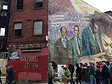
View of the Cantini Mosaic in its original location.
Virgil Cantini, an Italian-born, Pittsburgh-based sculptor and longtime chair of the University of Pittsburgh's fine arts department, created his 1964 mosaic, Dream Garden, on commission from the Urban Redevelopment Authority for a pedestrian tunnel beneath Bigelow Boulevard, connecting Chatham Street and Seventh Avenue. The tunnel linked downtown Pittsburgh to the Lower Hill District, a historically Black and immigrant neighborhood leveled by 1950s urban renewal to build the Civic Arena and Crosstown Boulevard.
In 2016, the Sports and Exhibition Authority (SEA) of Pittsburgh and Allegheny County, the City of Pittsburgh, and the Pennsylvania Department of Transportation (PennDOT) used a federal TIGER VIII grant to plan the I-579 Cap, a park reconnecting downtown Pittsburgh and the Lower Hill, as it had been in the 1950s.
Local preservationists and historians—including Cantini's daughter Lisa Cantini-Seguin, architectural historian Laura Ricketts, Preservation Pittsburgh's Brittany Reilly, and the Heinz History Center's Melissa Marinaro—brought the mosaic's significance to the Pennsylvania State Historic Preservation Office (SHPO's) attention. In 2018, the artwork was determined eligible for the National Register as a significant example of Cantini’s work and as one of the first public works of its kind in the United States in its design, installation, and scale. Cantini had consulted on the design of the tunnel, which was deemed integral to the design of the mosaics.
What We Would Have Lost
In 2016, plans for Pittsburgh's I-579 Cap Urban Connector Project—a proposed park spanning the highway that previously severed the Lower Hill District from downtown during 1950s urban renewal —called for burying an existing pedestrian tunnel containing all 28 panels of Virgil Cantini's 1964 Dream Garden mosaic. Local preservationists drove the Section 106 review process, saving and relocating the artwork while also allowing the park to be built as planned. Under the Advisory Council on Historic Preservation's proposed regulatory changes, the public's opportunity to comment on federal preservation decisions would become entirely optional and significant cultural landscape and setting features, like the pedestrian tunnel designed to house the mosaics, would no longer be considered historic properties.
Determination of National Register eligibility triggered a formal adverse-effect under Section 106 of the National Historic Preservation Act, prompting a series of meetings from 2018 to 2019. During this time, thirteen consulting parties worked with PennDOT, Federal Highway Administration (FHWA), the SHPO, and the SEA to negotiate a Programmatic Agreement covering removal, conservation, and reinstallation of all 28 panels. The panels were carefully removed in 2019, stored by the city, and sent to McKay Lodge Fine Art Conservation Laboratory for cleaning and repair, with missing tile fragments replaced using materials donated by the Cantini family.

photo by: Markosky Engineering Group
Detail of the Cantini Mural Wall.