Step Back in Time With Every Sip at Five Distinctive Distilleries
Before the founders of St. Augustine Distillery debuted their Florida business, consultants told them they needed three elements to succeed: high-quality products, a bottle design that stands out, and a compelling story that connects with consumers.
The distillery’s story intertwines with the rich history of the brick-and-concrete industrial-style building that houses the business. Opened in 1905 as a power plant, it started producing commercial ice two years later, primarily to preserve seafood transported by rail before the days of refrigeration, says Chief Operating Officer Will Hensler.
“Every visit to the distillery isn’t just about learning how we make bourbon or gin,” Hensler says. “It’s learning about this historic site and what it used to be before we started making spirits here.”
Following a $2.5 million renovation that preserved the original walls and the archway door where the ice was sent out, St. Augustine Distillery opened on the first floor of the Riberia Street structure in 2014. The founders conceived the project in tandem with the owners of the Ice Plant Bar, a farm-to-table restaurant and craft cocktail bar that serves St. Augustine spirits and is located in the building’s two-story 1920s addition.
“When I’m giving a tour I’ll say, ‘Hey, where we’re standing right now, more than 100 years ago, the first block ice in Florida was made,’” Hensler says. “And more than 100 years later, we made the first Florida bourbon in the same building, which is really fun.”
Distilleries around the country have opened in buildings with distinguished histories, making their stories as compelling as their spirits.
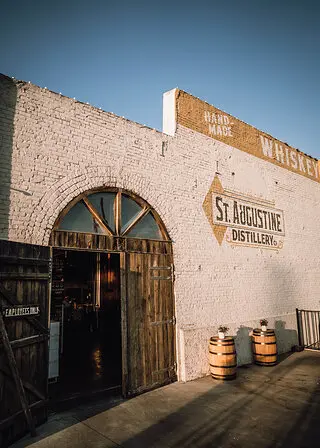
photo by: Brady Skye
The restored arched doorway at St. Augustine Distillery.
Keeping much of the property intact enhances the visitor experience by connecting the present with the past. In many cases, owners incorporate history into other aspects of the experience, from naming spirits after local sites to relying on traditional production methods.
Customers touring McClintock Distilling in Frederick, Maryland, can see original beams, repurposed as a door frame, that still bear grease stains from when the early 20th–century building was an auto repair garage.
“When we moved in, we found a lot of cool parts that we wanted to repurpose and made sure that the history was kept in place,” says cofounder Braeden Bumpers.
The original wooden sliding front doors remain in place, while the “Ideal Garage Co., Inc. Service Dept.” sign hangs above the distillery bar as another reminder of the building’s former life. McClintock opened in 2016 and expanded in 2021, adding an underground cocktail bar in a space where auto parts were once stored. McClintock’s Back Bar serves drinks made with the company’s gin, vodka, liqueurs, and whiskey.
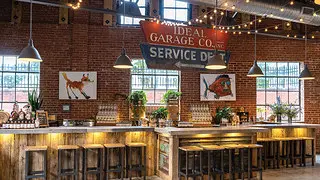
photo by: McClintock Distilling
McClintock Distilling displays a sign from the building’s past life as an auto repair garage.
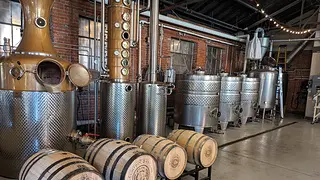
photo by: McClintock Distilling
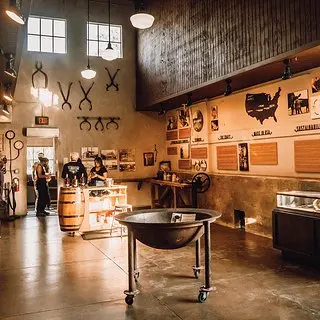
The company’s production room.
Stay connected with us via email. Sign up today.
But preserving a building that is more than 100 years old takes time and money. Bumpers, his business partner and cofounder Tyler Hegamyer, and Hegamyer’s parents handled much of the initial renovation themselves to cut costs, spending 17 months and $150,000 on the project.
The team removed the carpet, drywall, and other features added over the last few decades to return the property as much as possible to its original appearance. They restored the original steel-framed windows, some of which were concealed behind drywall, and spent months carefully removing paint from the walls. “The building was not in the best shape when we took it over, so we really wanted to restore it to that original look that it had,” Bumpers says.
Renovating a historic building requires balancing the need for preservation with practical details that make it usable. When Charlie Pipal purchased the early 20th–century structure that now houses Quincy Street Distillery in Riverside, Illinois, in 2009, it was a sizable warehouse with a spartan interior. Built circa 1915, the vast space likely housed an auto showroom and/or repair garage, and would require dividing up to accommodate multiple businesses. Pipal’s development company, Quincy Street Studios, installed partition walls inside the building, whose vernacular exterior architecture blends Classical Revival and Arts and Crafts styles.
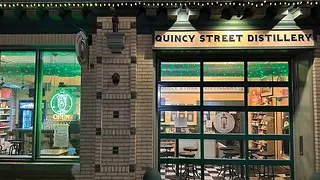
photo by: Derrick Mancini
Quincy Street Distillery's exterior.
“We did it as sensitively as possible, because we enjoyed seeing the nature of the space—the Chicago common brick walls and these giant concrete trusses overhead,” says Pipal, who is also a professor of architecture and historic preservation at the School of the Art Institute of Chicago. Quincy Street Studios placed the partitions under the trusses so they remained visible, allowing tenants and visitors to appreciate the building’s height and structure.
“I think that is one of the most impressive things that was saved,” says Quincy Street Distillery owner Derrick Mancini.
Some distilleries rely on old-fashioned production methods to lend more authenticity to their operations. The current iteration of George Washington’s Distillery & Gristmill, located at the first president’s historic Mount Vernon estate in Virginia, was reconstructed less than 20 years ago but remains a manual operation, says Jeremy Ray, Mount Vernon’s senior director of interpretation. The original distillery ran from 1798 to 1808, and the building burned in an 1814 fire. Relying on the labor of six individuals enslaved by the Washingtons, it was one of America’s largest rye whiskey distilleries and produced nearly 11,000 gallons at its peak in 1799.
After much archaeological and historical research, the Mount Vernon team excavated the site to uncover the old distillery’s stone foundation, as well as evidence of five stills and a boiler. They rebuilt the distillery and mill using period materials, and began making whiskey according to the 18th-century method. Using long rakes, distillers mix the grains and hot water in mash tubs before adding yeast, which eats up the sugars. Then they transfer the mixture into the stills and heat it over a wood fire. “It’s part of George Washington’s history,” Ray says. “He was more than a general and a president. He saw himself as a farmer and an entrepreneur. So you get to kind of live that when you come to Mount Vernon.”
.webp)
photo by: Mount Vernon Ladies’ Association
Inside George Washington’s Distillery.
Bourbon maker Woodford Reserve also relies on old-school production methods at its historic facility. A different distiller constructed the building in 1838 in Woodford County, Kentucky. Longtime distilling company Brown-Forman owned the property from 1941 to 1973 and then repurchased it in the 1990s. After restoring it and adding cypress wood fermentation vats, Brown-Forman opened Woodford Reserve in the space. The site’s previous distilleries also used wood vats, says Master Distiller Emeritus Chris Morris. Smaller than typical stainless steel tanks, wood fermenters keep temperatures lower, which takes longer and creates a more complex flavor, he adds.
“I’m very proud of the fact that one of the things we did at Woodford was to make a modern bourbon the way our ancestors did,” Morris says. “We are making whiskey like it was made when the building was made in 1838. Not many people can say that.”
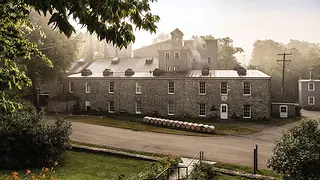
photo by: Kertis Creative
Woodford Reserve's restored historic property.
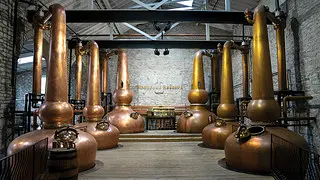
photo by: Kertis Creative
The Woodford County, Kentucky, distillery's polished cypress fermentation vats must be steam-cleaned after each use.
Other historic buildings on the estate include an 1812 log cabin known as the Pepper House (named for the Pepper family, which founded the original distillery on the site). After a $3.5 million restoration completed in 2024, Woodford now uses the Pepper House for VIP tasting experiences. Visitors on tours will also see rehabilitated warehouses that date to the late 19th and early 20th centuries. The distillery’s commitment to restoration earned it designation as a National Historic Landmark.
At many distilleries, embracing history goes beyond the physical building. Designed by Frederick Law Olmsted and Calvert Vaux, Riverside is one of the earliest planned communities in the United States, and Quincy Street Distillery honors that past during tours and tastings. Patrons can order cocktails made with any of their 20-plus spirits, many named after pieces of local history. Old No. 176 Railroad Gin takes its name from an engine on the Chicago, Burlington and Quincy Railroad that once ran nearby. The Haas & Powell bourbon honors a 19th–century distillery in Riverside that burned after one year of operation.
McClintock Distilling’s tour, tastings, and history classes educate customers about the thriving rye whiskey industry in Maryland before Prohibition. The distillery uses single-varietal, non-GMO, organic grains grown locally to highlight the state’s agriculture, Bumpers says. “It really enhances the experience when you’re sitting in a part of history, as well. We wanted to kind of embody that history from start to finish.”
Save Historic Places That Tell Our Full American Story
When you join the National Trust, you help save historic and culturally significant places nationwide.