5 Lessons on Teaching Students with Women's History
A new website and additional investment supercharge resources for STEAM education at historic sites.
How can we teach kids to express themselves through art, innovate through engineering and design, inquire into natural phenomena using the scientific method, and respect the contributions of women artists across history—all at the same time? Recipients of the Dorothy C. Radgowski Learning through Women's Achievement in the Arts Grant, a collaborative project between two programs of the National Trust for Historic Preservation—Where Women Made History (WWMH) and Historic Artists' Homes & Studios (HAHS)—have come up with many creative ways to do exactly that.

photo by: Stacy Myers/Easthampton Historical Society
Students beading at a Thomas and Mary Nimmo Moran Studio Workshop as part of a program funded with the Dorothy C. Radgowski Learning through Women's Achievement in the Arts Grant.
WWMH believes all students benefit from learning about women's histories, and HAHS encourages young students to nurture their own senses of artistry and wonder. These merged commitments drive Teaching Students with Women's History, a new website that showcases a freely accessible archive of curricula centering women's ingenuity, agency, and imagination. The National Trust created this platform to highlight the Radgowski grantees' work so educators across the United States can easily adapt and learn from these exemplary projects.
Founded in 2022, the Radgowski grant program continues to grow. A recent generous gift of $400,000 from our lead donor has enabled two more rounds of grant disbursement, which means ten more HAHS members will be able to expand their programming to reach even more students. As additional projects are completed, these newly created resources will also be accessible online for educators.
The website already features inspiring work that will help educators envision how they, too, can inspire interdisciplinary critical thinking among young learners.
Here are just a few lessons learned from Radgowski grantees who are currently featured on Teaching Students with Women's History:
Connect kids to the natural world.
.webp)
photo by: D'Amico Institute of Art, Amagansett, NY
A detail view of a third Grader from the Amagansett School District Working on a Found Art Bird Sculpture at the D'Amico Institute of Art.
At the Mabel and Victor D'Amico Home and Studio and Art Barge in Amagansett, New York—about a hundred miles from New York City on Long Island's East End—students experimented with found object artmaking inspired by Mabel D'Amico's creative legacy.
D'Amico had a particular interest in ornithology, both as an ardent bird watcher and as an inspiration for her art. From carved bird decoys to glass mosaics, birds recur as a motif across her art, much of which was made from objects she found on the beach near her home, including driftwood, rocks, feathers, and sea glass. Found object art democratizes artmaking by using freely available objects; there's no need for expensive supplies when you can instead craft a bird using rocks, branches, and imagination.
At Teaching Students with Women's History, viewers can watch a video about Mabel D'Amico's career and learn about the workshop series the site implemented to teach children about the wildlife dwelling in Napeague State Park, carefully bridging art, the natural sciences, and engineering principles. Observing natural phenomena like birds' nests as wonders to inspire artistic creativity, as feats of precision engineering, and as scientific marvels that reveal patterns in nature provides kids with multiple enriching ways to interact with the world around them.
Dig deep and tell new stories.
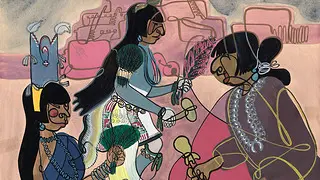
photo by: Sam and Alfreda Maloof Foundation for Arts and Crafts, Alta Loma, CA
Afreda Maloof, untitled (detail). Unidentified date, Gouache on Paper. Collection Sam and Alfreda Maloof Foundation for Arts and Crafts.
The Sam and Alfreda Maloof Foundation for Arts and Crafts in Alta Loma, California was initially focused on celebrating Sam Maloof's legacy as an internationally renowned furniture maker. However, Alfreda Maloof was herself a potter, painter, woodworker, and arts educator. She played a pivotal but largely unrecognized role in Sam's craftsmanship, managed the business side of Sam's furniture workshop for five decades, and oversaw the citrus groves located on their property. The Maloof Foundation's burgeoning commitment to honoring both Sam and Alfreda motivated the creation of the "Alfreda Abstract," a research document detailing, among other things, the significant part Alfreda played in California's citrus industry.
Through the Radgowski grant program, the Maloof Foundation created bilingual lesson plans that unite math, science, and art to teach students about Alfreda's business acumen and citrus groves. Students tested pH levels to determine optimal citrus acidity, designed their own advertisements using color theory and insights about effective branding, and learned how to draw in Alfreda's style by using continuous, unbroken lines to create their subject's contours.
Think community-wide.
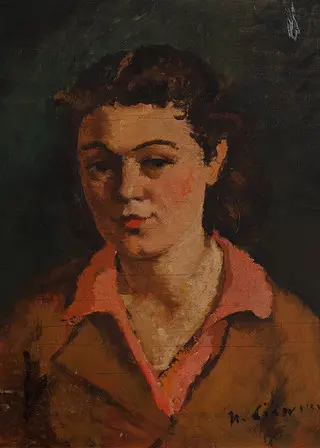
photo by: Renee & Chaim Gross Foundation
Nicolai Cikovsky, Portrait of Renee (detail). 1932, oil on wood, 12 ½ × 9 inches. Collection the Renee & Chaim Gross Foundation, Courtesy of the Renee & Chaim Gross Foundation.
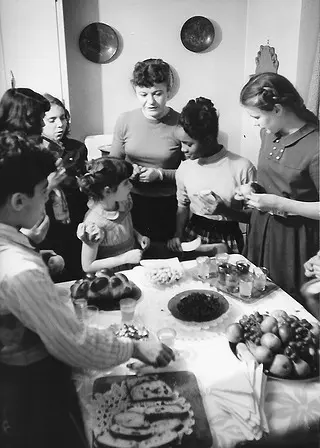
photo by: Renee & Chaim Gross Foundation
Lisa Larsen, Renee Gross with children on the Upper West Side, c. 1946-7, photograph. Life Magazine.
The Renee & Chaim Gross Foundation, headquartered in New York City, built lesson plans focused on Renee Gross, a Lithuanian immigrant activist and philanthropist who advocated for equal pay for equal work and organized welfare projects to support recent Jewish immigrants to the United States. Renee was far more than simply a muse and model for her husband Chaim's carved sculptures.
It makes perfect sense that the Gross Foundation commemorated Renee's life and legacy by illuminating the strength of community. As a pillar of New York City's immigrant and Jewish communities, her advocacy and influence stretched beyond herself and her family. The Gross Foundation's decision to make their lesson plans fully online and freely available facilitated community outreach on a new scale, as the site's small size had previously made connecting with large in-person school groups impossible. Their lessons feature PowerPoints and discussion guides that lead students through photographic analyses, exploration of immigration histories, and examination of women's art.
Be flexible.
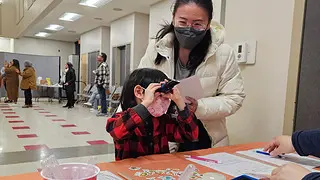
photo by: Sam and Alfreda Maloof Foundation for Arts and Crafts, Alta Loma, CA
Students and Parents learning about the Maloof Citrus Grove operated by Alfreda Maloof at a STEAM Fair hosted by the Sam and Alfreda Maloof Foundation.
Radgowski grant recipients thought outside the box to bring their educational programming to life. From the ground up, they built in elements that would allow educators to adjust the lesson plans to best suit their specific classroom's needs, making the modification of activities based on grade level, statewide benchmarks, and student proficiency easy.
The lessons profiled on Teaching Students with Women's History provide grounded examples of readily implementable curricula. They also provide food for thought as a guide to STEAM educational principles. STEAM is a much-desired but also much-misunderstood pedagogical framework; projects accomplished by Radgowski grantees show how unique places tackled STEAM-based learning. Already uniquely well-equipped to highlight artistic creativity, HAHS sites broadened their horizons through the Radgowski program to explore how artistic innovations connect to scientific discovery and experimentation.
Do what you can, when you can.
.webp)
photo by: Georgia O'Keefe Museum
Michelle Seymour, tour and program manager works with two children at the Georgia O’Keefe Museum with their Looking Closer tour which was funded in part by the Radgowski Grant.
Contemplating a new project can be daunting when time, finances, and bandwidth are limited. However, relatively modest investments can have an enormous impact.
None of the sixteen prior Radgowski grantees to date had any dedicated programming for K-5 education prior to receiving up to $18,000 through the Radgowski grant program. The outcomes facilitated by that investment have been nothing short of extraordinary. Grant recipients' new educational programming has reached thousands of students and family members nationwide, bringing Gen Alpha into historic artists' homes and studios and museums, and introducing them to the women who were instrumental in their history.
Giustina Renzoni, Director of Historic Properties at the Georgia O'Keeffe Museum, described the Radgowski grant as "transformative," as it allowed the site to "reimagine how historic sites can engage children, creating experiences that invite them to explore, create, and connect.” The National Trust is thrilled that the Dorothy C. Radgowski Learning through Women's Achievement in the Arts Grant Program will continue to connect youth to stories about women's creativity across Historic Artists' Homes & Studios.
Continue to follow the program's work at Teaching Students through Women's History as new projects and educational materials are added throughout 2026.
Save Historic Places That Tell Our Full American Story
When you join the National Trust, you help save historic and culturally significant places nationwide.