A Q&A with Vanessa Miller, Author of The Filling Station
Miller’s novel weaves emotional nuance into the history of the Threatt Filling Station and Tulsa Race Massacre
Author Vanessa Miller decided she wanted to write a novel about the Threatt Filling Station after watching a piece about it on the Discovery Channel.
The gas station was built in 1915 in Luther, Oklahoma, and was an important rest stop for Black travelers to get gas and food, and gather safely for decades. In the aftermath of the Tulsa Race Massacre in 1921, it became a lifeline for survivors after a white supremacist mob who burned down homes and businesses in the city’s historic Greenwood district, once considered to be the “Black Wall Street” of America.
Miller was fascinated by the connection and dug into archives and American Red Cross reports about Black residents who survived the massacre. The years of research led to publishing her historical fiction book The Filling Station in March 2025. The story follows two sisters, Margaret and Evelyn Justice, who fled the massacre and find refuge at Threatt Filling Station as they navigate how to survive and rebuild after the violence.
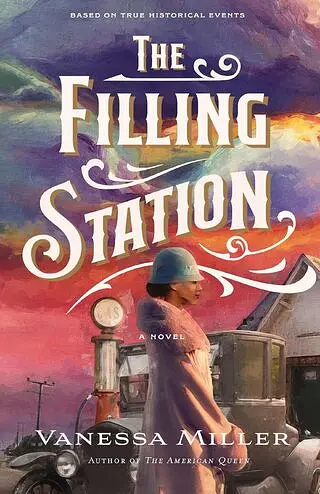
photo by: Bookshop.org

photo by: Vanessa Miller
Author Vanessa Miller
Over a century after the Tulsa Race Massacre, the Threatt Filling Station still stands. As Route 66 crossed the country and ushered in a new wave of road trip travel, the Threatt Filling Station survived as the only Black-owned establishment of its kind on the nation’s “Mother Road.” To learn more about the real-life inspiration for Miller’s book, and how the Action Fund is supporting the station, read an interview with members of the Threatt family.
African American Cultural Heritage Action Fund editorial fellow Marissa Evans sat down with Miller to talk about her writing process, how she balances imagination and history, and why understanding our history matters more than ever in America.
What do you feel gets lost in the conversation when we talk about the Tulsa Race Massacre?
I feel what gets lost is the people. We're always talking about the great wealth that they were building, the businesses, Black Wall Street. But I think people generally don't take time to recognize that these were real people walking up and down these streets, these small blocks that mattered to them more than anything, and we forget that it was their homes that were destroyed. It was their businesses that were destroyed. And that's what I wanted to bring to the forefront when I began to write the book. I wanted the reader to understand this from a personal perspective.
How do you balance historical research, and telling the story of a place that already exists, with your own imagination?
Stay connected with us via email. Sign up today.
What I also decided was that I'm going to bring in the actual people who lived and moved at the Threatt Filling Station and in Tulsa. So you meet a lot of the people who actually lived there. Nonfiction history books tell you what happened but historical fiction tells you what it felt like. I think readers want to dive into a book that can make them feel something. This is "I'm showing you the real people who are journeying through this and I'm showing you their emotions." I think that's what makes a difference.
As I told Margaret and Evelyn's story, I wanted to make sure that I rooted them in what was real about Tulsa at that time. So, Evelyn, she's my depiction of what happens to a person after post-traumatic stress. Even though that wasn't a term back at that time, people still dealt with it, and we just didn't label it, and that's why you see her go off into so many different areas, and she's heading totally in the wrong direction.
With Margaret, she's my depiction of so many survivor stories that I read where people had this determination to rebuild this area, and all of that I put into her. She was my person who was going to rebuild no matter what, and she had to have strength.

photo by: Charles David Threatt, Threatt Filling Station Foundation
An archival photo of Ulysses Threatt servicing a vehicle at the filling station.
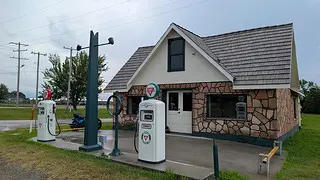
photo by: Rhys Martin
A photo of Threatt Filling Station today.
What was going through your mind as you were researching, and what surprised you the most?
It was a lot of sadness to me. At the beginning, I did not know if I could really get to the finish line on this story until I read about the 1925 Convention that came to Tulsa, with a parade declaring Greenwood back open for business, and Route 66 opening in 1926. Those were the pieces of joy that I found, and that’s how I end the book because it needed to end on hope.
But the thing that shocked me the most was the report the American Red Cross released about the massacre. I was truly shocked by the comments that show us how Black people are treated differently, even in the midst of a disaster. To me, it is a great travesty of this nation that this continues even to this day.
These were people who had just been thoroughly traumatized. They had just had their homes burnt down. Their businesses were gone. Their children had no clothes. They didn't know how they were going to take care of this or that, and the Red Cross told them. “Oh, well, you have to work for whatever relief you receive.” They were not allowed a moment to process what happened to them, a moment to grieve the losses of the people who were murdered in the street. And that, to me, was heartbreaking.
What do you hope readers take away from this book?
I consider The Filling Station one of the most important books that I have written to this day, and it is because of the moment that we're in right now where people don't want to really know about what happened to Black people in this country. They want to shove it under a rug. The way I look at this is you cannot change history. It is what it is. But we can look at it, we can learn from it, and we can move forward. So, my hope while I was writing this was that this history lesson would be something that taught us in America how to move forward.
Save Historic Places That Tell Our Full American Story
When you join the National Trust, you help save historic and culturally significant places nationwide.