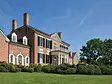
A Conversation with Candace Calloway of the Detroit Association of Women's Clubs
Over the years, nothing has stopped the members of the Detroit Association of Women’s Clubs (DAWC), a 105-year-old nonprofit civic organization, from serving their community and elevating Black women. Not racially restrictive covenants on the 1913 Colonial Revival house they purchased for their headquarters, not the ups and downs of Detroit’s economy, and not a burst pipe that forced the group to close its doors two years ago.
The water damage inspired the National Trust to name the clubhouse one of America’s 11 Most Endangered Historic Places this year. As part of the organization’s work to commemorate the nation’s semiquincentennial, the 2026 list focuses on places that amplify a founding principle: “All people are created equal.”
We spoke with Candace Calloway, the DAWC’s 32-year-old executive director, about the clubhouse and her fight for its future.
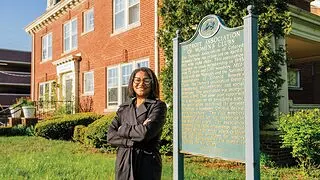
photo by: EE Berger
Candace Calloway outside the Detroit Association of Women’s Clubs headquarters. The organization is part of the National Association of Colored Women’s Clubs.
What is the DAWC?
The Detroit Association of Women’s Clubs was founded in 1921 by eight women who wanted to dedicate their time to community service, education, charity, and being in fellowship with one another. It had about 3,000 members at its peak in 1945.
The mission has always been to uplift Black women. Today, we continue to lead community service initiatives, like food distributions, cleanups, literacy and STEM programs, workshops, lecture series, and grassroots organizing. Our motto is “Lifting As We Climb.”
What’s your history with the DAWC?
I’m a native Detroiter, and so are my parents. My mom volunteered [with the DAWC] and eventually became president. She always brought along me and my two sisters. So I’ve been coming to the DAWC and meeting elected officials and community leaders since I was 10 or 11. It’s always been this hub for political education, advocacy, and celebrating Black women and their history in Detroit, which all continue to be top priorities of mine.
How long has the DAWC owned the house?
Dr. Rosa Slade Gragg, who was a Black educator and activist involved in the club, saw a “for sale” sign outside a house on the corner of Brush Street and Ferry Street. It was the family home of a building contractor named William Lennane. Dr. Gragg wanted a physical meeting place for the DAWC, so she approached him with an offer. She took out a second mortgage on her house and bought it for $25,000 in 1941. We’ve been there ever since.
This neighborhood had covenants forbidding Black people from owning homes on certain streets, right?
I’m not sure what was going through [Lennane’s] mind when he accepted her offer. But he did. As you can imagine, the neighbors, who were predominantly white and wealthy, were not happy with Black people going in and out of the house. They complained to the city.
So Dr. Gragg got creative. Ferry Street [had racially restrictive covenants. According to club history,] she bricked in that door so the house’s only entrance was on Brush Street [which did not have the covenants]. She had the address officially changed with the city and everything.
Inside, we hung an oil painting of Dr. Gragg where that door used to be. We did a secondary street renaming of Ferry Street in October of 2019, so now it’s also [named after her].
Why was the clubhouse eligible for the 11 Most list this year?
In February 2024, we had a pipe burst on the third floor, where Lennane built the servants’ quarters and kitchen. All the water trickled down to the first floor. We sustained major damage to the woodwork, staircase, plasterwork, all in the central part of the house, so we had to close our doors. We’ve been closed to the public ever since.
When we discovered the damage, we were standing in an inch and a half of water, crying. But then I was like, OK, that’s enough. Let’s get the water out of here. Let’s get out fans. This place is our home. I’ll do whatever it takes to get it back.
What will it take to get it back?
I like to see the bright spot. With this damage, we realized now is the time for us to take a step back and modernize the facility. A hodgepodge of updates had been made over time, but there are no modern plumbing or mechanical systems. No energy efficiency. We still have knob-and-tube electrical in parts of the house.
Now that we’re closed, we can seriously evaluate our space. We’re undertaking a historic structure report through a grant from the National Park Service. We know the house is structurally sound, because we had a civil engineer evaluate it. But if we’re going to open again to the public safely and have it be a comfortable place to gather and host events, we have a lot of work to do. A lot of money to raise.
Does the local community know the significance of the DAWC, or are you more of a hidden gem?
It’s a bit of both. Folks who have been in Detroit a long time are very familiar with our clubhouse and what we do. But Detroit is changing. There’s a lot of investment happening downtown, a lot of new folks moving in.
We’re being challenged with telling the story to a new generation. We’ve been on podcasts. We were part of a local Women’s History Month project. We’re filming a documentary about our club. We’re connecting with other young leaders around preservation and Black women’s history.
We want folks to know that just because we’ve had to close our physical space, our work has not stopped. We’re still engaging with our community and volunteering and feeding people. We’re still talking about our history. That won’t stop.
It sounds like you’re hopeful for the future of the building.
I like to tell people she’s been here for 113 years, and I intend for her to be here for at least 100 more.
Editor's Note: After the Summer 2026 issue was published, the DAWC received a National Grant from the National Trust's African American Cultural Heritage Action Fund.
Save Historic Places That Tell Our Full American Story
When you join the National Trust, you help save historic and culturally significant places nationwide.