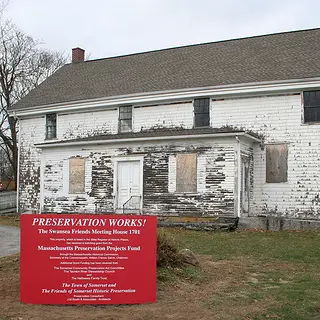
11 Most Endangered Historic Places
Swansea Friends Meeting House
The Swansea Friends Meeting House in Somerset is recognized as the oldest surviving Quaker meeting house in Massachusetts and tells the story of how early Quaker settlers struggled for religious freedom and safety. Rooted in the Quaker belief of “Inner Light,” which emphasizes spiritual equality and universal dignity, the meeting house was an important site where these ideals were discussed and applied to the abolition movement and the expansion of women’s roles within the church. Today, the Meeting House stands as a powerful reminder of the tireless pursuit of equality for all.
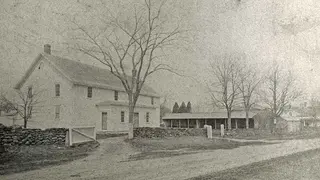
photo by: Public Domain
Swansea Friends Meeting House, historic photo taken in the late 19th to early 20th century.
The geographic area of Somerset (once Swansea) largely consisted of the ancient Shawomet lands of the Pokanoket Tribe, which were sold by the Plymouth Colony to finance King Philip’s War. Due to religious persecution, the early Quaker community settled in this area because of its proximity to the Rhode Island border, where religious freedom was supported by colony leaders. The original Meeting House was built between 1701-1702, and additions were made in 1742, 1872, and 1889. The founders of the Meeting House had a significant influence on the struggle for religious liberty in Massachusetts, with their advocacy resulting in a new state law exempting Quakers from being taxed for the support of Puritan ministers.
The Quaker belief in equality provided an opportunity for Patience Brayton to serve as an early female minister of the congregation from 1760-1794. Minister Brayton is considered to be the driving force behind Swansea becoming one of the earliest towns in Massachusetts to abolish slavery. Between 1771-1783, Minister Brayton traveled to eight American colonies, Great Britain, and Ireland to preach and promote the abolition of African American and Native American slavery.
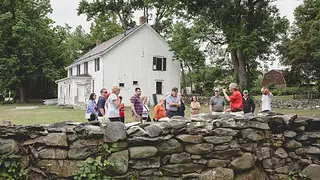
photo by: Scott Daigle
Swansea Friends Meeting House, Somerset, MA.
After the remaining members of the small Quaker congregation conveyed the Meeting House to the Town of Somerset in 2008, the building was no longer in regular use for almost a decade and began to deteriorate. In 2017, a group of Somerset residents committed to preserving Somerset history and the Meeting House established an organization called the Friends of Somerset Historic Preservation (FOSHP), which took emergency action to stabilize the building and replace the roof. Today, the Meeting House is not open to the public and needs significant interior and exterior rehabilitation, requiring substantial funding and expertise.
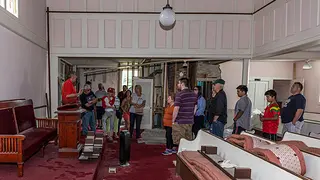
photo by: Scott Daigle
Swansea Friends Meeting House, Somerset, MA.
Exterior repair work funded by the Massachusetts Historical Commission, the Town of Somerset, and other private sources is now underway, but more than $1 million in additional funding will be needed to complete the exterior and interior restoration, make the building accessible, and add interpretive materials. Once restored, FOSHP plans to open the Meeting House to the public as a community cultural center. As a key location within the proposed Sowams National Heritage Area, activating the Meeting House to serve the public would promote regional history and tourism, and illuminate the Quakers’ significant role the pursuit of religious freedom, abolition of slavery, and women’s rights.
Swansea Friends Meeting House was named to the National Trust's list of America's 11 Most Endangered Historic Places for 2026.
Support our work to save places that matter.
Donate NowStay connected with us via email. Sign up today.
Related Stories
-
National Preservation Awards WHALE: A Beacon of Preservation and Progress in New Bedford -
Preservation Magazine A Rhode Island Couple Transforms a Rundown Millhouse Into Their Dream House -
Preservation Magazine Transitions: Threatened—Southwest Pavilion


Explore More Places


Senate Bill S. 5653 would limit a process that considers how federal projects affect historic places and make community consultation optional for many projects. Urge your senators to oppose the bill as written and demand meaningful changes to its provisions.
Send Letters