L.A. Women's Landmarks Project Presents at NAPC FORUM
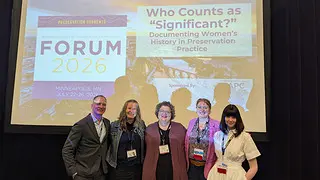
photo by: Jill Dolberg
L-R: Adrian Scott Fine, Chris Morris, Jill Dolberg, Rebecca Wallisch, and Rachel Alison.
In July 2026, over 600 preservation commissioners, advocates, and local and state government staff from 46 states convened in Minneapolis, Minnesota, for the National Alliance of Preservation Commissions (NAPC) FORUM. FORUM is the only national conference focused on the issues facing local historic preservation boards and commissions. Reaching this large national audience of preservation professionals is a priority for the Los Angeles Women's Landmarks project, a partnership between the National Trust for Historic Preservation and the Los Angeles Conservancy.
Together the two organizations are creating a more equitable approach to designation in L.A. intended to be a new model of preservation practice for cities, organizations, and commissions across the country.
Christina Morris, manager of the Where Women Made History initiative of the National Trust, and Adrian Scott Fine, president and CEO of the Los Angeles Conservancy, led a thought-provoking session, "Who Counts as 'Significant?' Documenting Women’s History in Preservation Practice," that confronted the critical gaps in how the preservation field defines significance, evaluates resources, and memorializes our shared past.
Using examples from the work of the L.A. Women's Landmarks project, Morris and Fine challenged attendees to adopt the research strategies, documentation methodologies, policy interventions, and funding opportunities they've identified to fundamentally change how communities acknowledge women as part of their histories. Lessons from the L.A. Women's Landmarks project also are being shared with commissioners nationwide through NAPC's quarterly publication, The Alliance Review (PDF).
Also featured in the session were Rachel Alison and Rebecca Wallisch, associates at Post Oak Preservation Solutions, and Jill Dolberg, historic preservation planner, City of Lincoln, Nebraska, presenting their groundbreaking work in Nebraska documenting the roles of women in the building trades on a statewide level in a new National Register survey and designation. Together, we encouraged a more comprehensive approach to preservation and "significance" that finally recognizes all aspects of our history.
As one session attendee stated, "Really appreciated that the speakers talked about their framing and application strategy work to get the stories told, not just the importance or the process. Strategy is the how-to."