For the People: National Identity Through 5 D.C. Civic Landmarks
As the capital of the United States, Washington, D.C. communicates our nation’s founding principles through its architecture and urban design. Pierre Charles L’Enfant, the city planner chosen by George Washington, built the city “around the idea that every citizen was equally important,” symbolized by “a great public walk,” open to all, where generations of Americans have exercised their rights to freedom of speech and assembly. In further recognition that power in the United States resides in the people, L’Enfant placed Congress, not the president’s house, on a high hill overlooking the Potomac.

photo by: Library of Congress
A zoomed in and detailed view of one of the earliest extant plans of Washington, D.C., known as "The L'Enfant Plan. c.1791. Note the notations for the President's House (upper left) and Congress House which is the United States Capitol building (middle right).
The architectural features of significant buildings also embody the idea that our government is "of and by the people." These are places where the tenets of our democratic republic take shape and where our ideas about power find material expression. They belong to all of us and not to any single party or administration.
As Carol Quillen, president and CEO of the National Trust for Historic Preservation, said, "as the United States prepares to mark its 250th anniversary, these places invite us to reflect on our aspirations as a nation and on our shared responsibility to safeguard what future generations will inherit. Once irreversible changes are made to an historic structure, there is no going back, and we risk undermining not only the physical coherence of our capital city but also our shared understanding of who we are as a people."
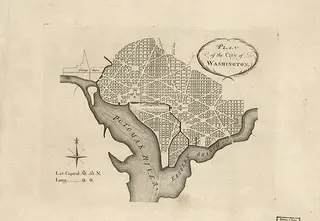
photo by: Library of Congress
Plan of the city of Washington. An annotation presumes this to be a copy of the final printed version of the L'Enfant Plan printed in 1794.
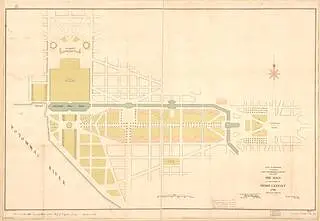
photo by: Library of Congress
The National Mall as proposed by Pierre L'Enfant 1790, from the original. This copy was developed in 1900 from the L'Enfant plan of the whole city and enlarged for the report of the U.S. Army Corps of Engineers.
This Preservation Month, the National Trust for Historic Preservation is taking a closer look at five remarkable civic spaces and landscapes—places that have shaped American democracy and that hold meaning far beyond the borders of the Nation’s Capital.
As you explore these historic sites, we ask you to consider what places in your community define your civic identity. What would you fight to protect?
Arlington National Cemetery to Lincoln Memorial

photo by: Kelly Paras
To date, over 400,000 individuals are laid to rest at Arlington National Cemetery.
Located just over the border in Virginia, the site now known as Arlington National Cemetery was once a plantation founded by George Washington Parke Custis, Martha Washington’s grandson. The plantation passed down to Custis’ only daughter, Mary, who had married Robert E. Lee—and over time, the Custis-Lee family enslaved over 100 people at the site.
On April 20, 1861, following Virginia’s secession from the Union, the Union Army gained control of the site for its strategic position protecting Washington, D.C.
In 1863, a portion of the former plantation was home to formerly enslaved people in an area known as “Freedman’s Village,” which remained through 1900. In 1864, the site became a national cemetery, eventually holding the remains of approximately 16,000 Civil War soldiers.
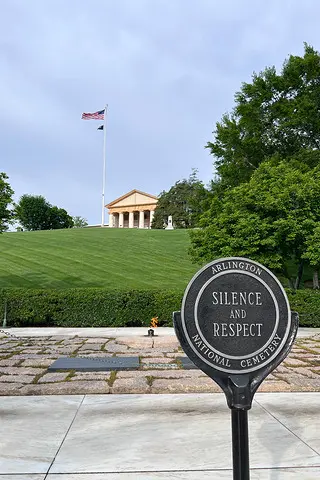
photo by: Kelly Paras
View of Arlington House from the grounds of the cemetery.
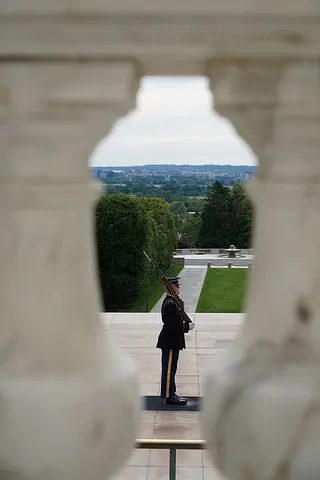
photo by: Kelly Paras
The Tomb of the Unknown Soldier at Arlington National Cemetery.
In 1932, Arlington National Cemetery became the southern anchor for the Arlington Memorial Bridge. With the recently completed Lincoln Memorial (1914), it created a physical expression of national reconciliation, stretching across the Potomac and connecting the Union and the Confederacy in a gesture of healing.
Today this viewshed continues to honor those who, in Lincoln’s words, gave “the last full measure of devotion.” In 2022, descendants of Robert E. Lee and those enslaved at the estate—the Parks, Grays, and Syphaxes—came together at Arlington House in a remarkable act of reconciliation.
It is because this viewshed carries so much meaning that the National Trust has raised concerns about a proposed “Triumphal Arch,” whose scale, location, and design will disrupt this important visual and symbolic vista. The Arch will dwarf the Lincoln Memorial and disrupt the long, open, and uninterrupted viewsheds, overwhelming the entry to Arlington National Cemetery.
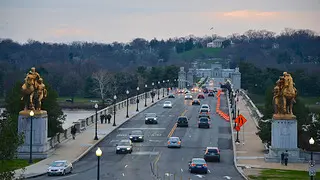
photo by: joeshlabotnik via Flickr CC BY-NC-SA 2.0
A 2016 view of Arlington National Cemetery looking west from the Lincoln Memorial. Straight ahead is the Military Women's Memorial with Arlington House above.
The White House
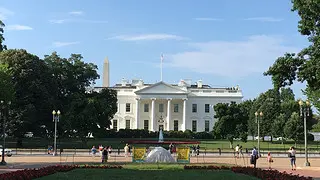
photo by: Kelly Paras
View of the North Facade of the White House in 2016.
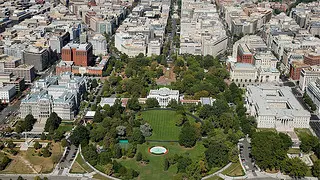
photo by: Carol Highsmith/Library of Congress
Aerial view of the White House.
No building in America carries more symbolic weight than the White House. Since John Adams first took up residence in 1800, it has served simultaneously as a home, a seat of executive power, and a material testament to the voice of the people, as its architect was selected through a public competition. A National Historic Landmark stewarded by the National Park Service on behalf of all Americans, it sits in the context of L’Enfant’s carefully conceived plan for the city, with clear line of sight to Capitol Hill that serves as a physical reminder of the connections among our branches of government.
Designed by Ireland-born architect James Hoban, the White House was built over eight years from 1792-1800. Its construction reflects the full complexity of American history: envisioned by George Washington, designed by an Irish immigrant, built by enslaved people, who contributed to nearly every phase of the work, from quarrying stone and cutting timber to producing bricks, and assembling its roof and walls, alongside paid white workers.
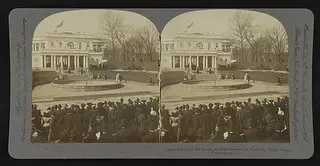
photo by: Library of Congress/LC-DIG-stereo-1s06329
Arrival of the guests at Alice Roosevelt's wedding, White House, Washington, D.C. c. 1906
While the White House has evolved considerably over two centuries (most dramatically when British forces burned it in 1814), it has endured as what generations of Americans have simply called the “People’s House.” Heads of state, politicians, artists, scientists, and ordinary citizens have all passed through its doors, and its image has become shorthand for the principles underlying the American democratic republic.
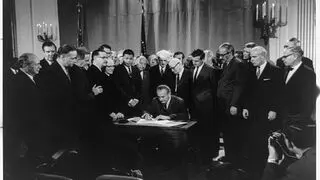
photo by: Library of Congress/ LC-USZ62-95480
President Johnson signing the bill commonly known as the Fair Housing Act at the White House in 1968.
That symbolism is inseparable from its setting and relatively modest scale and design. The White House’s position, originally in direct sightline with the Capitol, was not accidental. L’Enfant designed the city so that the legislative and executive branches would be visible to one another. This relationship between buildings is itself a civic argument, one that has shaped how Americans and the world understand the architecture of democratic power.
Although the sightline was partially obscured by the construction of the Treasury Building, the proposed construction of a new White House Ballroom, if built as currently proposed, would further interrupt the sightline between the Capitol and the White House and overwhelm the intentionally modest dignity of the historic residence.
On December 12, 2025, the National Trust filed suit in the US District Court for the District of Columbia, asserting that construction of the Ballroom is proceeding unlawfully and asking the court to halt further construction activities until the government completes the legally required review processes. It is a rare and necessary step, taken because the stakes, for the integrity of this place and for what it represents, could not be higher.
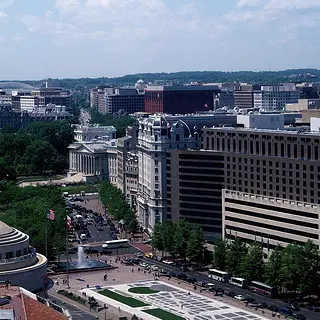
photo by: Carol Highsmith/Library of Congress
View of the White House from Freedom Plaza in Washington, D.C.
National Mall
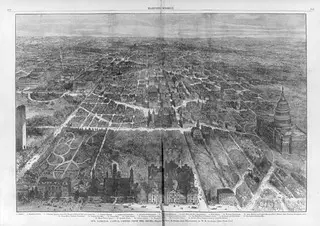
photo by: Library of Congress Prints and Photographs Division/Harper's Bazaar
Drawing by Theodore R. Davis of the National Mall in 1882 based on from photographs by W.H. Jackson.
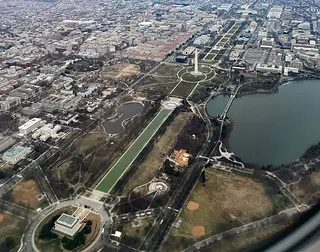
photo by: Kelly Paras
View of the National Mall from an airplane in 2022.
From the steps of the Lincoln Memorial to the dome of the Capitol, and from the White House to the Potomac River, the National Mall is an expanse of land where generations of Americans have gathered to exercise and demand their rights.
The L’Enfant Plan envisioned a broad avenue anchored by the U.S. Capitol Building and a monument to George Washington, a plan only fully realized a century or so later by the 1902 McMillan Plan, which expanded L’Enfant’s original dream.
Before 1902, the “Nation’s Front Yard” as it is now known, had an open sewer system running through it, along with segregated stations for streetcars and trains. Prior to the abolition of slavery in D.C. in 1862, it also contained holding pens and auction blocks for enslaved people. While the Mall has been at times both an “industrial area and public park,” it has also always been a place for Americans of all ages to physically draw attention to important issues facing the nation.
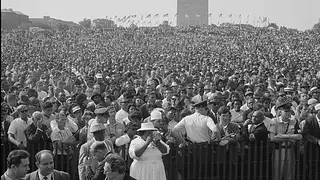
photo by: Warren K. Leffler/Library of Congress
View of the crowd during the 1963 March for Jobs and Freedom.
The first large scale protest was in 1894, when 500 unemployed workers, as Coxey's Army, came to the National Mall to draw attention to an economic depression. Since then, the space has seen women march for the right to vote, World War I veterans looking for support following their service, Rabbis calling attention in 1943 to the Holocaust and, in 1963, 250,000 people gathered for the March for Jobs and Freedom and heard a young John Lewis and Rev. Martin Luther King, Jr. call for action.
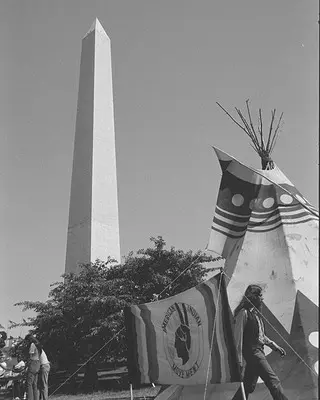
photo by: Warren K. Leffler/Library of Congress
The 5 month protest, The Longest Walk, came to an end at the National Mall in 1978. This protest by the American Indian Movement, aimed to draw attention to 11 pieces of legislation that would violate treaty rights.
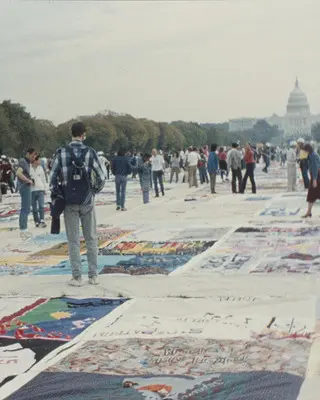
photo by: Names Project Foundation/Library of Congress
View of the Names Project AIDS Memorial Quilt in 1987 as part of the National March for Lesbian and Gay Rights.
In 1978, the American Indian Movement ended The Longest Walk from Alcatraz in San Francisco to Washington, D.C., to draw attention to critical legislation, and in 1987 in conjunction with the National March for Lesbian and Gay Rights, the Names Project AIDS Memorial Quilt was unveiled with panels provided by family and friends who had lost loved ones to the devastating disease. In the 21st century, these moments of protest continue to play an important role in Americans’ fight to protect their rights.

photo by: Kelly Paras
The Vietnam Veterans Memorial sits on the National Mall adjacent to the Lincoln Memorial. In the 1960s and '70s Americans gathered on the National Mall for a number of protests calling for an end to American involvement in the war.
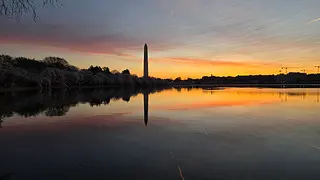
photo by: Priya Chhaya
The Tidal Basin, seen here in spring 2026, is a part of the National Mall and brings people together every year to view its iconic Cherry Blossoms.
Today, our National Mall unites us with generations of Americans, holding different and even conflicting convictions, who have come here to peacefully exercise rights and freedoms guaranteed to each of us. Visiting this powerful place now reminds us of our obligation to safeguard these freedoms for future generations.

photo by: National Air and Space Museum by Eric Long
In July 2019, over 500,000 people gathered on the National Mall to mark the 50th anniversary of the Apollo 11 Moon landing in 1969.
The Supreme Court
Just steps away from the United States Capitol Building, the Supreme Court stands as the final arbiter on the law for the United States. Etched above the west facade’s sixteen columns is a promise, one impossible to miss: “Equal Justice Under the Law.”
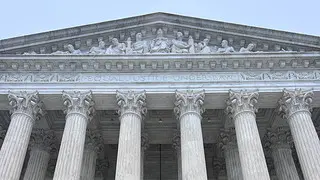
photo by: Kelly Paras
Detail exterior view of the entrance to the Supreme Court.
From 1810 to 1860, the Court met within the Capitol Building in a space now known as the Old Supreme Court Chamber. Pierre L’Enfant did not include a separate building for the Supreme Court in the plan for the capital city. It was only in 1935, following a campaign by former President-turned-Chief Justice William Howard Taft, that the current structure became the permanent home of the Supreme Court, creating a separate physical site representing the equal status of the third branch of government in the landscape of Washington.
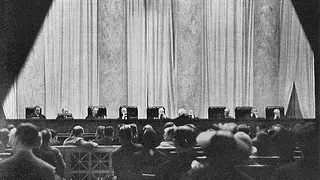
photo by: Public Domain
Interior of the Supreme Court Building during a session on June 7, 1937.
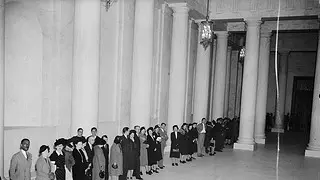
photo by: Library of Congress
On October 3, 1938, a crowd gathered for the opening of the Supreme Court.
This neoclassical building, designed by Cass Gilbert, was named a National Historic Landmark in 1987. Gilbert’s design recalls the form of a Roman temple, with a great flight of broad steps at the entrance. His intention, as stated on the Architect of the Capitol’s website, was to “achieve balance between classical grandeur and quiet dignity, appropriate for the nation’s highest court.” For the people, this entry, as highlighted in the Washington Post, “dramatizes the open access to justice.”
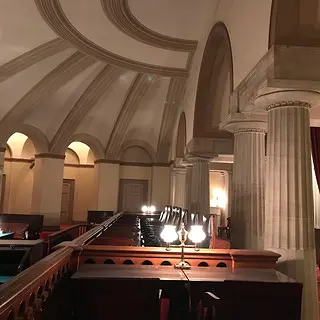
photo by: Kelly Paras
Interior of the Supreme Court chamber in September 2018.
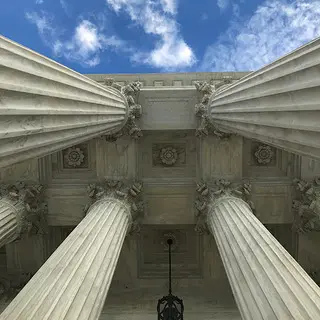
photo by: Kelly Paras
Detail view of the entrance to the Supreme Court in September 2018.
The early Justices—and particularly John Marshall—ensured that the courts, as a coequal branch of the federal government, would serve as a check on executive and congressional overreach. And, since its inception, the Court’s landmark rulings have continued to shape American civic life and identity.
Arguments before the Supreme Court often represent the culmination of years of effort to shift our collective understanding of “Equal Justice Under the Law.” In 1954, the Court’s landmark decision, Brown v. Board of Education, found school segregation unconstitutional, and overturned its earlier 1896 decision in Plessy v. Ferguson. In the 1970s, a series of cases before the Supreme Court argued for gender equity, and opinions in these cases led to Congressional action that paved the way for equal opportunity for women. More recent opinions issued by the Court extended those rights to same-sex couples.
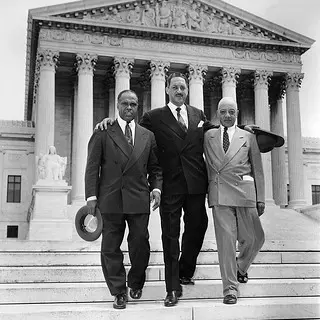
photo by: Library of Congress
George E.C. Hayes, Thurgood Marshall, and James M. Nabrit on the steps of the Supreme Court after the landmark Brown v. Board decision.
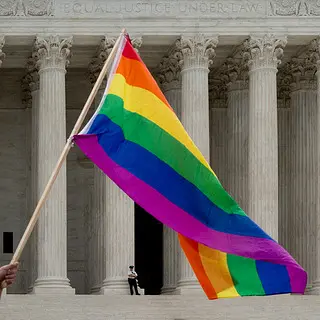
photo by: Victoria Pickering via Flickr CC BY-NC-ND 2.0
A crowd gathered in front of the Supreme Court on June 26, 2015, when the Court ruled in Obergefell v. Hodges granting same-sex couples the right to marry.
These and other decisions made within this civic landmark have shaped the daily lives of everyone who lives within the United States. For the American people, this building, the demonstrations and press events that take place in front of it, and the deliberations that take place within it, reflect the promise made to all who enter those hallowed halls.
The United States Capitol
When Pierre L’Enfant laid out his vision for Washington D.C. in 1791, he placed the building he called Congress House on a commanding rise above the Potomac River, visible from nearly every approach. In a city designed around symbolism, his placement said everything—that the will of people, through the legislative branch, was paramount.
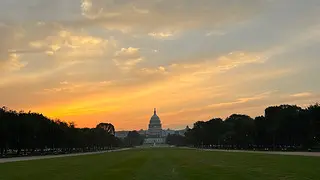
photo by: Kelly Paras
A view of the U.S. Capitol looking up from the National Mall c. 2023.
Inspired by examples of Greek and Roman architecture, the winning design by Dr. William Thornton envisioned a building that projected permanence and democratic ideals in equal measure, with a domed rotunda between the Senate and House wings. Construction began on September 18, 1793.
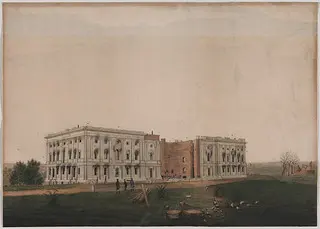
photo by: George Munger/Library of Congress
Drawing showing the the ruins of the U.S. Capitol following British attempts to burn the building. The image shows fire damage to both wings along with the shell of the rotunda with the facade and roof missing.
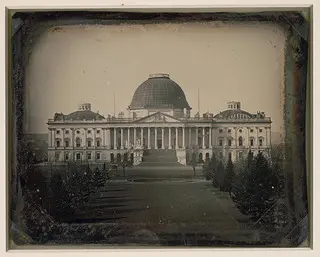
photo by: John Plumbe/Library of Congress
The East Front Elevation of the U.S. Capitol Building from a image c. 1846. Considered the earliest photograph of the Capitol Building, it shows the former copper-sheathed wooden dome.
Taking decades to complete, the Capitol also faced near destruction along the way. While many of the principal rooms were damaged when British forces burned the city in 1814, it was due to the then Architect of the Capitol Benjamin Latrobe’s use of fireproof building material and a rain shower that much of the main structure survived. Re-built after the war, over time the Capitol building expanded to accommodate the additional Senators and Representatives of a growing nation. By the 1850’s the larger building also required a larger dome and a new cast iron dome designed by Thomas U. Walter was built.
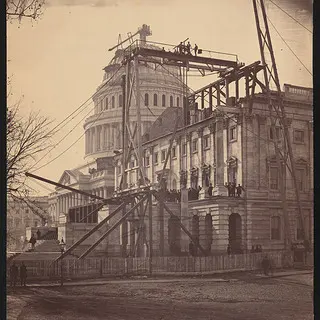
photo by: John Wood/Library of Congress
A photograph from between 1860-1863 showing the construction of the Senate pediment on the U.S. Capitol Building.
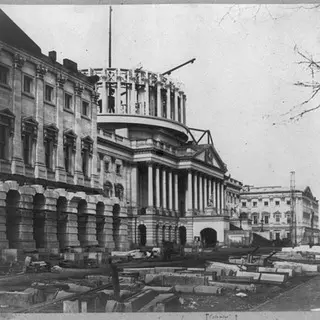
photo by: John Wood/Library of Congress
A photograph from January 1859 showing construction on the Capitol (east front looking north) as it expanded for the growing nation. This included the newer, larger, dome under construction.
Like the White House, the early Capitol was constructed using a mix of free and enslaved laborers and skilled artisans. Among those whose contributions deserved to be remembered is skilled artisan Philip Reed, a man enslaved by Clark Mills whose foundry cast the 19-foot-tall Statue of Freedom by Thomas Crawford, that stands above the Capitol dome. Reed, alongside free “blacksmiths, finishers, and stucco workers,” likely played a critical role in completing this symbol that welcomes visitors to the Capitol Building to this day.
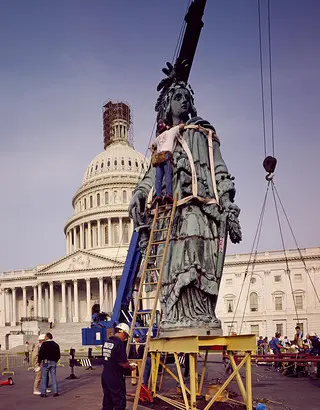
photo by: Carol Highsmith/Library of Congress
The bronze Statue of Freedom by Thomas Crawford has sat on top of the Capitol Dome since 1863. Here the statue is being lowered for restoration in 1993.
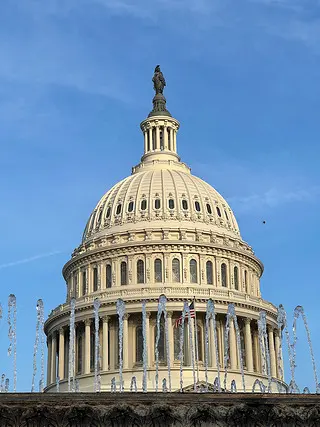
photo by: Kelly Paras
A detail view of the U.S. Capitol Dome with the Statue of Freedom looking east to welcome visitors.
Since 1800, the Capitol has been the arena where the nation’s laws have been debated, written, challenged, and changed. Working as counterbalance to the power of the executive and judicial branches, this is the sole branch that can make new or change existing laws and holds the all-important power of the purse. The building has also played an important ceremonial role as the backdrop for presidential inaugurations, state of the union addresses, and the lying in state of important civic leaders after they have died.
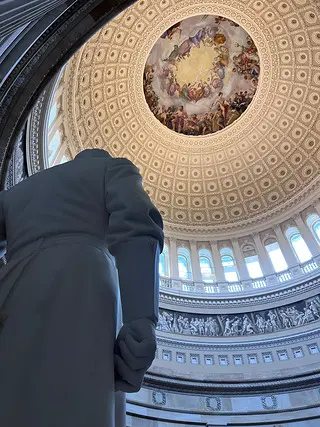
photo by: Kelly Paras
The interior of the rotunda at the U.S. Capitol looking up at “The Apotheosis of Washington” created by Constantino Brumidi in 1865.
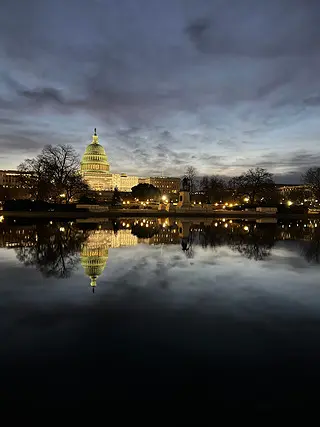
photo by: Kelly Paras
The U.S. Capitol Building at night c. 2023.
Today, with its high position rising above the National Mall, the Capitol Building is the visible symbol of the legislative branch’s preeminent role in civic life. With the Washington and Lincoln Memorials in its direct line of sight, the White House visible along Pennsylvania Avenue, and the Supreme Court nearby, the work that happens within the U.S. Capitol is predicated on a solemn responsibility to the American public. It is the physical embodiment of the fundamental idea that “we the people of the United States...” elect our representatives.
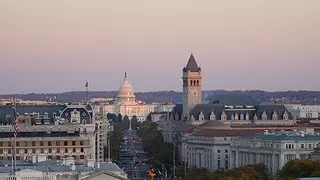
photo by: Kelly Paras
A view of the U.S. Capitol Building looking up Pennsylvania Avenue. The Old Post Office Pavilion is on the right in this image from 2025.