The Historic Architecture of DeLand, Florida, Provides a Framework for a Thriving Downtown
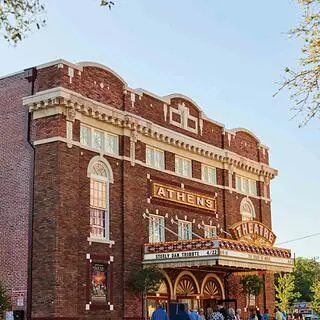
Under the bright sun, the restored Athens Theatre serves as a constant backdrop to what’s become the typical hum of activity in downtown DeLand, Florida. On one recent evening, the 1921 venue hosted a production of The Sound of Music while residents and tourists gathered nearby for a weekly farmers market. The next day, downtown would be crowded again for a music and art festival.
Built in the Italian Renaissance Revival style, the Athens began as a vaudeville house and a silent movie palace before later operating as a cinema and then a dinner theater. Years of deterioration followed a midcentury renovation, and the theater shuttered in the early 1990s. It reopened in 2009 after a restoration that removed a 1950s facade and reinstated the building’s defining features, including the brick exterior, arched windows, and a striking lit sign and marquee.
The reopening marked the start of a second act for the Athens, which has since become both a visual and cultural anchor for a broader transformation of DeLand—one that has brought regular foot traffic, a thriving network of small businesses, and a full calendar of community events to the city’s downtown.
“Restoring the theater—it did give a cultural center and heartbeat back to downtown,” says Sarah Finch, executive director of the locally based West Volusia Historical Society. “DeLand is called the ‘Athens of Florida’ in part because of its arts and culture and philosophy of living, and it’s been that way almost since the inception. So I really do think that restoration effort probably did feel like a big turning point.”
Decades past an initial push for revitalization that predated the theater restoration, downtown DeLand has continued to evolve beyond its previous mix of department stores, vacant storefronts, and antiques malls into a dynamic blend of restaurants and independent shops catering to both longtime residents and a regular wave of visitors. What began as a traditional preservation effort has gradually shifted into a bigger-picture balancing act between honoring the Central Florida city’s historic character and accommodating the expectations of a growing region.
Initially known as Persimmon Hollow for the wild fruit that grew there in abundance, the place that would become DeLand attracted early homesteaders, possibly drawn in by the area’s suitability for the cultivation of citrus. Settlers founded the city in 1876 and named it after baking soda tycoon Henry Addison DeLand, who hoped to make the area both an agricultural center and a cultural hub. Beyond his land holdings in citrus, he also established what would become one of the first private colleges in Florida.
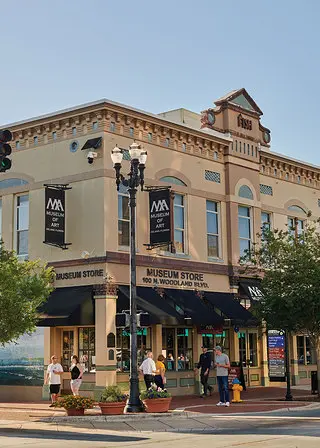
photo by: Tina Sargeant
The city’s art museum is located on Woodland Boulevard, the main thoroughfare.
His vision soon met adversity. Disaster struck in 1886 when a fire, reportedly sparked in a saloon, tore through the city’s main street, destroying nearly two dozen wooden structures. Parts of downtown were rebuilt using more fire-resistant sand-lime brick, which is still visible in many of the historic structures today. In an election held in 1888, DeLand won the right to serve as the county seat, but several years later, two devastating freezes wiped out much of the region’s citrus crop. Yet the town survived Henry DeLand’s misfortune. By then, it had secured a railroad connection, which helped sustain its early growth.
After the Florida land boom of the 1920s subsided, DeLand settled into a quiet town. In the 1950s and ’60s, the joke was that the sidewalks were “rolled up” by 5 p.m. Over the decades that followed, the rise of regional shopping malls in nearby cities drew both customers and businesses away from the historic core. By the early 1980s, downtown DeLand was grappling with the combined effects of departing businesses and the loss of historic properties. The business decline became so pronounced that “DeadLand” became a popular refrain for the city. By 1985, the vacancy rate downtown climbed past 85 percent.
“There were times in different years that I could’ve shot a cannon off in the middle of the street and not hit anybody, especially in the summer,” says Susie Macon, a longtime downtown merchant and property owner.
Facing that emptiness, DeLand bet on tourism and preservation as a strategy for survival. In 1985, the city became one of the first five communities in Florida selected for the National Trust’s National Main Street Center program (now an independent subsidiary and partner called Main Street America). This spurred a coordinated effort to revive downtown. MainStreet DeLand Association was established to lead the work, and city officials embraced the approach, says Bob Apgar, who served on the city commission and went on to a 21-year tenure as mayor that ended in 2022.
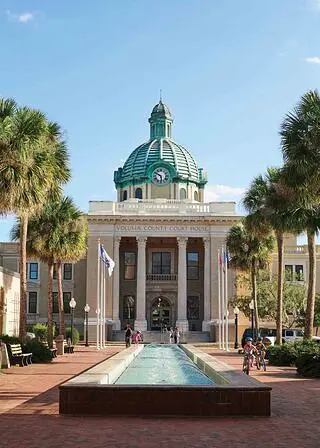
photo by: Tina Sargeant
The Neoclassical Volusia County Historic Courthouse originally opened in the 1920s.
Leaders took a hard inventory of downtown: identifying gaps, recruiting new businesses, and investing in the area’s historic character. Grants funded through the Downtown Community Redevelopment Agency (CRA) helped business and property owners return building facades to something closer to their original appearance. (This agency invests downtown commercial property tax revenues back into the Downtown CRA district.) The city and Florida’s Department of Transportation also undertook a sweeping overhaul of the commercial corridor, which included improving sidewalks, moving power lines out of sight, and bricking walkways.
“DeLand is called the ‘Athens of Florida’ in part because of its arts and culture and philosophy of living.”
Sarah Finch
With the city’s support, MainStreet DeLand also started hosting regular events that would draw residents and visitors, such as the DeLand Craft Show, now in its 27th year. A fall fine arts festival, now an independent nonprofit, has been running for more than 32 years. Preservation efforts extended to landmark projects, including the Athens Theatre. MainStreet DeLand purchased the building roughly 60 days before it was to be torn down, and oversaw the exterior restoration. (MainStreet later sold the Athens to a local theater company that rehabbed the interior.)
“Many places have tried to create their own downtown. One thing that makes our downtown attractive is, [it has] those good bones,” Apgar says. “DeLand is always changing, but always remains the same.”
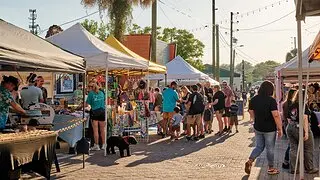
photo by: Tina Sargeant
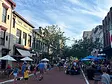
A popular farmers and artisans market takes place on Friday evenings.
The revived downtown now unfolds across a collection of late 19th- and 20th–century buildings, blending staple small-town businesses with a mix of restaurants, a wine bar, various clothing boutiques, and a shop dedicated to locally made art. The Museum of Art – DeLand recently reinforced the district’s cultural presence when it consolidated its collection into a historic downtown space.
On one corner, Pat and Toni’s Sweet Things offers handmade chocolate, milkshakes, and other sweet treats inside a brick building rebuilt after the 1886 fire. There are stores offering practical services like computer repair, while others, such as the local arts and crafts studio, offer room for more creative pursuits. At the DeLand Asian Market, shelves are stocked with 5-pound bags of crushed chili and bottles of cooking tamarind. (Though owner Kent Phongsangouane, who took over after his mother’s death a couple of years ago, says the shop’s most popular items are the drinks, snacks, and desserts.)
“Many places have tried to create their own downtown. One thing that makes our downtown attractive is, [it has] those good bones.”
Bob Apgar
And lasting impressions of the past are woven throughout downtown. A historical plaque outside The Muse Book Shop, an independent bookstore offering everything from children’s titles to antiquarian books and volumes on Florida history, notes the site has “a long history with the ‘written word.’” The building, constructed in the early 1900s with sand-lime brick made in the nearby city of Lake Helen, was previously occupied by newspapers and publishers.
At the far edge of downtown, under a canopy of tall trees trailing in Spanish moss, stands the campus of Stetson University, the successor to Henry DeLand’s original school that was later renamed for the hatmaker John B. Stetson. On the other end of downtown, at the center of what was once the city’s Black commercial district, is a 1920 brick building with green trim, developed by prominent Black banker and citrus grower James W. Wright to provide Black residents with places to shop during segregation. The National Register–listed James W. Wright Building has undergone a partial rehabilitation, aided by a $100,000 grant from the National Trust’s African American Cultural Heritage Action Fund, and the city hopes to eventually revitalize the surrounding neighborhood.
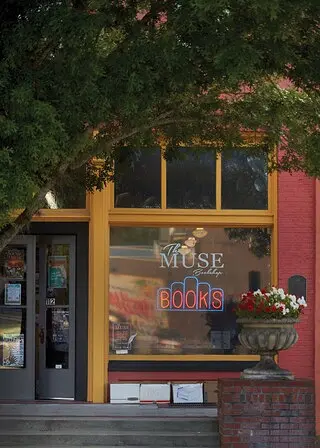
photo by: Tina Sargeant
The Muse Book Shop, which has operated on Woodland Boulevard since 1980, is one of many independently owned shops in downtown DeLand.
DeLand’s bid in the decades after joining Main Street was to position its downtown as a daytrip destination, says Stephanie Garcia Mullins, the current executive director of MainStreet DeLand. With a series of advertisements on television, radio, and in print, the organization targeted potential visitors living within a two-hour drive.
Less than an hour north of Orlando, the city sits within reach of Blue Spring State Park, where manatees are known to spend the winter, and De Leon Springs State Park. The beach is just a half-hour drive from downtown, making DeLand an easy stop.
For much of its history, the city was home largely to blue-collar workers employed in nearby agriculture and industry, whose incomes couldn’t always sustain a robust downtown retail district, Garcia Mullins says. Another consistent presence has long been Stetson University students. During the pandemic the city received an influx of higher income residents, including transplants from New York and remote workers with greater flexibility in where they lived. The most recent estimates from the U.S. Census Bureau show DeLand’s population has increased by about 72% since 2010, to 46,346 residents.
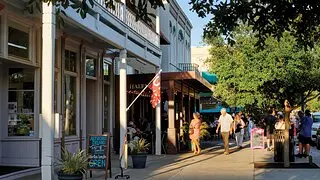
photo by: Tina Sargeant
Restaurants and shops cater to both locals and visitors.
While tourism remains central to its economic strategy, DeLand’s goals have gradually expanded to include a greater emphasis on livability. The idea is to create a downtown where people want to spend time regularly, and, increasingly, call home.
“We’ve done a great job of using what we have, and now we are at a point where we can dream a little bit and build a little bit more with the community,” Garcia Mullins says. “We’re really at a position where we’re just setting up the downtown and our organization for the next 30 to 40 years.”
The city’s 1985 master plan identified a need for permanent residences in downtown, Apgar says. That goal proved difficult to realize for decades, in part because of limited space. While the 1910 DeLand Opera House has long been converted into housing, other upper-floor residences remain scarce or are already lived in by longtime occupants. These include Macon, a former board member of MainStreet DeLand who describes herself as “entrenched.”
But now the longstanding objective of adding more housing is also taking shape. A new multi-story apartment development added a significant number of full-time residents to the downtown area when it opened in mid-2024. Plans are moving forward to build a new affordable and transitional housing complex across from City Hall, although, in a loss for the preservation community, the historic building on the site was demolished. A grant program funded through the Downtown CRA aims to encourage property owners to rehabilitate their upper floors for residential and commercial use.
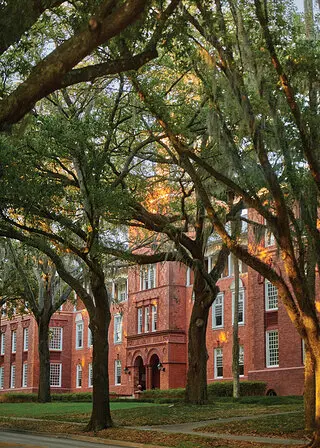
photo by: Tina Sargeant
Stetson University’s stately Elizabeth Hall dates to the 1890s.
City leaders are also looking ahead. DeLand has been hosting public meetings on an update to the city’s land development codes, which will help streamline future growth across the city. MainStreet’s long-term planning efforts for downtown also include adding parks or other gathering spaces, which it doesn’t have much of now.
MainStreet continues to coordinate community events, which draw between 150,000 and 200,000 attendees throughout the year. Grant programs that help business and property owners maintain their buildings still exist, but projects have shifted from larger rehabilitations into the upkeep work that’s more typical of what Garcia Mullins refers to as a “mature Main Street,” such as smaller repairs, repainting, or replacing old awnings.
The organization is also considering careful ways to expand downtown’s role without overextending it. MainStreet’s long-term vision for the historic commercial district includes setting it up more as a center of life that might address daily needs, including access to a corner market, a laundromat, or a gym.
Growth, however, brings new pressures. As Central Florida gains new residents, DeLand is feeling the impact of rising rents and ongoing debates about the scale and pace of new development. Residents across the county have raised alarms about flooding, blaming it on overdevelopment. Meanwhile, heavy weekend traffic along Woodland Boulevard has prompted worries about vibration and its potential impact on the historic sand-lime brick buildings.
“We have to be very careful when we use the word ‘growth,’” Garcia Mullins says. “Our goal is to tell newcomers, ‘This is your downtown. This is how you love it,’ in the hopes that they will come alongside and protect it just like the generations before them.”
Merchants want that, too. On a recent Friday morning, shortly after opening, Janet Bollum sat behind the checkout desk at The Muse Book Shop, cleaning newly acquired antiquarian titles that would be added to the stock of books filling the rows of wooden shelves. The store, which opened in 1980, is the longest-running business downtown.
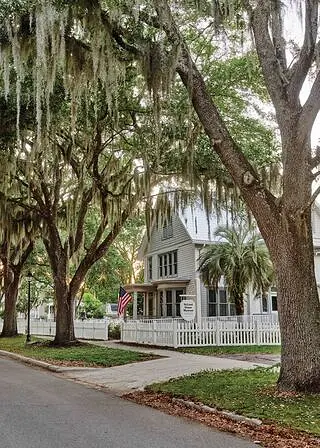
photo by: Tina Sargeant
The DeLand House Museum, located on the same property as the West Volusia Historical Society headquarters, is open for public tours.
Bollum, who has spent 46 years operating The Muse, has witnessed DeLand’s revival up close while wearily watching what she describes as “too much” development of formerly agricultural land in the surrounding area.
She points to downtown’s more measured, preservation-focused approach as the key to ensuring its efforts are enhancing, rather than eroding, the character and accessibility that have come to define DeLand.
“We’ve done a great job of using what we have, and now we are at a point where we can dream a little bit and build a little bit more with the community.”
Stephanie Garcia Mullins
At the center of that character is a strong network of locally owned businesses. Aside from a handful of chains, Bollum notes, the vast majority of storefronts in the Main Street district are independently operated. Step inside and you’re likely to meet the owner, whether behind the counter or in the kitchen.
“It has that real downtown feel, which is hard to replicate,” Bollum says. “People try to replicate [that] in some places, but [here we have] a real downtown core. [It] … should remain in perpetuity, we hope, because we’ve laid the groundwork.”
DeLand, Florida, is an Accredited Main Street America community. For more on Main Street America, an independent subsidiary and partner organization of the National Trust, visit MainStreet.org
Save Historic Places That Tell Our Full American Story
When you join the National Trust, you help save historic and culturally significant places nationwide.