11 Most Endangered Historic Places
Angel Island Immigration Station
Located in the middle of the San Francisco Bay, the Angel Island Immigration Station stands as a reminder that the United States—a nation to which generations of immigrants have contributed—has at times implemented unjust policies toward those pursuing entry into the country. Built to enforce racially exclusionary immigration laws, the station detained more than 300,000 immigrants, primarily from Asia and across the Pacific. While Ellis Island is remembered as a gateway of welcome, Angel Island tells a different story of lengthy interrogations, months or even years of detention, invasive medical exams, and family separation. Diving deeper into these histories, visitors will also find courageous stories of resilience, hope, and determination. The Angel Island Immigration Station allows visitors to experience its vital history through the perspective of immigrants and serves as a visceral reminder of our obligation now to honor the ideal of that all are created equal and to continue the work of building a more perfect union.

photo by: Angel Island Immigration Station Foundation
This image is of a room on the first floor of the detention barracks museum at Angel Island Immigration Station. A stack of 6 bunk beds provide an idea of how cramped and crowded this room would be, with bunk beds sandwiched between all of the poles.
At its peak, the Angel Island Immigration Station was the busiest immigration port on the West Coast, processing approximately 1,000,000 people between 1910 and 1940. More than 300,000 people from 80 different countries (mainly China, Japan, and other Asian Pacific Island countries) were unjustly detained on the island, many due to their race. When the immigration station closed in 1940, the site was used to detain 700 civilians of Japanese heritage living in Hawai’i and California, and served as a prisoner of war processing facility during World War II. In 1963, Angel Island became part of the California State Park system.

photo by: Public Domain
This 1923 photo portrays the intensive physical examinations that Asian and Pacific Island immigrants endured at Angel Island.
More than 200 poems carved into the detention barracks walls by the immigrant detainees ultimately helped to save the buildings. These poems provide a rare first-person testimony of detainees’ experiences and emotions and inspired a grassroots advocacy movement to save the buildings from demolition in the early 1970s.
In 1997, Angel Island Immigration Station became a designated National Historic Landmark. After the site was previously included on the 11 Most list in 1999, California State Parks and the Angel Island Immigration Station Foundation (AIISF) partnered to restore the detention barracks and the hospital, which are now open to the public as a historic site.
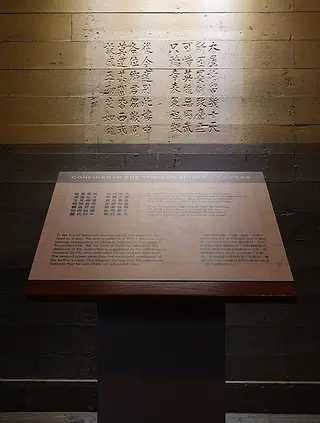
photo by: Angel Island Immigration Station Foundation
This image is of one of the hundreds of poems carved by immigrants into the detention barrack walls at Angel Island Immigration Station. The poem begins with the line: 'Detained in this wooden house for several tens of days.'
Although the detention barracks and hospital were successfully rehabilitated, they require ongoing maintenance in order to serve visitors’ needs. Several other historic structures on the island are deteriorating, including the powerhouse, mule barn, and World War II-era barracks. Due to its island location, the immigration station is subjected to constant wind and weather. Heavy rain has caused leaks in the elevators, restricting handicap accessibility, and wildfires scorched more than half of the island in 2008. Additionally, the current environment of heightened immigration enforcement has prompted some community members and school groups to reconsider their engagement with the site out of concern and consideration for students and community members who may have previously experienced immigration raids or detention, highlighting the political and social pressures that may affect Angel Island’s long-term stability.

photo by: Angel Island Immigration Station Foundation
This is a military barrack built during WWII when the military used the site of the former Angel Island Immigration Station to hold POWs from Germany, Italy, and Japan. The building is structurally unsound and has been significantly damaged by the elements.
The AIISF was founded in 1983 by descendants of Angel Island detainees and works closely with Angel Island State Park to manage preservation, interpretation, and programming at the site. Approximately 23,000 people visit the immigration station each year, but this is a fraction of the number of visits to nearby Alcatraz. Additional financial investment and expanded marketing efforts could help increase visitation, improve accessibility, enhance interpretation, and increase public attention.
Angel Island Immigration Station was named to the National Trust's list of America's 11 Most Endangered Historic Places for 2026. It was also named in 1999 and 2017.
Support our work to save places that matter.
Donate NowStay connected with us via email. Sign up today.
Related Stories
-
Preservation Magazine Correctional Innovation


Explore More Places

Announcing the Historic Preservation Defense Fund, a campaign to protect the places, laws, and principles that safeguard our nation's historic places.
Learn More