Act Now
11 Most Endangered Historic Places
Tule Lake Segregation Center
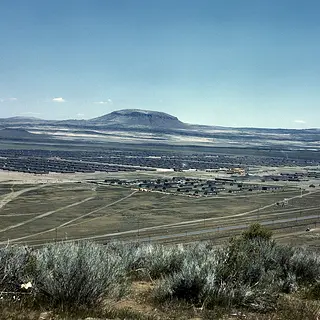
Tule Lake Segregation Center stands as a testament to the resilience of thousands of Japanese Americans who exercised their rights to protest and resist in the face of racial discrimination, incarceration, and direct attacks on their identities as American citizens. Beginning in 1942, the federal government forcibly removed over 126,000 people of Japanese descent—two-thirds of whom were American citizens—from their homes and incarcerated them at sites like Tule Lake. Today, Tule Lake is a place that honors the brave contributions of Japanese Americans who fought to protect the sanctity of the U.S. Constitution.
From 1943-1946, Tule Lake Segregation Center served as a maximum-security prison for Japanese Americans who protested race-based incarceration by refusing to answer or answering “no” to a government issued “loyalty” questionnaire.
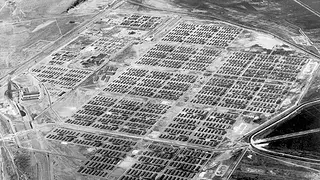
photo by: Tule Lake Committee
Aerial view of Tule Lake Segregation Center circa 1944-46.
For many incarcerated at Tule Lake, their questionnaire responses served as a form of peaceful resistance against a federal government that had violated their right to due process.
Later, over 5,000 U.S. citizens incarcerated at Tule Lake renounced their citizenship under duress, in many cases fearing for their safety and the safety of their families after the war. Thousands of people, including children, were deported to Japan. Most deportees eventually sought restoration of their U.S. citizenship, which was only granted after a long legal battle.

photo by: Public Domain
Nursery school children with model barracks, 1942.
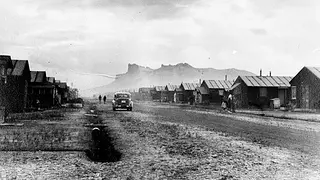
photo by: Public Domain
Tule Lake Segregation Center circa 1944-45.
Today, a token 37-acre portion of the Tule Lake Segregation Center has been designated as a National Monument, but the primary 1,100-acre site is unprotected. For the survivors and descendants of those incarcerated there, the entire Tule Lake site is sacred ground, a place of suffering, where 331 prisoners died. It is a place of community pilgrimage and private contemplation, yet staffing and public access is limited, and there is no adequate facility for larger groups to gather. After World War II, the majority of the Segregation Center’s structures were demolished or removed, and a rural airfield now occupies 359 acres at the heart of the former incarceration camp site.
The Federal Aviation Authority and Modoc County are seeking to construct a 3-mile long, 8- to 10-foot-high security fence around the airfield, which could permanently alter the setting, viewshed, and archaeological integrity of Tule Lake. Survivors and descendants believe the airfield desecrates this sacred site.
The Tule Lake Committee, an organization of survivors and descendants whose families were incarcerated at Tule Lake, is leading advocacy efforts to relocate the airfield from this sacred place. Protecting this American civil rights site would honor the people who resisted injustice here and provide opportunities to expand public visitation and interpretation at the National Monument.

photo by: Tule Lake Committee
Tule Lake Committee and docents at the State Historic Landmark marker adjacent to the jail stockade, which is part of the Tule Lake National Monument.
In partnership with groups including the National Trust, APAIHiP, NPCA, Japanese American Confinement Sites Consortium, Congressional Asian Pacific American Caucus, and others, the Committee has generated over 38,000 public comments in opposition to the proposed fence. Additional partnerships and support will be needed to ensure Tule Lake can be protected and its stories of resilience can be shared with future generations on the sacred site where thousands of American citizens bravely advocated for their rights.
Tule Lake Segregation Center was named to the National Trust's list of America's 11 Most Endangered Historic Places for 2026.
Urge your members of Congress to support the Tule Lake National Monument.
Send LettersSupport our work to save places that matter.
Donate nowStay connected with us via email. Sign up today.
Related Stories
-
11 Most Endangered Historic Places Preserving the Japanese American Experience at Tule Lake -
National Preservation Awards Digging Deeper with the Oregon Chinese Diaspora Project -
Preservation Leadership Forum After the Fire: The Restoration of Malmgren Garage


Explore More Places

Announcing the Historic Preservation Defense Fund, a campaign to protect the places, laws, and principles that safeguard our nation's historic places.
Learn More