Act Now
11 Most Endangered Historic Places
Hanging Rock Revolutionary War Battlefield
On August 6, 1780, a Patriot militia bolstered by Catawba warriors faced off with British and Loyalist troops at the Battle of Hanging Rock. The fierce three hours of fighting revealed the complex alliances, human cost, and unresolved tensions of the American Revolutionary War, particularly around who the Declaration of Independence’s principles of freedom and equality were meant to serve. At Hanging Rock, neighbors fought over loyalty, land, and self-government, each with distinct stakes in survival and autonomy.
The Hanging Rock Battlefield continues to reveal the complexities of the Southern Campaign—including the Revolutionary War experiences of Native Americans, women, and Loyalists living outside major cities occupied by either Patriot or British forces—and offers a powerful opportunity to broaden the story of the American Revolution beyond its most familiar narratives.
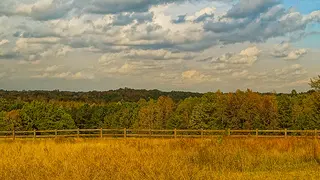
photo by: Brian Keely
A portion of the Hanging Rock Battlefield, owned by the South Carolina Battleground Preservation Trust, that is not currently open to the public. With additional funding, it could be made accessible with additional interpretation.
After the fall of Charleston in May of 1780, the British established several outposts intending to restore Royal authority over South Carolina’s population and resources. Hanging Rock, located between Camden, SC, and Charlotte, NC, was the most northerly of these British outposts.
Patriot General Thomas Sumter led 800 troops of Patriot militia and 40 Catawba warriors into battle against 1,400 British and Loyalist troops commanded by British Major John Carden. Sumter’s troops inflicted significant casualties on the British, and the battle is considered a Patriot victory that helped boost morale at a dark time in the Southern Campaign, ultimately weakening British control in South Carolina. The battle also marked the first wartime experience of a 13-year-old Patriot messenger, future President Andrew Jackson.
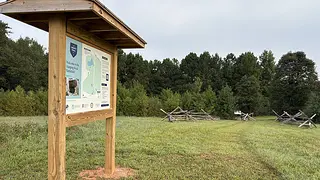
photo by: Catherine Noyes
Newly installed Orientation Kiosk and the start of the 0.75-mile loop trail on a portion of the Hanging Rock Battlefield, a site on The Liberty Trail.
Today, only a portion of the 600 core battlefield acres, where intense combat occurred, have been preserved and protected through acquisition for public access and recordation of permanent conservation easements, leaving much of the site vulnerable to alteration. The area is experiencing population growth and development pressures, which risk fragmenting the battlefield’s core acres. Significant funding is needed for land acquisition, park development, and long-term stewardship of the battlefield. These actions would create a space where visitors can further understand the Battle of Hanging Rock’s complexities while standing in the place where it happened.
A coalition led by the American Battlefield Trust and including the South Carolina Battleground Preservation Trust, South Carolina 250 Commission, South Carolina State Parks, and Friends of Hanging Rock, have been working to protect key battlefield land and develop public access improvements at the Hanging Rock Battlefield, including a walking tour and signage. The coalition’s vision is to expand public access, interpretation, and funding to support a sustainable and fully revitalized Hanging Rock Battlefield Park, but more funding and partnerships will be needed.

photo by: Andrew Keeley
A portion of Hanging Rock Creek located on land owned by the South Carolina Battleground Preservation Trust. This area of the battlefield is not open to the public, but with funding, it could be made accessible with interpretation.
Hanging Rock Revolutionary War Battlefield was named to the National Trust's list of America's 11 Most Endangered Historic Places for 2026.
Support American Battlefield Protection Program Amendments Act (H.R. 7618/S. 3524).
Send LettersSupport our work to save places that matter.
Donate NowStay connected with us via email. Sign up today.
Related Stories
-
40 Under 40: Places 40 Places Under 40 Years Old: Landscapes


Explore More Places

Senate Bill S. 5653 would limit a process that considers how federal projects affect historic places and make community consultation optional for many projects. Urge your senators to oppose the bill as written and demand meaningful changes to its provisions.
Send Letters