A Creative Space for Indigenous Artists in Washington State
In 2024, the National Trust for Historic Preservation’s Historic Artists’ Homes and Studios (HAHS) program welcomed the Lelooska Foundation and Cultural Center as one of its first Indigenous sites since the program’s founding in 2000.
Located in Ariel, Washington, and renowned for its diverse collection of Indigenous art and artifacts, as well as live dance and storytelling performances, the Lelooska Foundation and Cultural Center is looking forward to a new era of growth and transformation with HAHS support.
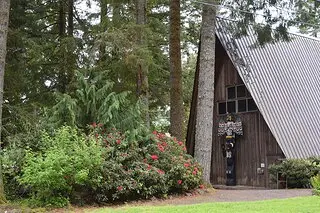
photo by: Lelooska Museum
Exterior of the Lelooska Museum in Ariel, Washington.
“We’re at a big transition point of growing and making our programs sustainable for future generations, and it’s great to have new partners who believe in that vision and are focused on preserving the history of artists, their lives, and their work into the future,” said Mariah Stoll-Smith Reese, the organization’s executive director.
Fostering Cultural Understanding
The Lelooska Foundation and Cultural Center has served as both a home and creative space for Indigenous artists since the 1960s, when Chief Lelooska, for whom the foundation is named, moved to the property. He and his family, including his younger brother Tsungani, who is Stoll-Smith Reese’s father, spent the early 1960s building the first structures on the wooded site, which now boasts a museum, a gathering hall, two ceremonial houses, an administrative office, and a workshop for totem pole restoration and canoe carving.
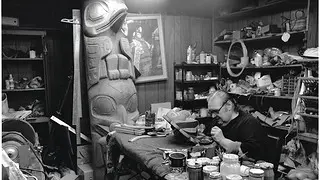
photo by: Lelooska Foundation
Chief Lelooska in his workshop in 1992.
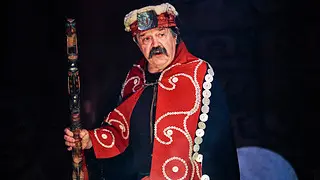
photo by: Lelooska Foundation
Chief Lelooska's younger brother, Tsungani, succeeded him as chief after his death in 1996, becoming the primary storyteller.
Although Lelooska was of Cherokee descent and his family came from the south-central United States, he was born in California and spent much of his life in Oregon and Washington, developing close ties with Pacific Northwest tribes. He was given the name Lelooska, meaning “to cut against wood with a knife,” by Nez Perce elders when he was just 12 years old, in recognition of his skill as a woodcarver.
This same skill brought him acclaim later in life, not only in the region but far beyond. Today, Lelooska’s carved, richly colored totem poles stand at the Oregon Zoo in Portland and at Christchurch International Airport in New Zealand. Another 140-foot-tall pole, once one of the tallest in the world, sits adjacent to the Columbia River in Kalama, Washington with four other poles towering along the waters edge.
After moving to Ariel, Lelooska also developed a close friendship with Chief James Aul Sewid of the Kwakwaka’wakw, an Indigenous group of the Pacific Northwest Coast in southwestern Canada. Sewid adopted Lelooska and his family, and, along with other Kwakwaka’wakw elders, they developed Living History Programs for the Lelooska Cultural Center, intended to bring traditional masks, songs, dances, and storytelling to the public for educational purposes.
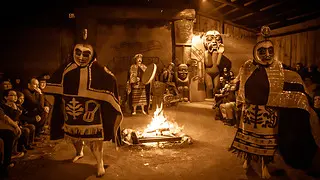
photo by: Lelooska Foundation
One of the Living History Programs inside the ceremonial house at the Lelooska Foundation.
“My uncle really felt like education is how you prevent prejudice; that prejudice is a lack of knowledge, and that if you can appreciate and understand a culture different from your own, then you're much less likely to do things to harm it,” said Stoll-Smith Reese of Lelooska’s and Sewid’s motivations for developing the Living History Programs that led to the cultural center.
Fostering cultural understanding remains an important mission of the Lelooska Foundation, which was established in 1977 to sponsor the Living History Programs, other educational programming, and a growing museum collection. Sewid and the other Kwakwaka’wakw elders whom Lelooska worked alongside grew up during a time when the government of Canada banned and criminalized certain Kwakwaka'wakw traditions.
Among the banned practices was the potlatch, which serves as the cornerstone of the social and economic vitality of the people in the sharing of ancestral histories through stories, song, and masked dances and the redistribution of resources in the gifting of property. The Living History Programs share a portion of this practice.
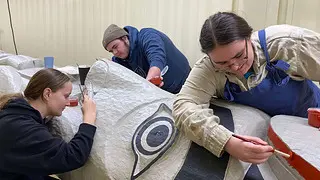
photo by: Lelooska Foundation
Artisans at the Lelooska Foundation restoring a totem pole.
“Lelooska, Chief James Aul Sewid, and the elders figured out what was appropriate to share with the public so that they could learn from and appreciate the culture, and do it outside of a potlatch,” explains Stoll-Smith Reese. “They wanted to make sure that people understood the masks, dances, songs, stories, and cultures of the Northwest Coast so that things like the outlawing of the potlatch never happened again.”
After Lelooska died in 1996, the chieftaincy was passed to his younger brother, Tsungani, who then also became the primary storyteller.
A Family Tradition
Today, Lelooska Cultural Center remains best known for live storytelling performances. Performers don hand-carved masks and ornate hand sewn wool robes and bring to life the stories of their ancestors connections and interactions with animals and beings across the family’s lineage story. These stories are portrayed in the masks of many creatures including, bears, wolves, puffins, and other beings and shared in the firelight of the site’s ceremonial house.
“The stunningly beautiful masks which are used in these performances are complex works of art in themselves,” said HAHS director, Valerie Balint. “The way in which they are made, with finely articulated parts such as wings and mouths that move, and the intricacy of the carving, show an artistic virtuosity that has been passed down through generations.”
“My uncle really felt like education is how you prevent prejudice; that prejudice is a lack of knowledge, and that if you can appreciate and understand a culture different from your own, then you're much less likely to do things to harm it.”
Mariah Stoll-Smith Reese
Lelooska’s museum also offers visitors a window into the artistic and cultural practices of tribes across the U.S. and Canada. The museum collection was developed over time through connections to other Native peoples and groups and includes some of Lelooska’s masks and other carvings, with the collection growing to feature over 600 Native American artifacts and artworks.
Many of Lelooska’s family members contributed works to the collection, including carvings, jewelry, paintings, and everyday items that they wore or used. Balint said this makes the Lelooska Cultural Center a unique addition to the HAHS network: “This is a site that represents both a historic multi-generational, and a contemporary “living” artistic legacy. This is about generations of artists who worked across disciplines, and where these practices continue to be passed down and honored today.”
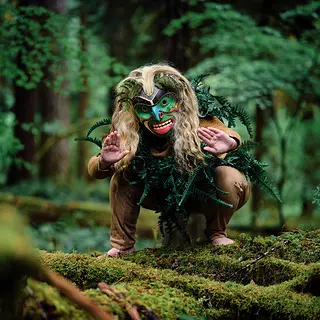
photo by: Justin Myers/Lelooska Foundation
A look at one of the storytellers at the Lelooska Foundation dressed as Bukwus, Wild Man of the Woods. Mask carved by Tsungani.
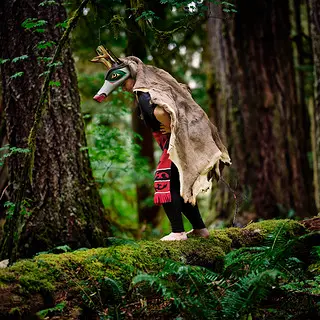
photo by: Justin Myers/Lelooska Foundation
One of the storytellers at the Lelooska Foundation dressed as Deer Dancer. Mask carved by Tsungani.
More recently, artists and collectors of Indigenous art have begun to recognize the museum as a hub for the preservation of Native art and artifacts and donated works to its collection. “Our museum, having such a diverse collection from across the United States and Canada, it’s really grown and expanded, and it’s really evident that we need a new museum building,” said Stoll-Smith Reese.
With support from the HAHS peer network, Stoll-Smith Reese plans to deepen her knowledge of preservation and collections management. The Lelooska Foundation is looking forward to building a new on-site museum space in the near future. As Stoll-Smith Reese said, “when people entrust you with their stories or a piece of art or an artifact that they want preserved, then you have a responsibility to carry that forward and share that knowledge with others in a way that honors them.”
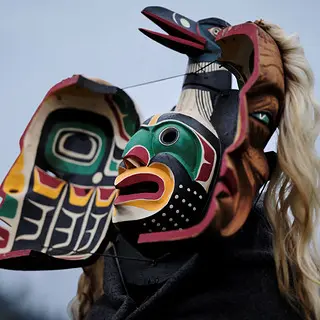
Cover image: A detail view of the Grandmother Loon Transformation Mask from the Lelooska Foundation collection. This mask was carved by Tsungani.
Save Historic Places That Tell Our Full American Story
When you join the National Trust, you help save historic and culturally significant places nationwide.