84 Years Later: Remembering Japanese American Incarceration
On February 19, 2026, the United States will mark the 84th anniversary of the issuing of Executive Order 9066 by then President Franklin Delano Roosevelt. This order authorized the United States military to remove more than 120,000 adults and children of Japanese ancestry living on the West Coast to 10 major incarceration camps and other detention sites. The order also forced Japanese Americans to leave businesses, homes, friends, and community behind—sending them to sites often located in isolated and desolate parts of the western United States where they experienced not only the pain of living behind barbed wire merely because of their heritage, but also tests of loyalty, the contradictions of military service, and more.
These are stories of trauma—and of resilience and of starting over—stories that make sure that those years are never forgotten as a significant piece of American history.
Today, the history of these individuals and families are being told through oral histories, online exhibitions, interactive experiences, and collections. For this Day of Rememberance, we’ve selected a few of these experiences so you can learn more.

photo by: Library of Congress, LC-USZ62-34565
Posters of Civilian Exclusion Order #5 at First and Front streets in San Francisco in April 1942.
1. Tanaka Photo Studio: Family, Tradition, Business, and Community Before WWII: This online exhibit from Japanese American National Museum highlights the work of photographer Chikashi Tanaka whose studio operated in Los Angeles’ Little Tokyo from 1912 when his family was forcibly moved to the Gila River incarceration Camp in 1942. These images show life before the war, and the exhibit allows visitors to zoom in to see various details of each photograph.
Stay connected with us via email. Sign up today.
2. Remembering Mitsuye Endo and the Supreme Court Case That Helped End Incarceration: December 2025 marked the landmark decision Ex Parte Endo, the final of four cases challenging the treatment of Japanese Americans during World War II. In a piece written by legal scholar Lorraine Bannai for Densho we learn about Mitsuye Endo, the plaintiff, and the way this case moved through the courts along with its important impact. To hear more from Densho, checkout our 2025 AAPI Digital Public History Showcase.
3. Resettlement: Chicago Story: While this film was released in 2022, it was recently featured in 2025 as part of Tadaima! A Community Virtual Pilgrimage hosted by Japanese American Memorial Pilgramages. The short film (directed by Reina Higashitani) and educational web experience (produced by Full Spectrum Features), shares the story of the Yamamoto family who were forced by the government to leave their farm and live at an incarceration camp in Arizona. This virtual experience navigates what came after the war ended when the family was resettled in Chicago rather than being allowed to return home.
4. Defining Courage: A live, interactive event, from Story Boldly, this show combines archival video, historic films, interviews, and more to share the story of Americans of Japanese ancestry who served in the segregated military units of the United States military. Watch the promotional video and see future tour dates.
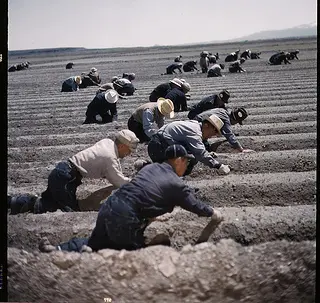
photo by: Library of Congress LC-DIG-fsac-1a35013
A group of incarcerated Japanese Americans farming at Tule Lake Incarceration Camp in Newell, California (c. 1942 or 1943).

photo by: Library of Congress, LC-USZ62-23602
Exterior of the Wanto Co. store located at 401 - 403 Eighth and Franklin Streets in Oakland, California. The business was owned by the Matsuda family. Tatsuro Matsuda, a University of California graduate, commissioned and installed the "I am an American" sign. The photo was taken in March 1942.
National Trust Stories and Places
- Finding Unexpected Family History at Seattle's Nippon Kan Theatre
- Photo Essays of Manzanar: Jack Iwata, Dorothea Lange, Ansel Adams
- How A Lost Internment Camp Became A National Monument
- Q&A: Naomi Harada on Her Family’s Civil Rights Legacy
- Back Story: A Different Tune with Linkin Park's Mike Shinoda
- Tadaima! Lessons From a Community Virtual Pilgrimage (2020)
- Places: Panama Hotel | Historic Wintersburg
Save Historic Places That Tell Our Full American Story
When you join the National Trust, you help save historic and culturally significant places nationwide.

.webp)