Envisioning the Olympic Games at 5 Historic Sites
This February, the 2026 Milan Cortina Winter Olympics kick off in Italy. To celebrate this cultural moment, we asked staff at the National Trust’s Historic Sites and Historic Artists' Homes and Studios to imagine what the Olympic Games might look like if their sites were the host.
In the spirit of the Olympic Games, each site explored its histories and collections to unearth a gold medal-worthy story. Read ahead for a selection of athletic imaginings as we wander through our own Olympic landscape.
Ski Mountaineering at Oatlands
Oatlands Historic House and Gardens, a historic estate in Leesburg, Virginia, would host ski mountaineering. Also called “SkiMo,” ski mountaineering is making its Olympic debut this year. In the photo below, Helen and Margey Eustis stand in winter clothes with long walking sticks. They look ready for a hike, which is exactly what ski mountaineering involves—hiking uphill with long skis (either wearing them or carrying them), and then skiing downhill.
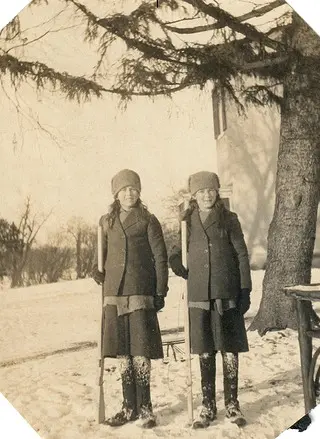
photo by: Oatlands
Helen and Margey Eustis enjoy a snowy day at Oatlands in 1912.
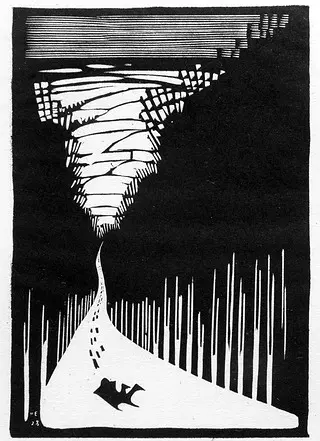
photo by: Wharton Esherick Museum
“Winter Play,” a woodcut created by artist Wharton Esherick in 1928, depicts his daughter sledding.
Bobsleigh at the Wharton Esherick Museum
The Wharton Esherick Museum in Malvern, Pennsylvania, which houses hundreds of artworks by artist Wharton Esherick, would host bobsleigh. In his 1928 woodcut Winter Play, Esherick depicts his daughter, Ruth, sledding down the long slope of Diamond Rock Hill, where the family’s farmhouse was located. Ruth later reflected on this moment, recalling the ski jumps created by shallow trenches that were intended to divert rainwater, and the long hike back to the top of the hill. This woodcut of Ruth sledding depicts a seemingly endless slope and the icy environment of winter, elements that are characteristic of bobsleigh.
Sculpture at Brucemore
Brucemore, a 26-acre estate in Cedar Rapids, Iowa, would host sculpture. While the arts are no longer included in the Olympic Games, they once were. Between 1912 and 1948, more than 150 official medals were awarded for architecture, painting, sculpture, writing, and music composition. One Olympian and artist—Edward Bruce Douglas—was the nephew of Brucemore’s second owners. Douglas competed in Sculpture in the 1936 Olympic Games in Berlin, Germany. Though he did not win a medal, he is remembered as an Olympian who competed in the arts for his country.
Lost Olympic Medals and Nazi Germany
In this video produced by Brucemore, public historian Megan Clevenger explores Edward Douglas’s experience as a sculptor at the 1936 Berlin Olympics.
Ice Hockey at The Glass House
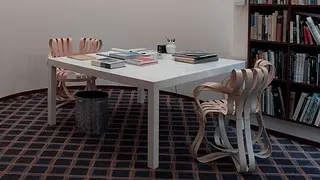
photo by: Carol Highsmith/The Glass House
Nicknamed the "hockey stick chairs," these pieces were designed by Canadian-American architect Frank Gehry in 1990.
The Glass House in New Canaan, Connecticut, would host ice hockey. Architect Frank Gehry, a friend of the Glass House’s architect Philip Johnson, designed the Cross Check Chairs (they are also nicknamed the “hockey stick chairs”). They are named after a hockey infraction in which a player holds their hockey stick vertically to block, or effectively check, another player. The name also refers to the seat of the chair, which is crafted from interwoven maple plywood strips to create a check pattern. This combination of maple wood and hockey pays homage to Canada, where Gehry was born and spent his early childhood years.
Cross-Country Skiing at the Edith Farnsworth House
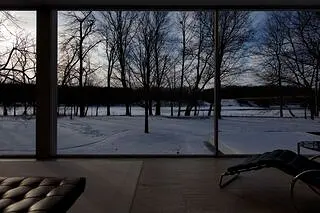
photo by: Tom Rossiter/Edith Farnsworth House
A view of Illinois' wintry landscape from the interior of the Edith Farnsworth House.
The Edith Farnsworth House, the weekend retreat of nephrologist and translator Edith Farnsworth, would host cross-country skiing. This 60-acre estate in Plano, Illinois, encompasses both woodlands and open terrain, making it a prime location for a ski route. Designed by Mies van der Rohe, the house features glass walls that reflect his interest in connecting the indoors with the outdoors. In this hypothetical situation, van der Rohe’s design would provide spectators with a fantastic view of the estate’s cross-country ski loop.
Save Historic Places That Tell Our Full American Story
When you join the National Trust, you help save historic and culturally significant places nationwide.