Strength, Courage, and Commitment: A Vision for the Future of the Palmer Memorial Institute Campus
“Freedom is not on the bargain counter—it cannot be obtained at an auction sale. Freedom is a fighting word..."”
Charlotte Hawkins Brown, “The Role of the Negro Woman in the Fight for Freedom” June 6, 1943.
The story of Palmer Memorial Institute (PMI) in Sedalia, North Carolina is a story of Dr. Charlotte Hawkins Brown and over 1,000 students from across the globe who graduated during its 69 years of operation. When Brown—who was only 19 at the time—opened PMI, it was in response to the closure of another school which would have left an entire community of Black children without access to education. Brown built a legacy of teaching that focused on academic, industrial, and agricultural education, showing students what success looked like. During her 50 years as president, PMI transformed from an old blacksmith’s shed into a sprawling 300-acre campus with 14 buildings.
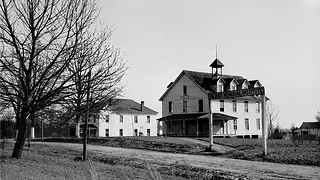
photo by: Jackson Davis/University of Virginia Library
Palmer Memorial Institute campus with the original Memorial Hall in the center.
Following a severe fire in 1971, the school was forced to close. Today, the site is owned by the State of North Carolina. The Charlotte Hawkins Brown Museum (CHBM), which is dedicated to telling the story of this incredible educator and activist, manages the remaining 12-structure campus. It stands as the only North Carolina state site recognizing the achievement of Black women.
However, more than 50 years after the fire, many of the structures are deteriorating and cannot be used. The three main dormitories have failing roofs, crumbling ceilings and walls, and water and fire damage. Lack of funding and competing priorities at the state level have made rehabilitation of the buildings almost impossible. In light of these concerns, in 2022, the National Trust included PMI on its list of America’s 11 Most Endangered Historic Places, a designation that was a turning point for the museum and the campus.
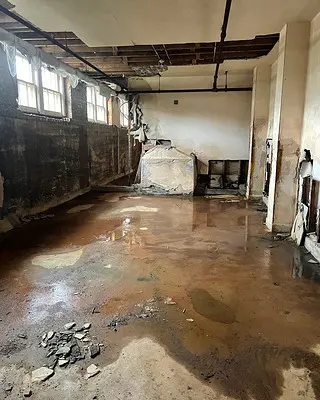
photo by: Chris Morris/National Trust for Historic Preservaton
View of some of the water damage at Galen Stone Hall on what was the Palmer Memorial Institute campus.
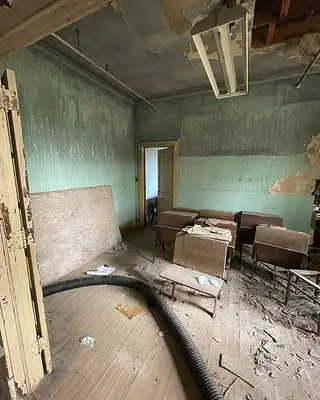
photo by: Chris Morris/National Trust for Historic Preservaton
An interior view of one of the classrooms in Galen Stone Hall showing some of the current conditions and deterioration on the campus.
PMI’s history and threatened status also brought it to the attention of the National Trust’s Where Women Made History (WWMH) initiative, whose partnership with RAMSA (Robert A.M. Stern Architects) brings critical pro-bono design, planning, and technical services to support sites of women’s history in need.
As Chris Morris, senior director of preservation at the National Trust and leader of the WWMH initiative said, “this is the first and only site of Black women’s history recognized as a state historic site in North Carolina, and unfortunately it is also one of the most under-resourced state sites. The RAMSA and National Trust teams came to this project as partners with the state and site staff, Palmer alumni, and residents to reimagine how PMI could build on Dr. Brown’s remarkable legacy and be revived as a center of education, excellence, and community for the next generation.”
Over the next three years, through a fully collaborative effort, CHBM, the National Trust, and RAMSA envisioned a future for PMI driven by the museum, PMI alumni, and the residents of Sedalia—all rooted in Brown’s extraordinary example of strength, courage, and commitment.
A Community First Approach
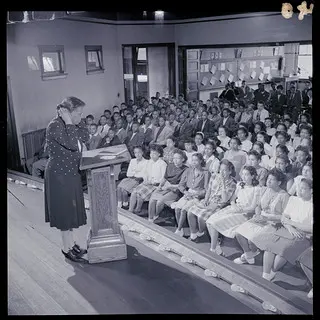
photo by: Griffith J. Davis/Duke University Libraries CC BY-NC-SA 4.0
Charlotte Hawkins Brown addressing the student body at a chapel service c. 1947. Daily personal contact with each student was fundamental to her education formula.
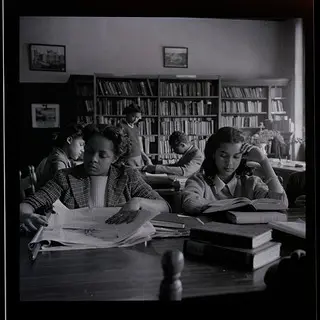
photo by: Griffith J. Davis/Duke University Libraries CC BY-NC-SA 4.0
Students studying in the library at Palmer Memorial Institute c. 1947.
When Brown started the Palmer Memorial Institute students were required to give time back to the school with activities such as operating the school farm, building needed structures (the bricks on the property were all made by students), or managing the school’s cafeteria and bookstore. The institute also had a positive influence on the Sedalia community, often caring for families in the area as the bureau of community welfare.
This sense of community and Brown’s example of leadership, both at school and in Sedalia, became the guiding principles that inspired PMI’s future. At the initial site visit in 2022, CHBM made that community focus central to the project. While they had a lot of ideas about what they wanted to do, nothing was concrete. This new collaboration with RAMSA and the National Trust gave CHBM the spark they needed to start making their vision a reality.
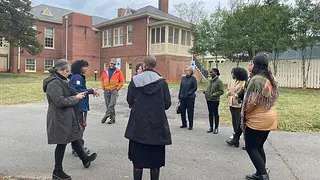
photo by: Chris Morris/National Trust for Historic Preservaton
In November 2022, a group of staff from RAMSA and the National Trust gathered for an initial site visit to the Charlotte Hawkins Brown Museum.
Former Assistant Site Manager Liz Torrez Melendez said as she “watched the RAMSA team learn and care as much as I did [about the site] and then use their skills to be able to envision this future, it was truly like magic. Every conversation left me feeling so renewed and so re-energized because it was [being in partnership with] someone who gets it and [can help us find] a path to a future.”
Buoyed by these discussions, CHBM embarked on a year-long strategic planning visioning process. In March 2023, the museum hosted a listening session with PMI alumni and Sedalia community members. Taking this time was critical, as Site Manager Tanesha Anthony said, to “decide really what we truly see for this site, what the community wants to see for this site, what the town wants to see for the site.”
Stay connected with us via email. Sign up today.
For the National Trust and RAMSA this was an unexpected yet necessary pause in the project. It was important to respect the site’s timeline, ensuring that the campus plans were informed by what CHBM and the community wanted the campus to become. The result was a vision that both honored Brown’s legacy and looked to the future.
Planning a Cultural Beacon for the Future
The final campus plan envisions CHBM, as Anthony said, as a “a cultural beacon where folks know that they can come here to get a little bit of history, a little bit of celebration, maybe be able to feed their hobbies or their interests. We see this as a broad vision of a thriving cultural center.”
The vision CHBM presented to the RAMSA and National Trust team reflects Brown’s legacy, layering it onto a campus that is, at 35-acres rather than its original 300, still very large. Because of its size, one of the biggest challenges the team faced was navigation. The twelve remaining buildings are far apart, making wayfinding difficult and travelling between sections arduous.
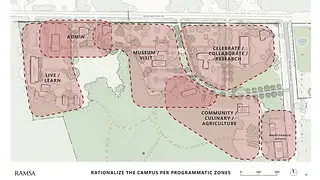
photo by: RAMSA
RAMSA's final report divides the campus into program-specific zones.
Keeping that in mind, RAMSA divided the campus into program-specific zones, each addressing the four focal points of CHBM’s new vision: economic development, education, community, and leadership.
The zones—museum/visit, administration, live/learn, celebrate/collaborate/research, community/culinary/agriculture, and maintenance/service—emphasize the site’s identity and legacy through landscaping, wayfinding, and placemaking. This approach allows CHBM to address long-time challenges, including visitor orientation, accessibility, and overcrowding of outdoor spaces during existing events
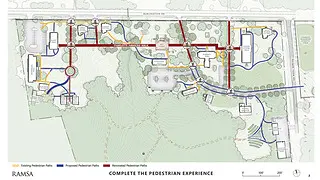
photo by: RAMSA
As part of the larger campus plan's goal for increased wayfinding and pedestrian safety, these proposed paths and central spine complete the pedestrian experience through the site.
Moving the visitor’s center to a building at the physical center of the campus makes it the starting point for all visitors’ experiences. Positioned along a central pedestrian spine that connects (through additional signage) each part of the campus, this simple but inspired adjustment now makes each building an activity zone easily accessible within a 2-minute walk of the visitor’s center.
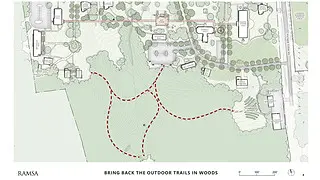
photo by: RAMSA
In this detail view of the campus plan the recreated trails in the campus' woods is marked by a dotted line. Brown encouraged students to take walks in nature for their mental health. In the bottom right, the plan shows the location of a new community garden, which was included following listening sessions with community groups in the lead up to the planning process. It recalls the original farming operations on the historic campus.
The plan also takes care to meet community needs while acknowledging historic precedent. In response to desires articulated through CHBM’s listening sessions, it enables new uses, including summer camps, living spaces for artists in residence, maker spaces, and facilities for community events. There is even a plan for a community garden, a reflection of the farm that was a part of the original campus, along with a series of outdoor trails in the woods—where Brown encouraged students to take walks for their mental health.
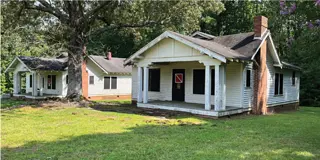
photo by: RAMSA
Constructed in 1930, the Gregg and Brightside cottages were used to house faculty members and their families. Both buildings are in poor condition, and RAMSA assumed that the building would require a full renovation.
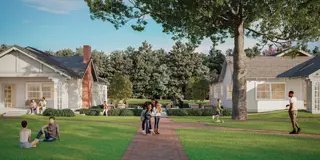
photo by: RAMSA
A rendering of the Gregg and Brightside Cottages as part of RAMSA's final report. In the new campus plan these buildings would be fully restored and can be used as artist-or-scholar in residence housing with a shared garden.
For Anthony the final proposal provides a clear path where “historically the school grew up with the town, the town grew up with the school, and so we would like to bring it all full circle and make sure that we are continuing to grow with the town, and that the town grows alongside us.”
Forward Momentum
From the beginning, it was important to the team that the final proposal needed to be, as RAMSA Project Manager Cheryl Xu said, actionable, implementable, and flexible. In dividing the plan into discrete sections and taking a 360-degree view of the campus, CHBM can phase the campus’ rehabilitation as support and funding becomes available. Moreover, because of that phased approach, the proposal also needed to be more than a standard campus plan, and so RAMSA included a high-quality video and a formal brochure that lays out the vision of the site. Both pieces make the proposal accessible and appeal to potential partners, funders, legislators, and others CHBM would like to support the implementation phase of the project.
While Morris, DelVecchio, Xu, and the rest of the project team know that implementation might take a long time, they believe the plan along with the outreach material will be instrumental in making the vision for PMI a reality.
Charlotte Hawkins Brown Museum: A Vision for the Future
To reinforce this work, in 2024 the National Trust’s African American Cultural Heritage Action Fund awarded CHBM $75,000 to hire a financial sustainability advisor to support long-term planning, preservation, and education work around setting up an endowment. This will give CHBM some financial and decision-making independence from the state and indirectly has led to the establishment of a friends group in the next year, creating further opportunities for the realization of the campus plan.
The next steps involve getting this project and plan in front of the right people, including leadership, fundraisers, and legislative liaisons. Matthew Berry, CHBM’s maintenance technician, said “The RAMSA [plan] is the first step in building CHB back into the beautiful school it once was. This site was once the center of African American culture and learning for Sedalia. It now has the chance to be that for the whole state. That is a chance worth taking.”
While CHBM’s and PMI’s preservation story is far from over, what has been accomplished shows how perseverance, partnership, and community buy-in (all with a clear sense of intention) can change the fate of a historic site, one step at a time.
Save Historic Places That Tell Our Full American Story
When you join the National Trust, you help save historic and culturally significant places nationwide.