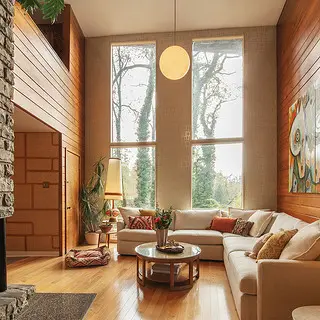
Autumn and Ryan Hadbavny Bring Their Pittsburgh-Area House Back to 1962
From our interview with homeowners Autumn and Ryan Hadbavny.
Ryan: We lived in the East End of Pittsburgh for about 10 years. We owned a small 1955 Cape Cod in a great, walkable neighborhood not far from here.
Autumn: We did a lot of restoration work on it and enjoyed the process.
Ryan: But the goal was always to find a Midcentury Modern home.
Autumn: Yes, eventually! Not necessarily so soon. But we were driving around looking at Christmas lights one year, and we accidentally stumbled upon this neighborhood. We turned a corner and all of a sudden it felt like we were sucked into a wormhole and transported to the 1960s. We couldn’t believe we hadn’t known about this area in Churchill, just outside city limits. Some locals call the neighborhood Marbury, which is the name of the main road. The houses were all built between about 1955 and 1972.
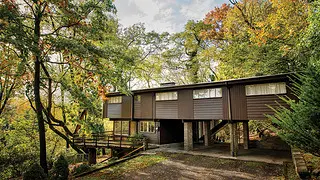
photo by: Rob Larson
The house's exterior. In 2025 it was featured on the Churchill Midcentury Modern Home Tour, organized in part by the Pittsburgh Modern Committee of Preservation Pittsburgh.
Ryan: We started watching the neighborhood. Occasionally houses would go up for sale and we would tour them, even though we knew we couldn’t afford them.
Autumn: I set up a Google Alert. Then in January 2022, I got an alert about this house going on the market. We were in the middle of a giant blizzard, but I dragged a real estate agent out to see it. I knew someone would snatch it up immediately. We could see from the listing photos that it wasn’t in good shape. But then we went inside. No one was living in it. There was extreme water damage. Parts of the ceiling were collapsing. It was bad. But we saw what was underneath.
We made a reasonable offer based on its condition. We told [the sellers] we were going to take the house right back to 1962. They had another, all-cash offer from someone who was probably intending to flip it. But they took our offer. We were entrusted to be the custodians of the house, and we’ve been trying to live up to that mission ever since.
We are the second owners. It was built for a couple and their three children. They did a lot of entertaining and were really into design. The house was totally covered in wallpaper, on the walls and all the ceilings. Every room had a theme, and it was all very mix-and-match.
Ryan: A lot of the house was in its original condition. But there was a point when it became too much for the previous owners, and they stopped making appropriate repairs. A lot of original bathroom tile was lost.
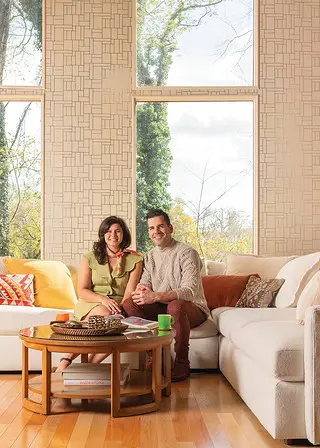
photo by: Rob Larson
Autumn and Ryan Hadbavny
Autumn: But we’ve been piecing it all back together, figuring out how to either put it back the way it was, or find a configuration that honors what was there before. We’ve done a lot of the work ourselves, like tearing out the old brown shag carpeting and removing some of the water-damaged areas. The previous owners had put UV-blocking film on the 12-foot windows in the main room, and we removed it by hand, on ladders, with razors, inch by inch. It took forever, but we didn’t want to damage the original windows.
And it was fun peeling back old wallpaper and finding other layers underneath. We could see areas where [the previous owners] were deciding on paint colors.
We have a lot of renovation experience from our previous house, and if there’s something where we don’t know what to do, we have family and friends who are contractors and subcontractors and who know people who can help. And we know our limits! We know when to call a professional, like with the mold remediation and replacing the HVAC system. But we’re also paranoid. We know you can’t have just anyone come in and do work. It’s too special, and with restoration projects, you hit a point where you can’t get stuff back. And with all the water damage, we had lost enough [of the original materials] already. We don’t want to lose any more. So we’re protective, and we’re trying to be as careful as we can.
Stay connected with us via email. Sign up today.
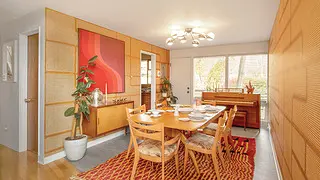
photo by: Rob Larson
Period-appropriate furnishings fill the dining room.
Ryan: A lot of work we’ve done, or need to do, on the interior and exterior requires scaffolding. We’ve got 15½-foot ceilings in the great room, which equates to almost 30-foot-tall exterior walls, all on a very uneven hillside. Accessing repairs on the exterior can be extremely challenging and requires a lot of courage. There was a lot of damage to the siding, a lot of cracks and water seepage and holes from woodpeckers. We’re trying to preserve the integrity of the original wood.
Autumn: I think the only moment I wanted to quit was when we had to take the ceiling down in the great room. There was a hole, and as we removed parts of the plaster to make repairs, the plaster kept crumbling, and eventually the whole thing had to come down. The first two people we called to rebuild it said they wouldn’t take the job because of the ceiling’s height. It was really scary having people say, “We’d love to help you, but your ceiling is too high.” I was terrified. We were like, “Did we get ourselves into a pickle?”
But eventually we found someone. And that became part of a bigger, really hard decision. We consider ourselves purists. But we decided to use drywall when we replaced the ceiling, instead of re-plastering. We talked with other historic homeowners, and everyone told us, “Look, with a flat-roof home, it’s not a matter of if but when you have leaks, and when you have a leak, it’s so much easier to deal with drywall than plaster.” We had to make a choice. And that’s what we did.
Ryan: There’s still so much to do. The house is livable—no holes in the walls or anything like that. But we’re probably five years away from touching everything we’ve wanted to address.
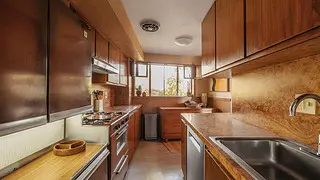
photo by: Rob Larson
The vintage GE Americana refrigerator, shown at far left in photo, is divided into two portions with a built-in countertop between.
Autumn: And things always take longer. Our goal was to have the outside of the house painted last year, but it rained all summer. We only got halfway done.
It is a lot of work, but it’s also been so fun. Sourcing original appliances for this house has been a dream. Just a mile down the road, I found a GE Americana refrigerator with the built-in countertop. All it needed was a new set of gaskets, which I custom ordered and installed myself, and it’s been working perfectly ever since. It’s been really rewarding to find and use the appliances they would have had here in the ’60s. And not just appliances—also furniture, art, vintage Christmas trees, everything.
Ryan: We really love it here. Sitting in the great room, with the big windows, and the floor-to-ceiling Belgian block fireplace, and the tongue-and-groove redwood walls, and the wallpaper, the art, the plants, the lamps—it all comes together and transports you back in time.
Autumn: We love having people over, too. We’ve gotten so close with our neighbors. Everyone is so generous and helpful in this community. We share [recommendations for subcontractors, such as] the name of the good plumber. And if someone needs a tool or a random piece of hardware, someone has it in their garage. We’re all curious about each other’s houses and seeing everyone’s interpretations of living in a midcentury house. There’s a lot of support. But of course, whenever we gather at each other’s houses, everyone always ends up in the kitchen. And in these midcentury houses, the kitchens are tiny! But that’s when it feels most like home. And being in this house feels like being home.
Save Historic Places That Tell Our Full American Story
When you join the National Trust, you help save historic and culturally significant places nationwide.