The Eldorado Ballroom, Long a Symbol of Resilience in Houston’s Third Ward, Glows Again
To reach the second floor of the Eldorado Ballroom, a cultural institution in Houston’s Third Ward, visitors climb a notoriously steep wooden stair. Sections of the hulking staircase’s original pine have been worn smooth after 87 years, losing some of their natural grain to the touch of countless visitors to the dance hall and social venue.
Musical greats like Ella Fitzgerald and Duke Ellington once climbed those stairs to perform in the space, alongside generations of Third Ward residents who were barred during the Jim Crow era from gathering in many other places. Today, the ascent doubles as an entry into the Eldorado’s history—and its future. The ballroom has been restored to its midcentury glory, reaffirming its role as a touchstone in a neighborhood that has endured decades of neglect and now faces mounting development pressure.
“The fact that people from the community could walk those same steps, I think, is symbolic of the greatness that comes through Third Ward and why it was so important to keep those stairs there,” says Danielle Burns Wilson, executive director of the nonprofit Project Row Houses, which owns the building and led the rehabilitation.
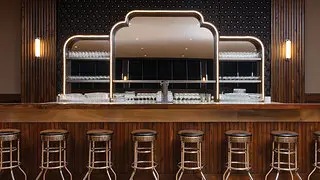
photo by: Shannon O’Hara
The new upstairs bar’s curved lines reflect the building’s Streamline Moderne style.
Created as one of Houston’s first numbered subdivisions after the city’s founding in 1836, Third Ward became a stronghold of Black community- and institution-building, forged by residents who made spaces for civic life in the face of exclusion and discrimination.
Among the lasting symbols of that work is Trinity United Methodist Church. Founded by formerly enslaved people in 1865, it played a role in establishing historically Black colleges and universities like Texas Southern University, less than a mile away. Emancipation Park, one of the oldest public parks in the state, was established in 1872, when a group of formerly enslaved people purchased the 10-acre tract.
Just southeast of downtown, Third Ward would become home to one of the largest concentrations of Black residents in Houston by the 1930s. And by the end of that decade, across the street from Emancipation Park, would rise the Eldorado Ballroom.
Commissioned by black entrepreneurs and philanthropists Anna Johnson Dupree and Clarence Dupree, the Eldorado opened in 1939 and quickly established itself as a centerpiece of the Black music scene in a deeply segregated city. Anna was a successful beautician, while Clarence worked in hospitality. The couple built up their savings and began investing in real estate and other projects that primarily served the Black community, including the nearby Pastime Theater. They used their business fortunes to fund institutions that provided social services, such as an orphanage for Black children, housing for elderly residents, and other charitable endeavors.
Locals and visitors flocked to “the ’Rado,” as some regulars were known to call it, for a showcase of popular music of the day. It became a dignified destination for some of the best jazz and rhythm-and-blues music to be found in the South, hosting legends like Fitzgerald and Ellington but also Ray Charles, Etta James, B.B. King, and James Brown. Lined with pine, the ballroom is the backdrop for thousands of memories made by Black Houstonians, often captured in photos dressed in their finest clothes, socializing in a venue built just for them.
The Eldorado was also architecturally significant. The sleek, two-story building, designed by architect Lenard Gabert in the Streamline Moderne style, had a rounded corner, so that the second floor seemed like it was floating above the Black-owned businesses that occupied the first floor. Its oversize windows were often kept open, letting music flow over the storefronts and out onto the street.
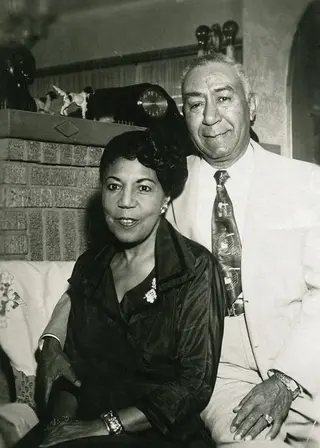
photo by: Houston Public Library
Anna Johnson Dupree and Clarence Dupree in 1949.
Part of a segregated yet bustling commercial district, the Eldorado was a community hub beyond entertainment, hosting social club gatherings, charity events, sock hops, and talent shows. Its stage served as a launching pad for up-and-coming singers and musicians, including renowned jazz and blues singer Jewel Brown, a Third Ward native who began performing as a child in talent shows at the Eldorado and other Houston venues. She became a fixture of the area’s jazz scene and toured the world as part of Louis Armstrong’s band.
“The Eldorado was the club of Houston. They had all the big bands, and they had Nat King Cole. Everybody was coming. Everybody who was somebody [performed at the] Eldorado,” Brown said in an oral history collected by the Houston Landing. “I didn’t even at the time fall into the class of those people. But they loved me.”
The Eldorado Ballroom thrived for three decades, but ultimately it could not keep up with the forces of change. Musical tastes moved past its mainstays. Locals moved up the economic ladder and purchased cars, but the Eldorado lacked sufficient parking. Smaller venues declined in popularity. And once Black residents were no longer confined to neighborhoods like Third Ward—long a target of disinvestment under segregation—they began to leave the inner city. The venue shut its doors in the 1970s.
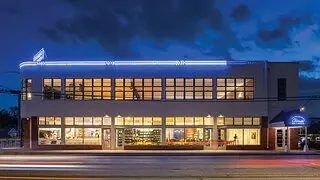
photo by: Shannon O’Hara
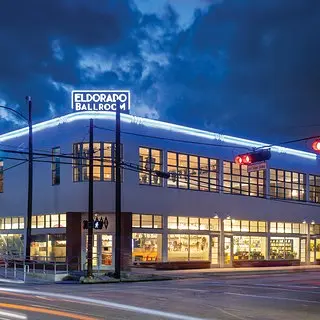
The rooftop sign and neon stripes are historically accurate.
The ballroom entered its next chapter in 1999 when oilman Hubert S. Finkelstein, who had acquired it in 1984, donated it to Project Row Houses, a community-based nonprofit founded by Black artists hoping to preserve the cultural heritage of Third Ward. Although it continued to house retail tenants on the first floor, the building’s condition had deteriorated. A series of starts and stops to improve it crystallized in 2021, when Project Row Houses launched a $9.7 million capital campaign for a full rehabilitation.
“We really learned a story about the ballroom,” David Bucek of Stern and Bucek Architects says of his firm’s initial assessment of the Eldorado. “It’s a story about fire.”
The building was one of Third Ward’s most prestigious structures when it was built, but the team found many of its original features had been obscured during repairs following a fire in 1941 and a second fire in the early 1950s. While there were plenty of historic interior photos, they could only find one exterior photograph taken before the second fire. It dated to 1948, so Bucek and associate Delaney Harris-Finch set out to return the building to that time period.
The rehabilitation meant replacing the non-historic main windows with historically accurate ones—a project funded in part by a $100,000 grant from the National Trust’s African American Cultural Heritage Action Fund. The work also included removing the building’s drywall, a post-fire relic that had encapsulated the original wood and other detailing, including in the entry staircase. Downstairs, the team discovered reeded wooden pilasters that captured the Art Deco sensibility of the time. The renovation crew patched damaged wood paneling, restored the exterior second-floor stucco, and stripped paint off the first-floor brick to expose the original red brick underneath. Bucek and Harris-Finch worked with renowned paint and decorative finish conservator Jhonny Langer to determine original finishes and paint colors, which went back up on both the interior and exterior walls.
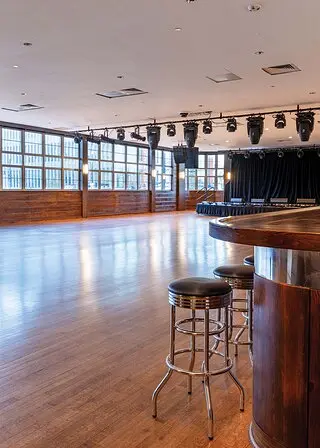
photo by: Shannon O’Hara
Project Row Houses earned state historic tax credits for the ballroom’s rehabilitation.
Before the restoration, the second-floor space was still used on occasion for events like anniversary celebrations, for which older attendees—often grandparents who had danced there in their youth or held their bridal showers at the Eldorado—sometimes had to be carried up the steep staircase. A new rear addition allowed the venue to add an outdoor deck, ADA-compliant bathrooms and, perhaps most important, an elevator.
“The Eldorado Ballroom feels like an epicenter for Third Ward.”
Danielle Burns Wilson
The project also revealed quiet traces of the ballroom’s past that had never fully disappeared. While much of the pine floor upstairs had been replaced after the fires, the outline of the original stage remained. The stage itself had burned but had protected the wood floor underneath, which was left intact during the renovation.
“It’s my understanding, or others have imparted to me, when you can tell a story about history within the same walls [where] the history happened, it’s much more powerful,” Bucek says. “Since so much of the original fabric survived or could be reconstructed from the [historical] analysis, you feel the sense of history when you’re there. That’s the ongoing story, and that’s the treasure.”
Throughout construction, locals stopped by and told crew members about how their parents had met at the ’Rado; others revisited memories of dances long past. The recollections carried by longtime Third Ward residents also proved crucial to shaping the Eldorado’s story today. The photograph of the building’s original rooftop sign existed only in black and white, so it wasn’t clear what color it had been. Andrea Greer, senior advisor for strategy and research at Project Row Houses, hoped to find the answer by talking with attendees at a Juneteenth celebration held in the Eldorado’s parking lot. She lucked out when one woman recalled the sign’s deep blue hue without hesitation.
Today, blue stripes light up in neon to trace the top of the National Register–listed building at night, and a replica sign glows overhead.
The Eldorado’s rehabilitation falls within a broader model of preservation in Third Ward: Organizations such as Project Row Houses hold historic spaces in trust for the community and return them to active use, rather than treating them as museums.
“It fits in this larger narrative of Project Row Houses as really pioneers of creative placekeeping as distinct from placemaking, because there was [already] a place there,” Greer says. “Third Ward was already well established, and so to be able to hold onto one more piece of it has been important, I think, for a lot of people.”
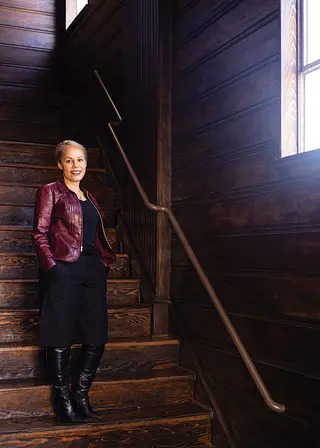
photo by: Shannon O’Hara
Danielle Burns Wilson, executive director of Project Row Houses, stands in the restored stairwell.
Among the businesses on the first floor is Kindred Stories, a bookstore and community space where titles by Black authors and other authors of color line the shelves. Kindred Stories first opened in a smaller shotgun house before moving around the corner into the ballroom building. Readers are greeted by an eye-catching wallpaper of florals—inspired by the type you might see in your grandmother’s house—overlaid with portraits of Black authors and cultural figures. The wallpaper was custom designed by Houston-based artist Tay Butler.
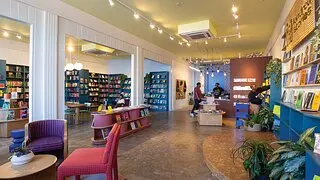
photo by: Shannon O’Hara
Kindred Stories, the bookstore on the Eldorado’s ground floor, hosts book clubs, readings, and other community events.
The Eldorado’s revitalization comes as Third Ward increasingly faces the pressures of gentrification and displacement, with developers seeking to capitalize on its proximity to downtown. Various townhouse projects already surround the blocks near the ballroom. Other historically Black neighborhoods like Fifth Ward and Freedmen’s Town have changed more quickly, but the pace of development in Third Ward has been slower, because many of the historic properties are owned by churches and nonprofits or comprise schools and municipal buildings. This has bought groups like Project Row Houses valuable time to preserve not only vital institutions like the Eldorado but also the historic shotgun homes from which the organization takes its name. A few blocks over from the ballroom, some of these houses serve as artist’s studios and others as art display spaces that are open to the public.
“[The ballroom project] all started through a conversation of putting an elevator in, and from there people really saying this space means a lot more and needs a lot more and it can add value to the community,” says Danielle Burns Wilson, the Project Row Houses executive director. “The Eldorado Ballroom feels like an epicenter for Third Ward.”
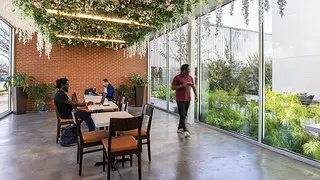
photo by: Shannon O’Hara
Rado customers often gather in the Garden Room, part of an addition to the rear of the building.
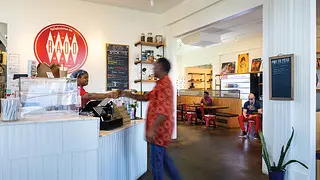
photo by: Shannon O’Hara
The Rado Cafe & Market takes its name from a longtime local nickname for the Eldorado.
When the Eldorado Ballroom reopened in the spring of 2023, Jewel Brown returned to its stage to usher in the venue’s new era. The singer presided over a temporary black-and-white dance floor in a dark blue brimmed hat, reprising her 1960s classic “Jerry,” which she had based on an earlier Harry Belafonte song and performed with Armstrong. (Brown died just a year later.)
Since then, the Eldorado has offered similar homecomings for other Houstonians.
The ballroom served as the namesake for a live, multi-disciplinary performance series created and curated by musician and Houston native Solange Knowles to honor contemporary and historic Black music. The “Eldorado Ballroom” series debuted in New York in 2023, with each run featuring various Black artists and musical styles, including classical, gospel, and zydeco. It came to Houston last year for a six-night run with shows at Jones Hall; the Museum of Fine Arts, Houston; and the Eldorado itself.
“You feel the sense of history when you’re there. That’s the ongoing story, and that’s the treasure.”
David Bucek
After a stint as a talent buyer for a popular New York City jazz club operator, another Houston native, Shelly Travis, found her way back to the city to serve as the Eldorado’s venue and programming manager. She remembers attending church services at the ballroom when she was younger and took music lessons nearby with the renowned conductor and educator Anne Lundy, who now hosts weekly violin classes at the building.
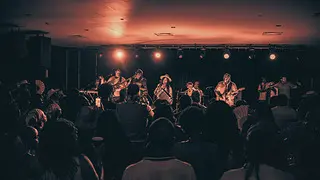
photo by: Sara Buchsbaum
Zydeco artist Rosie Ledet performed at the ballroom in June 2025 as part of Saint Heron’s Eldorado Ballroom series.
Since reopening, the Eldorado has focused on remaining an affordable venue for locals while building community through offerings such as the music lessons, a twice-monthly children’s literacy program, vendor markets, and a Thanksgiving meal for Third Ward residents. It has hosted events like 80th birthday celebrations and anniversary parties for residents who first came to the ballroom as teenagers for sock hop nights.
“I hear a lot of those stories and it just reminds me how much history is in this space and what these walls have heard and seen,” Travis says.
Now, the Eldorado Ballroom is looking to expand its programming with a new performance series kicking off this spring, as well as workshops and wellness events that will allow it to remain a cultural hub for residents of Third Ward. The space will also figure into Project Row Houses’ archives project, which will include oral histories from local residents.
“I hope they take with them a sense of safety and community when they walk into the building, knowing that this is a place where they can connect with folks,” whether it’s for work, book club, or a concert, Travis says. “I want people to know that this is their space.”
Save Historic Places That Tell Our Full American Story
When you join the National Trust, you help save historic and culturally significant places nationwide.