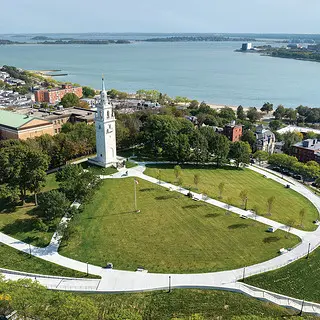
Monumental Makeover: Boston's Dorchester Heights Monument Gets a Much-Needed Refresh
Among the most notable Revolutionary War milestones was March 17, 1776, also known as Evacuation Day. After George Washington’s forces secretly fortified Dorchester Heights, a hilltop in what is now South Boston, the British Army retreated from the city, marking the end to the Siege of Boston. (See Preservation's feature story about historic places associated with George Washington for more information.) The 115-foot-tall Dorchester Heights Monument designed by Peabody & Stearns commemorates these events. Today, the 1902 monument is maintained by the National Park Service (NPS) as part of Boston National Historical Park.
As the marble-clad structure weathered decades of harsh Boston winters, it deteriorated. Ahead of the semiquincentennial, NPS hired architecture firm SmithGroup to assess the monument’s challenges and design its restoration. The refurbished Dorchester Heights Monument was dedicated, fittingly, on March 17, 2026. We talked with SmithGroup Vice President and Director of Historic Preservation Jim Shepherd about this undertaking, part of a $34 million project that included hardscape work by a separate firm and was funded through the Great American Outdoors Act.
What caused the structure to deteriorate?
Jim Shepherd: When you’re designing a monument in a harsh marine climate, marble is not the best choice. ... The monument does sit on one of the highest spots in downtown Boston.
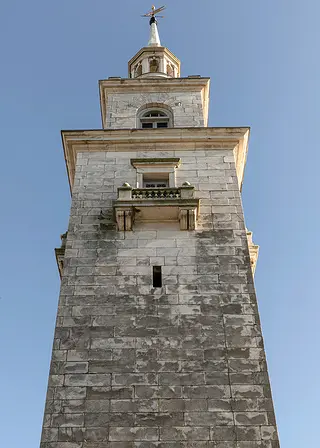
photo by: Colin Winterbottom
Before the restoration, much of the Dorchester Heights Monument's marble cladding was discolored.
That means that it witnesses a whole lot of weather—winds, rain, snow—and of course, the continued freeze-thaw cycle.
Marble has a beautiful, monumental quality. I’m sure when the monument was finished, everyone was very pleased with how it looked. ... Shortly thereafter, there was ongoing deterioration, so much so that I would say every 20 years there was some kind of restoration campaign to arrest deterioration and to correct structural deficiencies.
The solution [in these cases] was to seal the monument up so that the moisture that was getting trapped within would no longer get in. ... The problem with that is, then the moisture didn’t get out. [This] accelerated a lot of the damage to the steel and to the interior masonry.
How did your team approach this project?
Shepherd: The building was designed to be open to the elements. As the monument rises, there were a series of openings along the elevation ... and there was a natural chimney effect of air being able to rise up and out.
[We used] building forensics modeling tools to confirm that if we were to take out the enclosures that filled in all the openings and allow this to function as it had previously done, it would work.
Engineering firm TYLin was a major contributor to the decision about how we chose to implement the repairs. Because of the condition of the steel, we chose to go the path of disassembling the top third of [the tower]. Building Conservation Associates helped us with strategies for how to clean [and repair] the marble and how to define the best mortar to use for the repointing of the marble and interior brick.
Allegrone, the contractor, had done a digital scan to map out all of the stones and label [them]. As they started to get the stones down on the ground, the historic numbering systems for the stones [from] when the monument was constructed were exposed.
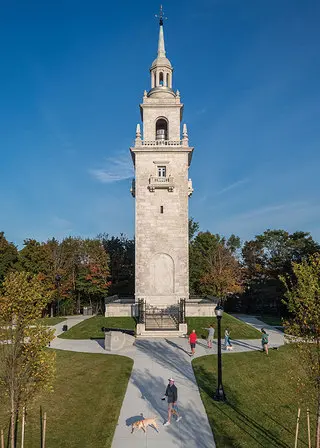
photo by: Colin Winterbottom
The monument after its comprehensive restoration.
A fair amount of the stone needed to be repaired, so it was repaired down on the ground in the field. ... We did have a few replacement stones for elements that had just deteriorated too much.
The synchronization and orchestration of the masons and the crane operator was amazing to watch. And then they had to reverse all that when they put it all back together.
What is the visitor experience like?
Shepherd: In the [surrounding] park, there are ... educational plaques that help to describe what happened on that site. Directly adjacent to the monument there is a cannon that points towards Boston Harbor; that gives the visitor a directional understanding of where Washington was and how the cannons were located and appointed.
That’s why I think sites like this are so important, because it gives you context [about] what challenges he had to overcome to achieve that victory. And it just helps you root yourself in what it must have looked like then and where we are now and how important that site was in the founding of our country.
Save Historic Places That Tell Our Full American Story
When you join the National Trust, you help save historic and culturally significant places nationwide.
.webp)