Saving America’s First Black Incorporated Town
Brooklyn, Illinois isn’t famous. It’s a little-known small town east of the Mississippi River, spanning a modest 518 acres and bordering St. Louis, Missouri. As of 2025, the town’s population stood at around 650, and about a third of that population meets the federal definition for poverty.
But Brooklyn, Illinois is also the first incorporated Black town in America. It was an early stop on the Underground Railroad, a burgeoning community for free and enslaved Black Americans, and home to the first Quinn Chapel African Methodist Episcopal (A.M.E.) Church in the Midwest. In later years, it became a hub for nightlife and Black entertainers, with its Harlem Club receiving an entry in the 1959 Negro Motorist Green Book, a list of safe establishments for Black travelers during segregation.
.webp)
photo by: Board of Trustees of the University of Illinois
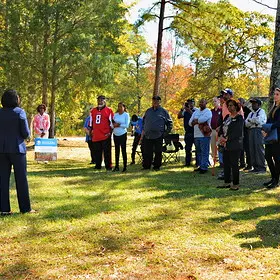
An Action Fund grant is supporting community interpretation and programming using archaeology to share Historic Brooklyn's story.
“It’s the only pre-Civil War town founded by Black [people] that’s still in existence,” said Roberta Rogers, president of the Historical Society of Brooklyn, Illinois Incorporated (HSBOI).
Brooklyn began as a refuge for eleven families, shepherded by the abolitionist “Mother” Priscilla Baltimore, who were escaping slavery in 1829. From there, the community grew into a small coterie of craftspeople, laborers, merchants, artisans, farmers and their families, formally incorporating the locale in 1873.
This historical significance is why the town, through the University of Illinois’s Board of Trustees, received funding from the African American Cultural Heritage Action Fund’s National Grant Program in 2025 in support of a twofold mission: to preserve the town and revitalize it. HSBOI had worked on these efforts for years, pursuing projects to mark the town’s historical resonance and generate a stronger economy in one fell swoop.
Stay connected with us via email. Sign up today.
“What Brooklyn needs now is funding for projects that will bring it back from the brink of extinction,” Rogers explained.
These efforts gained momentum in 2008 when Rogers encountered experts at the Illinois State Archaeological Survey (ISAS) as they were doing work nearby.
“It actually was, like, a chance meeting,” Elizabeth Lorraine Watts, associate research archaeologist and collaborative research liaison at ISAS, said. “We were doing compliance excavations at a pre-contact indigenous site that is on the eastern outskirts of Brooklyn.” When Rogers learned of the work they were doing, she asked, “Have you heard about the history of Brooklyn? I think we could use your help.”
Forging a Future
Later, ISAS conducted an archaeological field study finding artifacts to support a nomination for designation under the National Register of Historic Places. “All we had to go on was oral history,” Rogers explained. “Hopefully when we get the national designation, they’ll finally recognize Brooklyn for the archaeological significance and history that we have.”
From there onward, a sprawling coalition of archaeologists, urban planners, historians, and activists embarked on the goal to put Brooklyn on the map—literally.
“Brooklyn has been ghosted off of several historic maps,” Rogers said. “It’s not listed on any of the Road to Freedom maps. We were ghosted off Route 66.”
In collaboration with HSBOI, the Illinois State Museum and the University of Illinois’s Anthropology and African American Studies departments, ISAS launched an interdisciplinary research project formally documenting the town’s history that had long existed only in the realm of oral history.
“We’ve worked on and off and a little bit sporadically on doing some background research,” Alleen Betzenhauser, director of ISAS, explained, “looking at the historic documentation, maps and other records of the town, and then conducting some archaeological survey and excavation.”
African American Cultural Heritage Action Fund: A Search for Ancestors in Midland, Georgia
At Pierce Chapel African Cemetery descendants search for ancestors, constructing retroactive family trees to trace lineages that weren’t carefully written down.
So far the archaeologists have managed to find concrete evidence backing up the town’s mythos. “The cool things that we’re finding at Brooklyn are small but mighty,” Watts said, “small pieces of plates and bowls and cups that we can definitively date to the late-1820s or 1830s.”
The HSBOI is also working with Southern Illinois University in Edwardsville to develop green spaces to display the town’s history.
“Everything we’re doing on the preservation side is really to support these long-term goals that Brooklyn has for getting themselves more known in the world,” said Erin Benson, coordinator of the American Bottom Field Station at ISAS. These goals include getting the town nationally recognized as a historic site, carving out a cultural heritage tourism in order to bring in new sources of revenue, and reinvigorating the local education system.
Save Historic Places That Tell Our Full American Story
When you join the National Trust, you help save historic and culturally significant places nationwide.