This Connecticut Couple Converted an Old General Store Into Their Open-Plan House
From our interview with homeowners Allen Olsen and Sally Zimmerman.
Allen Olsen: Sally has been in historic preservation for as long as we’ve known each other, so 40-plus years.
Sally Zimmerman: I worked for the Massachusetts Historical Commission, and then I worked for 20 years for the Cambridge Historical Commission, running some of their historic districts.
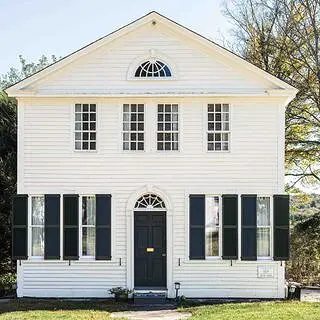
Allen: Over the years we had often talked about getting a carriage house, a barn, or some other old building and turning it into a house, and how cool it would be to preserve the structure. Fast forward to 2013—Sally was looking on Zillow one day, and there it was: an abandoned general store, in a town we’d never heard of in northeast Connecticut.
Sally: We were sure it was going to be surrounded by junkyards and used car lots or something like that.
Allen: But the town itself was amazing. House after house, beautiful historic structures from the 1820s, 1830s, 1840s, all on one street, which was the historic district. And this store was in the center of it.
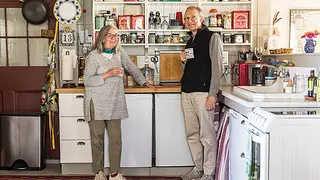
photo by: Julie Bidwell
Sally Zimmerman and Allen Olsen in their kitchen.
Sally: It was built in the late 1820s as a general store, and it was also the town post office from 1828 to 1950. By the early 20th century, though, buildings like this were becoming a thing of the past. There’s a picture of it in a newspaper article [from] 1974, and it looks like it’s ready to collapse. Around 1980, a neighbor purchased the building and did some remedial repairs. Otherwise, there’s no question it would have collapsed.
When we found it, it didn’t have heat, power, or plumbing. There were holes in the floors and the walls. It was a mess. But it hadn’t been spoiled with inappropriate updates, and it was a small enough building—and I knew enough people in preservation—that we knew we could handle it.
In 2015 we put in basic electrical service and replaced the roof. Then we took a weekend-long window rehab workshop up in New Hampshire and started doing window repair, because that was one thing we knew we could do ourselves.
Stay connected with us via email. Sign up today.
Allen: The windows had to be taken apart, stripped, re-glazed, and painted—the wood had to be painted several times, because it was really dry—and then we would do our best to get the panes back in without breaking them.
Sally: In 2017 we got connected with a preservation carpenter named Tim Wohlhueter, and he started working on the most egregious parts of the building.
Allen: It’s a timber-frame building, and there was a junction at the top of the first floor where both beams had rotted out.
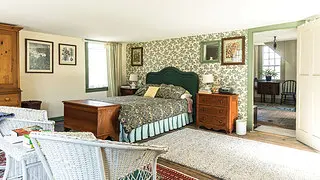
photo by: Julie Bidwell
The bedroom gets light from three sides.
Sally: So we reframed them, splicing in new sections of timber where needed. We rebuilt some of the dry-laid stone foundations and installed a perimeter drain around the basement floor. There had been a porch on the front, but we aren’t sure if it was original to the building so we didn’t rebuild it.
We hired an ornamental plasterer that I knew of, and in a week he had repaired the plaster in the whole building. We used Structo-Lite, which is a base-coat plaster that looks like the original lime plaster.
The only thing we took away and didn’t put back was the plaster ceiling on the first floor, partly because the joist bays above it were full of mouse droppings and mouse fur. So we had to take the plaster down, but we left it off because it told a really fascinating story: Along with the mummified mice, we found all these tacks and little strips of leather that had gotten stuck between the floorboards. It turns out that the original building had had two shoe shops on the second floor—there was a wall that ran down the center—each with its own separate internal entrance and staircase.
It’s a phenomenally interesting building, and the community is also phenomenally interesting. The store itself was a small enough project for us to manage without spending all of our retirement savings, and the town was small enough for us to research it. By now, Allen has transcribed a pretty complete deed history for every house in the historic district.
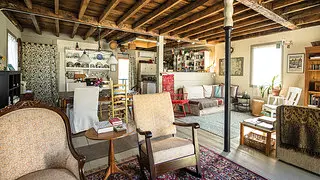
photo by: Julie Bidwell
An added partial wall separates the kitchen from the rest of the first floor.
Allen: When we got the store, we also got copies of the old ledgers that were found in the store, and we learned a lot about the social life of the town in the late 1850s and early 1860s. As I started doing deed research, it became clear that there had been a substantial boot-making industry here. There was a tanning pond for leather and a farm that grew sumac as a tanning material. There was a whole area of town devoted to this home industry.
Sally: We were committed to making only minimal changes to the building, so in general we left everything that was there in place. At the first floor we added a kitchen and converted a window to a rear exit door, and at the second floor we added the bathroom. Other than that, we repaired or maintained existing materials and features as we found them.
One of the first decisions we made was to put in a low beadboard partition at the kitchen. We didn’t want appliances to be visible when you walk into the building, so those are all below counter height. The bathroom is directly above the kitchen, also partitioned with beadboard. So in total we put in one and a half walls.
Preserving the original windows was a high priority for us, and since the old sash fit so loosely, we installed Innerglass interior storm windows. They save energy, and from the inside they disappear.
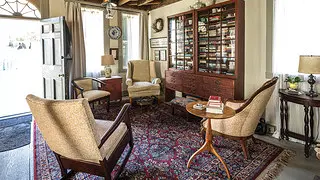
photo by: Julie Bidwell
Rugs help define the house’s main living spaces.
Allen: The ground floor had never been divided into rooms, and the upper floor [has had a big] open space for a long time. We left them that way. The bedroom upstairs has six windows, facing south, west, and north, so it’s a great place to read in the afternoon. At the first floor, we settled on basically just putting down four rugs, and those are our “rooms.” The idea was that we wanted people to see that there were places they could congregate.
Sally: It’s a great place for parties, because everybody finds a little corner, settles down there, and starts having a conversation. It’s easy to imagine one bunch of people talking at the dry-goods counter, another at the hardware counter, and some others getting flour and molasses. It’s incredibly satisfying to be in a space that so many people have been associated with, and to honor their lives and their work.
Save Historic Places That Tell Our Full American Story
When you join the National Trust, you help save historic and culturally significant places nationwide.