Documenting Durham's Historic Hayti District
HOPE Crew Digital Documentation Fellows work to preserve the history of a Black community in North Carolina.
Drive along the Durham Freeway today, and you will pass what used to be one of the busiest and most influential Black commercial districts in North Carolina and the South. The area today known as the Historic Hayti district was once a community of freedmen and women who migrated to the area drawn by new economic opportunities in Durham, North Carolina's emerging tobacco industry. By the early 20th century, this primarily Black community along Fayetteville Street grew into the southern leg of one of the “Black Wall Streets” that dotted the Midwest and Southern United States.
There is no marker to tell you any of this. And, if you blink, you’ll just miss the brick steeple of the historic St. Joseph African Methodist Episcopal (AME) Church, which sits on a hill in Durham, making it just visible from the freeway. This former church, now the Hayti Heritage Center, is just one of a few original buildings that survived the federal policy of urban renewal. Urban renewal dramatically reshaped the Historic Hayti district (and other nearby Black neighborhoods) with the construction of the Durham Freeway and the use of eminent domain to acquire and clear land deemed “blighted,” resulting in the displacement of over 4,000 families and 500 Black-owned businesses, at a cost of about $300 million.
This summer, the National Trust for Historic Preservation's HOPE (Hands-On Preservation Experience) Crew in partnership with the Hayti Promise Community Development Corporation (Hayti Promise) hosted the sixth cohort of Digital Documentation Fellows (DDF). This cohort produced projects in response to what they learned about Hayti’s history, advancing traditional forms of storytelling and interpretation.
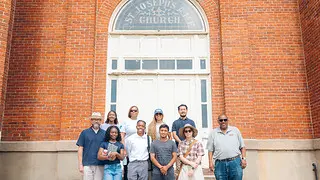
photo by: Jordan Abdur-Raoof
Digital Documentation Fellows Summer 2026 cohort and Prof. Scott Singeisen (left) and Prof. Andre Vann (right).
A Shifting Approach to Preservation
Historic preservation, as a discipline, has traditionally focused on saving, restoring, and preventing further decay of physical buildings and built fabric. Foundational preservation theorists tend to split between two camps. One believes that restoration is a creative act that gives its restorer a chance to complete a building as its original architect would have intended.
The other side of this argument believes that such restoration was just another name for vandalism, and that buildings should be allowed to decay and fall apart. Yet, the Historic Hayti district and surrounding neighborhoods along Durham’s Pettigrew and Fayetteville Streets—as is the case across hundreds of Black neighborhoods across the country such as Rondo in St. Paul, Overtown in Miami, the Fillmore in San Francisco—were systematically dismantled by federally funded highway construction and redevelopment. There is very little physical evidence of the structures that made up much of the Historic Hayti district, and this is intentional.
Stay connected with us via email. Sign up today.
In effect, traditional approaches to preservation cannot automatically be applied here. Andrea Roberts, now the associate professor and director of the Center for Cultural Landscapes at the University of Virginia, has spent years documenting rural settlements founded by people who were formerly enslaved, many with little or no built fabric left today. She argues that communities like these need "placekeeping" rather than "placemaking." These communities, like Historic Hayti, are not static landscapes but active communities. This shift is powerful because it allows us to recognize that old preservation paradigms do not always serve our current reality, that is to work in service of communities whose physical environment has been destroyed against their will.
In turn, one must ask: What do you preserve when there is little left? And, most importantly, how?
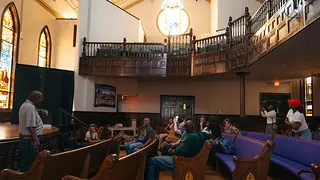
photo by: Jordan Abdur-Raoof
Andre Vann lectures about the history of St. Joseph AME church to workshop participants from Durham Tech.
Projects of the Digital Documentation Fellows
Our fellows worked to address these questions. In continuation of a partnership begun in 2025, this cohort was supported by the Hayti Promise and by North Carolina Central University educators Andre Vann, coordinator of the university archives and instructor of public history, and Scott Singeisen, associate professor of architecture. Six students with backgrounds in architecture, construction, psychology, history, and graphic design worked in groups to reinterpret and challenge traditional approaches to preservation.
Zamir Vazquez and Sydney Walker researched the impact of urban renewal on Hayti and surrounding neighborhoods along Fayetteville Street as well as community response and resilience to its destruction through the history of two buildings: the Scarborough House and the former office of Dr. Leroy Swift. The Scarborough House is the district's only surviving example of Neoclassical Revival architecture—built in part, according to local oral tradition—from materials salvaged from the deconstructed downtown Durham homes of wealthy white Durham residents like Frank Fuller and Julian Carr. The former office of Dr. Leroy Swift, the first Black board-certified OB-GYN in the Southeast, is one of the district's earliest Modernist architectural examples.
Both of these structures still stand today.
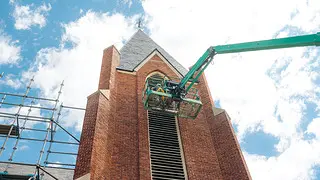
photo by: Jordan Abdur-Raoof
Taking down the louvered vents of St. Joseph AME to be restored.
Their stabilization and repair were supported by the Hayti Promise, which in 2024 received an initial seed investment of $10 million from the City of Durham in American Rescue Plan Act funds to catalyze a long-range revitalization effort dubbed the Fayetteville Street Corridor project. Working from archival research, Vazquez produced full-color architectural renderings of both structures as they looked at the height of the community's prosperity, with Walker historically contextualizing these drawings as what "might have been" had urban renewal not impacted Historic Hayti and surrounding communities.
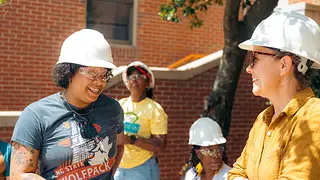
photo by: Jordan Abdur-Raoof
Durham Tech workshop participants at St. Joseph's the first day of our weeklong workshop.
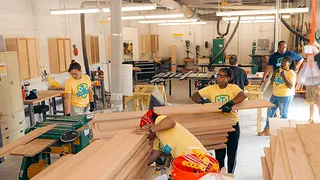
photo by: Jordan Abdur-Raoof
Durham tech workshop participants preparing materials in the woodshop.
Kevin Fiallos and Jose Coreas looked past physical architecture and toward the relationships that held the neighborhoods together, tracing the history of The Carolina Times, the Black newspaper that documented Hayti's civic life, and the historic St. Joseph AME Building, which hosted the mass meetings of the Durham Committee on the Affairs of Black People through the 1950s and 1960s. The paper's original offices burned down in a 1979 fire; the staff put out the next week's issue anyway and later rebuilt on Old Fayetteville Street (a vestige of Historic Hayti and the Pettigrew Street network lost during construction of the freeway), where the building still stands today.
Drawing on a June tour of the Fayetteville Street Corridor led by Vann, Imani Cosby and Asia Womack researched the Pearson family, prominent Hayti landowners, and turned that research into two different approaches to preservation. Cosby designed comic-style signage as a rethinking of historic marker design, betting that a generation raised on visual storytelling will stop for an eye-catching panel before it stops for a muted historic plaque.
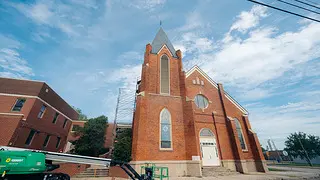
photo by: Jordan Abdur-Raoof
St. Joseph's with the repaired louvered vents.
Womack focused on the women of the Pearson family, using her research as the starting point for a podcast, Women of the Hayti. Reading the death announcement of Cynthia Anne Barbee Pearson—a Black landowner and washerwoman—Womack was struck to find her identified as "mother of" her sons for two full lines before her surviving daughter was mentioned at all, and not by name. Womack's podcast and Cosby's signage are both new forms of preservation working to hold what older ones have been unable to.
From Placemaking to Placekeeping
The Women of the Hayti: Episode 1
If preservation's purpose is, first and foremost, to keep a place and its history knowable to current and future generations, then these projects are a positive sign that preservation has shifted its focus from a focus exclusively on architecture. If we only protect what is still standing, we will always arrive too late, for example, for a woman whose name a newspaper never bothered to print.
These projects all insist and show that a community like Historic Hayti cannot simply be defined by what was taken from it. The preservation of this community and its history must include, but also move past, its physical reality. Beyond the freeway. On to what this community still has to say about itself.
Take a drive along the Durham Freeway. This time, don’t blink.
Save Historic Places That Tell Our Full American Story
When you join the National Trust, you help save historic and culturally significant places nationwide.