Building Community Through Preservation Along Durham's Fayetteville Street Corridor
In the run-up to Veterans Day 2025, a group of residents and local volunteers gathered at Beechwood Cemetery along Durham's Fayetteville Street Corridor for a day of history sharing, cemetery preservation, and service. It marked the launch of a service-learning partnership between Hayti Promise Community Development Corporation and the National Trust for Historic Preservation's HOPE (Hands-On Preservation Experience) Crew.
_HOPE%20Preservation%20Durham-015.webp)
photo by: Jordan Abdur-Ra’oof (ShotbyJBot)
Beechwood Cemetery in Durham, North Carolina in November 2025.
"This partnership is about so much more than preserving gravestones," said Milan Jordan, senior director of preservation projects at the National Trust. "It's about investing in the area's future by honoring its past—by creating pathways for community members to become better stewards of their historic spaces."
Hayti District and Fayetteville Street: A History
Established after the Civil War, the Hayti District in what is now Durham, North Carolina was a community of freedmen and women who migrated to the area drawn by new economic opportunities in Durham’s emerging tobacco industry. By the early 20th century, this primarily Black community along Fayetteville Street grew into the southern leg of one of the “Black Wall Streets” that dotted the Midwest and Southern United States.
The neighborhood was anchored by churches, including St. Joseph’s African Methodist Episcopal Church and White Rock Baptist Church, and found its success through businesses such as the North Carolina Mutual Life Insurance Company, whose land development subsidiary was critical in the construction of much of the Hayti district. In 1910, James E. Shepard founded the historically Black college that became North Carolina Central University, while other leaders built libraries, schools, theatres, and hospitals.
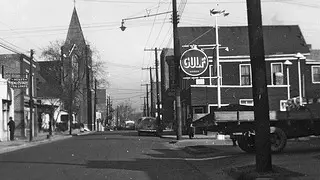
photo by: Durham County Library/North Carolina Collection/Open Durham
Looking north from the 900 block of Fayetteville St. in 1944. St. Joseph's is the spire on the left side of the photograph.
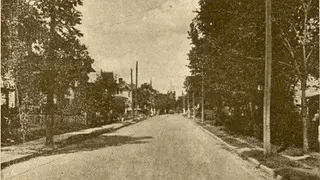
photo by: Duke Rare Book and Manuscript Collection/Digital Durham
The west side of the 1100 block of Fayetteville Street was a residential block. This photo is c. 1923.
In a story familiar to many Black communities, the once socially and economically thriving neighborhood declined in the wake of desegregation. In the 1960s and 70s federal urban renewal policies and the construction of North Carolina Highway 147 cut directly through Hayti, severing longstanding social connections and demolishing much of the historic fabric. The original White Rock Baptist Church was razed and relocated farther south, and the congregation of St. Joseph’s AME also moved to a new building. The historic St. Joseph’s church building survived only through strong community advocacy, reopening in 1975 as the Hayti Heritage Center.
But that’s not the end of Hayti’s story. Even with systemic disinvestment and population decline, communities along Fayetteville Street remain proud, resilient, and passionate. In 2024, Hayti Promise Community Development Corporation was awarded $10 million in federal funding from the American Rescue Plan Act to partner with the City of Durham and capable community organizations to catalyze sustained community-centered revitalization along the Fayetteville Street Corridor over roughly the next decade.
Stay connected with us via email. Sign up today.
Former Hayti Promise Board Chair, Dr. Faye Calhoun, said of the project, “We want to repair and rebuild this area to the point where we attract residents and businesses.”
The multi-year Fayetteville Street project focuses on creating positive changes for the community by creating a shared vision, improving appearance and safety, preserving cultural identity and historic sites, promoting naturally occurring affordable space for renters and owners, and supporting entrepreneurship by fostering meaningful collaboration with North Carolina Central University.
Preserving a Landmark
Established in the late 1920s as the first public burial space for Durham’s Black residents, Beechwood Cemetery is a window into local history and heritage along Fayetteville Street, serving as the final resting place of influential Durham business and civic leaders such as North Carolina Mutual Life Insurance Company founders John Merrick, and C.C. Spaulding; James Shepard, founder of North Carolina Central University; and contemporary trailblazers like groundbreaking speech pathologist Dr. Carol-Ann Henderson Brockenborough. The contributions and enduring legacies of these and other influential leaders shaped not only the Fayetteville Street Corridor and the neighborhoods of Historic Hayti, but the broader landscape of Black excellence and resilience in North Carolina and the South.
_HOPE%20Preservation%20Durham-115.webp)
photo by: Jordan Abdur-Ra’oof (ShotbyJBot)
A group of participants clean one of the grave markers during the November 2025 community event at Beechwood Cemetery.
During the November event at Beechwood, preservation expert Rusty Brenner demonstrated techniques to volunteers and cemetery staff. Debra Taylor-Gonzalez, vice president of Preservation Durham and president of Friends of Geer Cemetery, shared stories that brought figures named on gravestones back to life.
For Durham native, Daquan Roberts, a member of the City’s Cemetery Division, “after visiting Beechwood Cemetery due to the passing of peers, associates and loved ones, participating in the preservation program meant more… than just a few hours of overtime…bringing those old headstones back to life with the help of my teammates felt like we truly did our part in giving back to Beechwood’s legacy."
_HOPE%20Preservation%20Durham-152.webp)
photo by: Jordan Abdur-Ra’oof (ShotbyJBot)
Two children work to preserve one of the grave markers during the November 2025 community event at Beechwood Cemetery.
We Built This
Preservation work at Beechwood connects to a broader story. Beginning February 1st, Hayti Promise in collaboration with Preservation Durham and North Carolina Central University is hosting the traveling exhibit "We Built This: Profiles of Black Architects and Builders in North Carolina," featuring individuals with deep Fayetteville Street connections, including John Merrick and architect Phil Freelon, the architect of the National Museum of African American History and Culture, in Washington, D.C.
A key theme of the exhibit illustrates how architects and builders in the post-Reconstruction era often played dual roles as business owners and entrepreneurs who looked to serve their community, building services towards economic growth. Merrick is one such example. Trained as a brick mason during enslavement, he continued to work in his trade post-emancipation while expanding his skills as a barber and shop owner.
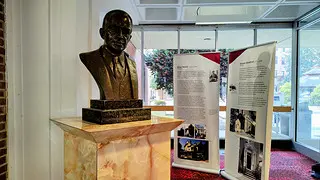
photo by: Julianne Patterson
A bust of James E. Shepard along with some of the display signs from the "We Built This" exhibit at NCCU.
Merrick was instrumental as the first president of Lincoln Hospital and one of the founders of North Carolina Mutual Life Insurance Company and Mechanics and Farmers Bank, providing insurance and loans to Durham's Black community at a time when segregation held strong. Preserving structures like the College Inn, the Scarborough House, or the other properties these leaders built requires understanding the vision and skill of those who created them. Preserved structures can create a powerful sense of place, connecting the past and the present, and underscoring that the work of historic preservation is ever-evolving—with the power to bring current residents of the Fayetteville Street Corridor and the broader community together.
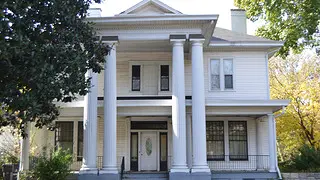
photo by: Nyttend via Wikimedia/Public Domain
Exterior of Scarborough House in the Hayti District. The house was built by Black funeral homeowner J. C. Scarborough and his wife Daisy.
Building Connection and Economic Growth
The Hayti Promise Community Development Corporation's partnership with HOPE Crew continues throughout 2026 with preservation projects and workforce development along Fayetteville Street. Future projects could improve cherished community spaces like the historic Harriet Tubman YWCA, the Hayti Heritage Center, or assist with stabilization projects slated to improve privately-owned properties tied to Hayti Promise’s partner initiative with the city, Preserving Home, Inc., and Preservation Durham.
PlaceEconomics, another Hayti Promise strategic partner with over thirty years of experience analyzing the economic impacts of historic preservation, is working along Fayetteville Street as well as conducting an asset-based economic survey and data analysis to craft recommendations to help guide future investments in an inclusive commercial district revitalization plan and the adaptive reuse of historic buildings.
This echoes the entrepreneurial spirit of those early Durham craftspeople who understood that preservation and progress aren't opposites. Building the future requires honoring what came before and ensuring that people who've always called a place home have the skills and power to shape and participate economically in what comes next.
As Hayti Promise CDC affirms: "Honoring our past, Empowering our Future."
Save Historic Places That Tell Our Full American Story
When you join the National Trust, you help save historic and culturally significant places nationwide.
Priya Chhaya is the associate director of content at the National Trust for Historic Preservation.
Irene Hui is a born and raised Durham native, a restaurant kid turned corporate operations pro. Following the COVID-19 pandemic, she pivoted toward marketing and strategy and is now fully leaning into creative work: writing, producing, shooting, and showing up on set.
.webp)