For a Doctoral Student and His Greyhound Bus, Preservation is All About the Journey
From 1940 through 1970, millions of Black Americans made their way out of the country’s South, drawn by wartime industrial jobs and the desire to escape racial violence and oppression. Much of this mass exodus—known as either the Second Great Migration or the second phase of the larger Great Migration—occurred on Greyhound buses, which were often cramped and segregated but offered the promise of a better future. It’s these “between spaces,” as well as the journeys that transpired on them, that Robert Louis Brandon Edwards—a Cleveland-based historian, artist, and Ph.D. student in preservation at Columbia University—is focused on sharing with others.
As part of his doctorate program, Edwards is restoring a 1947 Greyhound bus and turning it into a mobile museum called the National Museum of the Great Migration. It’s a type of experimental preservation, he says, that isn’t relegated only to buildings, but also includes moving architecture such as cars, trucks, and buses. As opposed to a general collection of exhibits highlighting the Second Great Migration, his project focuses on the moments that occurred within it: the experiences of Black Americans who didn’t have access to trains and couldn’t afford cars for their trips north. “We’ve had museums dedicated to bananas, potatoes, and Spam,” Edwards says. “But we don’t have many—if any—museums dedicated to the Great Migration.”
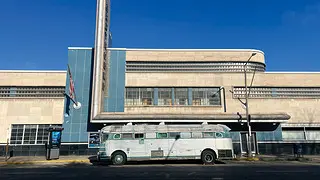
photo by: Karen Therese Nahra
Robert Louis Brandon Edwards’s 1947 Greyhound bus, parked outside the historic Greyhound bus station in Cleveland.
He first began thinking about the project in 2022 at the start of his Ph.D. program, but it wasn’t until 2024 that Edwards bought the decommissioned bus from a Pennsylvania junkyard. He then had it shipped to Cleveland, where it resides in the parking lot of the city’s historic Greyhound bus station. The property’s new owner, performing arts center Playhouse Square, has provided Edwards with the parking spot as well as office space. Once restored, the bus will be a place where visitors can interact with original objects and learn about Black travelers’ experiences through augmented reality (AR).
The vehicle is one of the few surviving 1947 General Motors PD3751 models in existence, a Streamline Moderne classic featuring the style’s signature horizontal lines, curved forms, and corrugated aluminum side panels—all intended to evoke speed and motion. “The bus is already doing what I wanted it to do, because I’m having conversations about architecture and preservation,” says Edwards.
He plans to leave the original parts of the bus’s exterior as is, with faded paint, various scratches, and side panels that still show the outline of the original Greyhound logo. However, Edwards is completely restoring its interior, using original parts such as upholstered seats, metal luggage racks, and signage, all from similar buses. He’ll keep its authentic features, including a back bench and perforated vinyl roof lining, which he found hidden beneath what he describes as a “tacky 1970s vibe.” (The bus had previously been converted into a recreational vehicle.)
Edwards’s bus is parked right next to the station’s operable vehicles, so people will often come over and ask him questions while he’s restoring it. “Someone even asked, ‘Was this the bus that Rosa Parks rode on?’” he says. “We had a really dope conversation, and when I asked them how their ancestors got to Cleveland, they said, ‘I don’t know.’” (They seemed interested in finding out, he adds.) It’s these types of exchanges that he finds both encouraging and inspiring, as they help people open a door to exploring the past and their own roles within it.
In fact, his own grandmother set out via Greyhound from Fredericksburg, Virginia, in 1963. The single mother was traveling to Harlem in New York City to make a better life for herself and her two daughters, and to essentially build a foundation for Edwards to stand on.
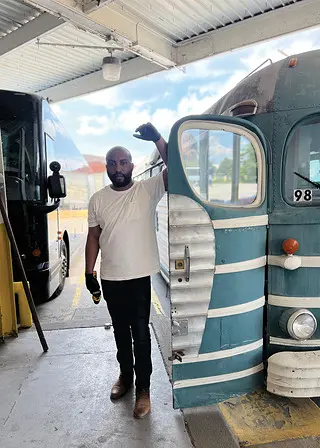
photo by: Leo Michael Nash
Edwards is restoring the bus’s interior himself.
It’s stories like hers and those of other working-class Black Americans that drive him. “Rosa Parks is cool,” he says. “John Lewis is cool. Martin Luther King Jr., Harriet Tubman, Frederick Douglass are all cool, and I really appreciate what they’ve done, but Black history isn’t represented by just five stars. It’s about the collective experience.”
The mobile museum will honor this collective experience by examining the interstate bus system as a means of mobility and freedom for Black Americans, as well as a space of discrimination and oppression. To really get a sense of how this duality worked, Edwards has pored over a heap of archival material: seeking out Greyhound advertisements that were printed for both Black and white audiences, listening to transcripts from interviews and oral histories, and even finding records of Black passengers who were arrested for refusing to sit in the bus’s designated “Colored” sections.
Stay connected with us via email. Sign up today.
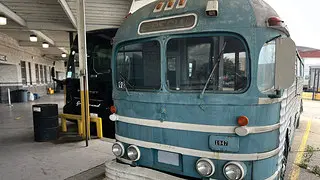
photo by: Leo Michael Nash
The original elements of the Streamline Moderne vehicle’s weathered exterior will be maintained as is.
Although the bus’s designer, Raymond Loewy, did not incorporate segregation into his original bus drawings, it became a prevalent feature regardless—one that altered the bus’s interior space and social dynamics. Visitors will be able to experience that firsthand by donning a pair of AR goggles, which will transport them right back to a bus in the midcentury era. Once on board, they’ll be given the choice: Do you want to sit in the front of the bus or the back of the bus?
From 2022–2024, Robert Louis Brandon Edwards served as an advisor to the National Trust’s African American Cultural Heritage Action Fund on the Sojourner Truth Legacy Plaza project in Akron, Ohio.
“Different scenarios will play out depending on the decision that they make,” says Edwards.
While he isn’t ready to give a set date as to when the museum will open, visitors can stop by and see the work in progress whenever he’s onsite. Which, he says, is often. “This work is a form of healing for me and a form of investigation. It’s also a form of remembering the many people who just got on a bus, went to some place that they didn’t know, and took a chance.”
Save Historic Places That Tell Our Full American Story
When you join the National Trust, you help save historic and culturally significant places nationwide.