Native Arts on Native Lands: A Tour of Women's Art at Four Historic Sites
The National Trust for Historic Preservation's Historic Artists' Homes and Studios (HAHS) Program is proud to highlight the creativity and innovation of Native women artists. Through four historic sites, visitors encounter immersive and collaborative interpretation that repositions Indigenous artists where they have always belonged—at the center of art history.
Jacobson House Native Art Center (Norman, Oklahoma)
The Jacobson House Native Art Center is named for Dr. Oscar Brousse Jacobson, a Swedish immigrant, painter, and advocate for Kiowa artists' education. In 1928, as the Director of the University of Oklahoma's School of Art, Jacobson founded an educational program for a group of artists now known as the Kiowa Six: Stephen Mopope, Monroe Tsatoke, Jack Hokeah, Spencer Asah, James Auchiah, and Lois Smoky.
The group was once known as the Kiowa Five, excluding its only woman: Lois Bougetah ("Of the Dawn") Smoky Kaulaity. She was part of the program's original cohort, but left after a semester and was replaced by Auchiah. Paintbrushes were traditionally only used by Kiowa men, so Smoky faced cultural pressures that her peers didn't.
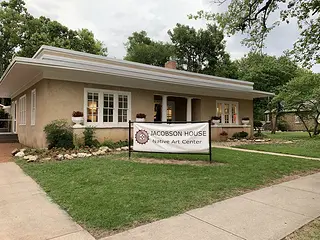
photo by: The Jacobson House Native Art Center
Exterior of Jacobson House in Norman, Oklahoma.
According to Jacobson House emeritus board member and former site director Tracey Satepauhoodle-Mikkanen, "Lois Smoky broke that traditional gender role through each stroke of her paintbrush." Smoky later married and had children, choosing to channel her creative energies into beadwork.
As stewards of the Kiowa artists' legacies, the Jacobson House restored Smoky to her place in art history alongside her peers. According to Satepauhoodle-Mikkanen, "The shift from the 'Kiowa Five' to the 'Kiowa Six' was driven by a re-evaluation of historical records and the desire, in collaboration with the Kiowa community, to give Lois Smoky equal and deserved recognition for her foundational role in the collective." The change required building consensus between the Kiowa Museum Board, community elders and Tribal leaders, and the artists' descendants.
Explore the West - Kiowa Six (National Cowboy Heritage and Western Museum)
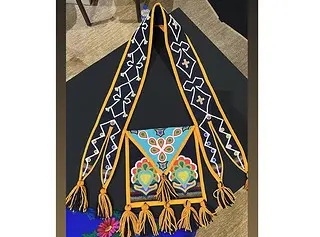
photo by: Jacobson House Native Art Center
Beaded bandolier bag by Tahnee Ahtoneharjo (Kiowa).
The Jacobson House promotes past and present Indigenous artists’ creativity, preserving the story of the Kiowa Six while also celebrating contemporary Native artists. Women artists continue to be vital to that mission. Pawnee filmmaker Randi LeClair partnered with the center to produce her forthcoming film The Circle of Chawce, and Kiowa beadworker Tahnee Ahtoneharjo won the top award at its 2025 biennial art show.
Lelooska Foundation and Cultural Center (Ariel, Washington)

photo by: Lelooska Foundation Permanent Collection
Shona-Hah, Grandparents.
The Lelooska Foundation and Cultural Center commemorates a family of artists and their communities. It was founded by Chief Lelooska, a woodcarver, storyteller and culture bearer.
Lelooska's mother, Shona-Hah ("Gray Dove") was an artist in her own right, well-versed in beadwork, sewing, painting, and carving. She was born in a black walnut log cabin on the Missouri and Oklahoma state line, spent her early years as a trick rider in rodeos, and eventually found her way to the Pacific Northwest.
Becoming part of the Sewide lineage of the Kwakwaka'wakw (Kwakiutl), she was given the name Tl'alihilugwa ("Whale Rising"). Her art shows the influence of many Native traditions, reflecting a cultural hybridity celebrated by the Foundation today. Shona-Hah is best remembered for her dolls, with intricately carved faces, hands, and feet, and with hand sewn clothes and regalia.
Shona-Hah was part of the foundation's educational programs from the 1960s forward. Now, almost thirty years after her death, the center is still going strong, educating the public about the diversity of Indigenous heritage across North America.
Grace Hudson Museum and Sun House (Ukiah, California)

photo by: Grace Hudson Museum
Pomo tray basket.

photo by: Grade Hudson Museum
Artists at Gathering Time’s opening event.
The Grace Hudson Museum & Sun House (GHM) holds an extensive repository of Hudson's paintings, many of which depict her Pomo neighbors. As a professional artist, Hudson found an enthusiastic audience for her portraits of Native people. Hudson and her husband John, himself an amateur ethnologist, were both deeply interested in Indigenous cultures. They accumulated an extensive collection of basketry that reflects Pomo women's artistry.
Joseppa Dick, known as “the queen of the weavers among the Pomo of Mendocino,” experimented with traditional Pomo weaving styles, creating remarkably intricate patterned baskets. Annie Burke’s baskets were, upon her request, preserved rather than destroyed (as was traditional) after her death. Burke hoped future generations of Pomo weavers could learn from her work. GHM’s collections are still used by Pomo weavers today.
Stay connected with us via email. Sign up today.
In 2022, GHM deepened its relationship with contemporary Pomo artists by organizing Gathering Time: Pomo Art During the Pandemic, exclusively dedicating exhibit space to displaying contemporary Pomo art. Gathering Time was guest-curated by Meyokeeskow Marrufo (Robinson Rancheria Band of Pomo Indians) and showcased artwork by fifteen artists. GHM's director, David Burton, described the exhibit as a "huge hit" that connected Pomo audiences with the museum, many for the first time. Meyokeeskow's curatorial work is again on display in GHM's current exhibition "Momím Wené: Medicine Water."
The museum is now looking ahead to 2027: the tenth anniversary of its Wild Gardens' opening, featuring plants that thrive in Ukiah's unique ecosystem. Pomo peoples have stewarded the land for thousands of years and continue to care for plants that provide medicine, food, and raw materials for basketry. Four of the five people on the anniversary exhibition’s advisory committee are Pomo.
Abiquiú Home & Studio, Georgia O'Keeffe Museum (Abiquiú, New Mexico)

photo by: Georgia O'Keeffe Museum
Art featured in the Georgia O'Keeffe Museum's exhibition "Tewa Nangeh/Tewa Country." Michael Namingha, "Disaster 8." Tewa Nangeh, 2025. Silkscreen on Canvas. 58 x 90 in.
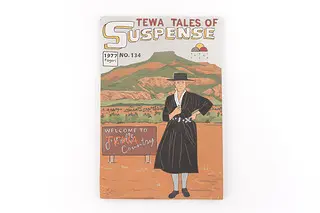
photo by: Georgia O'Keeffe Museum
Art featured in the Georgia O'Keeffe Museum's exhibition "Tewa Nangeh/Tewa Country". This is Jason Garcia. TEWA TALES OF SUSPENSE! #134 Fogeri 1977 ‘Welcome to Tewa Country’, 2025. Hand-processed clay, mineral pigments, traditional outdoor firing using Pueblo pottery techniques. 8.5 × 13 in.
The Georgia O'Keeffe Museum in Santa Fe currently hosts a temporary exhibition called Tewa Nangeh/Tewa Country, featuring multimedia art by Tewa creatives. Contributing artists visited O’Keeffe’s home and studio to prepare for the event.
Exhibit co-curator Bess Murphy described her and co-curator Jason Garcia's motivation for mounting the show: "It felt like it was time to bring a Tewa perspective into the museum galleries, not just as a response to O'Keeffe, but as a way of expanding the histories that we share about this place." After two years of development, the exhibit opened in November 2025 and will be open until November 2026.
According to Murphy, Tewa Nangeh "asks visitors to step out of a mythologized single narrative that implies that Georgia O'Keeffe was a solitary artist living in an empty desert," sparking dialogue about how and why O'Keeffe claimed private ownership over parcels of collectively stewarded Tewa lands. Although O'Keeffe's paintings did not directly reference Tewa artistic traditions, she engaged with a storytelling landscape steeped in Indigenous history. Those deeper meanings might not have been visible to O'Keeffe, but Tewa Nangeh makes them visible to public audiences today.
Murphy reminds us that "No artist works in a vacuum. By creating space to tell multiple histories, past, present, and future, we are asserting that art history is not static." Remembering Indigenous history makes art history dynamic.
Save Historic Places That Tell Our Full American Story
When you join the National Trust, you help save historic and culturally significant places nationwide.