From Our Readers: First Impressions
At the National Trust for Historic Preservation, our work is driven by our supporters’ passion for historic places across the country. In March, we asked readers of our weekly newsletter to share their first impressions when they come across a historic site or old building
We mapped the responses into a chart—and while the results won’t surprise you (we love our windows!)—the thoughts and feelings behind some of the submissions might bring a little joy.
.webp)
All the tiny slices represent 2.2 percent of the respondants.
What architectural details stand out to you when you first see a building?
Roof Lines and Variety
I really enjoy looking at the variety of roof lines. From the elegance of Victorian homes gracing Summit Avenue in St. Paul, to the slim lines of Mid-century Modern homes in Palm Springs. The variety is stunning. Just lovely. – Steve
– Steve B.
Proportions
If I am back far enough to see the whole building I first look at the overall proportions and the play of masses and light and dark spaces. I also like to see how the building relates to the nearby buildings or landscape. Does it dominate over them, stand out, blend in, or have harmonious independence?
Moving closer, I look at decorative exterior details.
Moving inside, how does the building make me feel?
– Nancy S.
Eggs and Darts
Both my father and grandfather were architects, so, I grew up hearing architectural terminology. I was working in our local Carnegie Library as a staff librarian, when it was added onto and remodeled in the 1990’s, and [my dad] would come in to read the newspapers (he was retired by then, so not on the project). Somewhere during that time I asked him what the design along the interior was called—and he said “eggs and darts.” I now see “eggs and darts” inside several of the old buildings here in Portsmouth, Ohio, especially the banks!
– Linda D.
Painted Brick
A very interesting thing to look for, especially in Chicago, is the sides of old brick buildings. Advertising signs were often painted onto the brick walls, then hidden when new buildings were built abutting those walls. When the new buildings are removed the old signs become visible again.
When my parents built a house in the ‘60s they searched out old bricks with remnants of painted signs, with the intent of having the painted bricks as a feature on the wall of the new fireplace. When my dad went home for lunch, he discovered that the builders were placing the painted sides to the reverse. Oh, no! They had to start over, showing the interesting painted bricks!
– Marsha P.
Stay connected with us via email. Sign up today.
Windows!
The architectural details that stand out to me when I first see a building are the windows. They can be simple, have ornate pieces built mostly above them, or can be next to them (such as shutters) and can be at a whole other level in themselves. There's also the windowsills which can have a particular depth to them or even [have] planter boxes incorporated. I love to look through the old wavy glass. I especially enjoy figuring out how they open and close. Some have rope with weights, and some have a notch that a bent nail will catch to hold it open. That depiction was in an 1843 farmhouse that I rehabilitated while living in it for over a decade.
– Sharon M.
A Warm Welcome
The first thing I notice? It's the windows. Definitely the windows.
The first thing I consciously look for is the front door. Is it welcoming? Is it original? Is it used (or do you enter on the side or through the garage)?
– Connie P.
Accessibility
I notice stairs first. I’m handicapped. Are the steps deep or shallow? How many steps are there? Are there two railings, one on each side or just one? If there’s just one, which side is it on? Is there a ramp instead of just stairs? If so, does the ramp also have railings?
– Janet H.
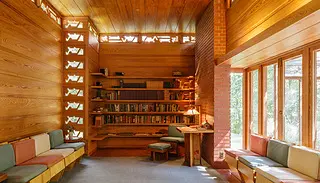
The geometric window design at Pope Leighey House, a National Trust historic Site, is one of the first things I gravitated to when I first saw this site.
Structure, Function, and the Environment
I am struck by the placement of a structure in relationship to the surrounding environment and the marriage of the function of the building to the aesthetic appeal that draws individuals into its space.
The luxury of designing a structure that is well considered, adequately proportioned to the function and made of quality materials which persist over time is what gains all of my appreciation. Attention to detail and superb workmanship is what makes these spaces treasures, in my opinion.
– Kim T.
Thanks to Barry G., Bonnie M., Cindy P., Debbie Z., Carolyn M., Pamela O., Linda D., Marsha P., Will S., Rose S., Richard W., Rita W., Susan K., Carla L., Susan D., Benjamin B., Susan B., John L., Dawn E., Vivienne A., Susan S., John Y., Thomas L., Catherine M., Pat M., Sue G., Al G., and Drew O. for your submissions.
Save Historic Places That Tell Our Full American Story
When you join the National Trust, you help save historic and culturally significant places nationwide.