Nathan and Oscar Saucedo Rescued a Greek Revival House in Harrodsburg, Kentucky
From our interview with Nathan and Oscar Saucedo.
Nathan Saucedo: I’m an executive at a regional community mental health center, and Oscar works as an engineer. We met in 2013 and got married a year later. We lived in Michigan, then Indiana, and by 2021 I wanted to come back to my home state, Kentucky.
We decided Harrodsburg would be convenient for both of us. It’s between our two offices, and approximately 30 miles north of the little town, Liberty, in Casey County, where I grew up on a dairy farm.
Over the years I’d driven along Beaumont Avenue in Harrodsburg and was enchanted with the old homes. Many years ago, I saw this house for sale, and I remember thinking, “Well, that’s a hotel, or that’s a business, it would be way too much to keep up.” But then in 2021 I saw a for-sale sign again here. I looked in the windows and thought, “This is doable.”
I don’t know why I thought it was doable. I think I was delusional. But all the glorious original detail, the ornate moldings, the fireplaces, 14-foot ceilings on the first floor, 16-foot ceilings on the second floor, all that was intact. I told Oscar about it.
Oscar Saucedo: One of Nathan’s dreams was having a big house to remodel. It has nothing to do with the way I see the world, I can live in a tent. But it’s been a dream of his, and I support him, so I said, “You know what? We’re in.”
Nathan: When he said that, I almost fell over: “Really?” We first came here around early March, and it was so cold, you could see your breath inside the house. I could see potential, potential, potential everywhere, and Oscar could see money, money, money needed. But it was a good price: $310,000, with 22 rooms, 11,000 square feet, on just under an acre of land. It needed way more than the asking price just to make it livable.
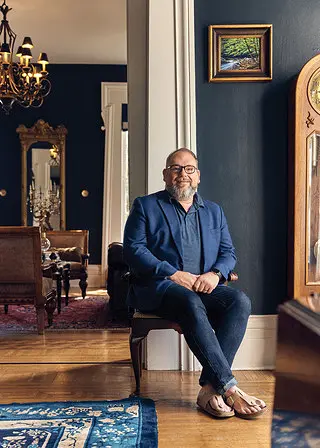
photo by: Aaron Conway
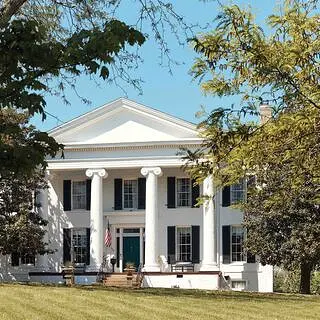
Nathan Saucedo in the dining room. He and his husband, Oscar (not pictured), bought the house (shown at top) in 2021 and worked with local tradespeople to repair and restore it.
Oscar: Something else decisive for us buying it was when we first drove up to the house, there were two neighbors outside, who said, “Are you looking for a new home?” And they called the Realtor immediately. They wanted this place sold to somebody who could put it back to the way it was supposed to be.
Nathan: When we bought it, there was no heat. Only one bathroom worked, with only cold water. The dining room ceiling had collapsed. The kitchen had a sink, a cabinet with the doors hanging off, no stove, no refrigerator, and what seemed like seven layers of linoleum on the floor. It was like walking on a marshmallow. People had been living here in a few rooms with a space heater—it’s a wonder the old wiring didn’t cause a fire. Many windows had fallen out, and they had been just taped back up.
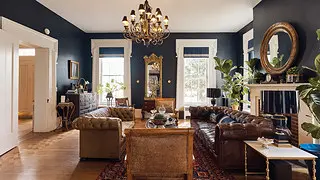
photo by: Aaron Conway
The living room has 14-foot ceilings.
Oscar: The putty on the windows was dry and brittle. It fell apart. When our cat was touching the windowpanes, the glass would fall on the grass. That’s how he was escaping.
Nathan: Our priority at first was just getting the windows to not fall out and sweeping up the garbage—basic things. We filled large plastic lawn bags with debris and dirt.
We started tracing the whole history of the house. It was built in 1840 for Dr. James Shannon, an immigrant from Belfast [in what is now Northern Ireland]. He was a medical doctor, a preacher, and an educator. He ran a college here before serving as president of the University of Missouri. The next owner was John Bowman, who ran what’s now the University of Kentucky. During the Civil War, the house functioned briefly as a soldiers’ hospital. There are still bloodstains on the floorboards. After the war it was used as a boys’ school, then a grand home, and then a guesthouse with nine guest rooms.
And we know that enslaved people built and cared for this house. Anywhere from six to eight enslaved women managed the household and lived in the house, and additional enslaved people managed the grounds. A stone building nearby that’s been converted into a garage—that may have been this house’s slave quarters.
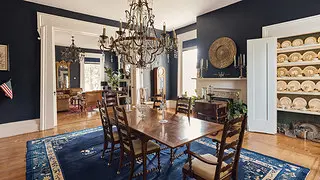
photo by: Aaron Conway
The dining room contains a salvaged chandelier.
Oscar: The craftspeople that we brought in, they’ve stayed our good friends. The shutter dogs, those pieces of metal that hold back the shutters, I went home to Mexico and asked my dad to make those for us. He’s a welder, his name is Juan Saucedo. I asked him, “Dad, please chisel your full name on them.” If somebody ever takes them apart, they’ll see his name on every single shutter dog, imprinted in the metal.
Nathan: Casey County, where I grew up, it’s a very agricultural area, with a lot of people who have skills and need work: painters, carpenters, electricians, plasterers. It took six people 13 weeks to tuckpoint and paint the bricks on the outside of the house.
Oscar and I and the team researched and learned new skills to repair all the plaster walls, ceilings, and moldings; repair and repaint the wooden fireplace mantelpieces; rebuild the plumbing and electrical systems inside the walls; redo the parquet floors; and create a kitchen from scratch.
The roof was relatively new, but we’ve had tremendous issues with the four chimneys. Now they’re wrapped in rebar and covered in cement, we’re hoping they’re fixed for good. But there’s absolutely no way I would ever have an open fire in the fireplaces. They’re very shallow, they were meant for burning coal. We’ve put new valves on the old radiators. They heat the whole house efficiently and miraculously.
Oscar: Descendants of people who lived here, they stopped by and asked for a tour. So I said, “How about you guys give me the tour?” They gave me the tour for what they remember about the house. That was a beautiful moment.
Nathan: When we had a yard sale, for a lot of equipment used in the renovation and other stuff we didn’t want, a lady came by. She said, “I used to work here, for 30 years. I made beds, I cleaned rooms, and I took care of people, I cooked and served them breakfast and everything.” And I said, “Would you like to see the inside?” She said, “Absolutely, oh my gosh,” and she started tearing up. I brought her in, and she was so happy. She lives three streets over, and for years, she hated watching this place go downhill.
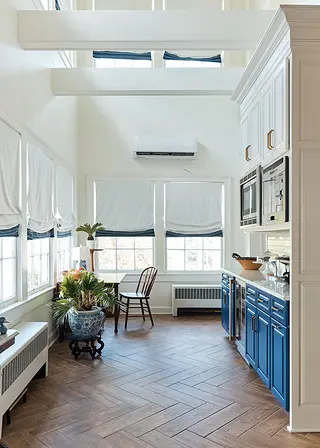
photo by: Aaron Conway
The new kitchen’s breakfast nook.
Next, we need to work on the basement—we’ll put in a gym there—and the landscaping.
Oscar: And the hardscaping.
Nathan: We would love to have a wood-planked fence encasing our backyard, so the dogs can run around. And for planting more trees and shrubs, that’s going to be a big ordeal; everything here has to be big and tall. Otherwise they’ll be dwarfed by the house.
Oscar: Even our Christmas trees inside, those have to be 14 feet tall, otherwise they look like a joke.
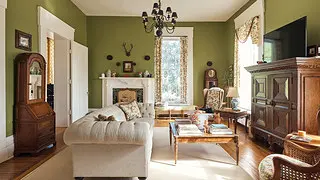
photo by: Aaron Conway
Fireplaces grace 12 rooms, including the den.
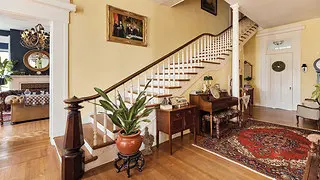
photo by: Aaron Conway
The house’s original woodwork, including the main staircase, has been restored.
Nathan: We would love to put a fountain in the front yard, and it has to be a FOUN-TAIN [he spreads his arms wide]. We’ve had to look for large furniture, too. The dining room chandelier, from a hotel in Indianapolis that was demolished, is so big we had to take it apart to get it through our door. Oscar polished every single crystal and made sure the chains that hold the crystals together were good.
Oscar: Something else important to say is that people here have been very welcoming and helpful. They’ve brought us bourbon, gift baskets, vegetables from their gardens and farms, they’ve helped us paint and plant flowers. It’s been a very beautiful welcoming.
Nathan: We give back to the community partly by volunteering. I’m the president of the local community theater, and we’re both on the boards of the local historical society and other nonprofits.
Oscar: We open our home for events: parties, board meetings, fundraisers, political events.
Nathan: We’ve had the governor, the lieutenant governor, and the chief justice of the state Supreme Court here. Speakers for the historical society, they can stay overnight here. Anybody in this area who’s wanted to see this house, by now I believe that they have been in this house, at some point, since we’ve had it.
Save Historic Places That Tell Our Full American Story
When you join the National Trust, you help save historic and culturally significant places nationwide.