Places Restored, Threatened, Saved, and Lost in Preservation Magazine's Fall 2026 Issue
In each Transitions section of Preservation magazine, we highlight places of local and national importance that have recently been restored, are currently threatened, have been saved from demolition or neglect, or have been lost. Here are five from Fall 2026.
Restored: Iola Theatre
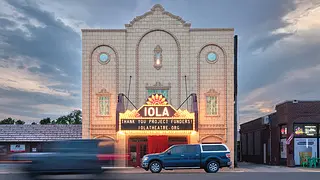
photo by: Dimensional Innovations
Stay connected with us via email. Sign up today.
For years, a 1931 cinema in Iola, Kansas, needed a makeover. The Iola Theatre’s original marquee was removed in the 1970s, and following its most recent use as a church, the building has been vacant since the early 2010s. Now the nonprofit Iola Theatre Association has largely returned the exterior of the Mission Revival structure designed by B.F. Churchill to its original look. Work has included repairing terra cotta finishes, repointing brick, replacing windows and doors with historically accurate replicas, and, most notably, re-creating the original Art Deco marquee.
“[We used] an algorithm that can look at old black-and-white photos, and based on the shades of the grayscale, it can guess what those colors are,” says engineer Keanan Smith of Dimensional Innovations, a design/build firm. “It gave us a high-confidence guess for what the colors should be.” The marquee’s 668 bulbs shone during an unveiling ceremony held in April 2026.
Next steps will include restoring the ticket booth and rehabilitating the Art Deco interior. Once the theater is complete, the Iola Theatre Association envisions it as an event venue and community space. So far, the project is funded by private donors and grants, plus $3 million from a HUD Community Project Funding grant. “Our hope [is] that it can be a time capsule,” says association board member Maria Unruh. “And that people will want to come in and see what it used to be like.”
Restored: Streamliner Diner #751
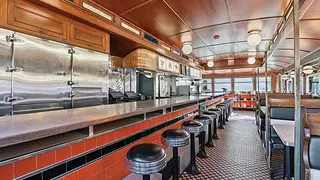
photo by: JTVS Builders
Between 1906 and 1961, the Worcester Lunch Car and Carriage Manufacturing Company in Massachusetts built 651 “streamliner diner” cars, each donning a unique serial number from 200 to 850. Despite their appearance, the structures were meant to be stationary food establishments. But #751 still managed to cover some mileage. Manufactured in 1938, the Streamline Moderne–style diner car was moved from its original home in Hanover, New Hampshire, to Newport, New Hampshire, in 1957. In 1990, the Savannah College of Art and Design (SCAD) purchased and relocated the streamliner to Savannah, Georgia, where SCAD used it for student dining.
Strange Bird, a popular local restaurant, has rented the unique space from SCAD since around 2023, but the business had to temporarily close after a February 2025 fire. SCAD quickly assembled a team, including Savannah-based Lynch Associates Architects and JTVS Builders, to repair and restore the structure. “There was a lot of smoke damage through the whole thing, and a lot of the original wood detailing was damaged to the point that it wasn’t salvageable,” says architect Andrew Lynch.
The restoration team replaced those elements in kind, relying on photos to reproduce details where needed. They saved original seating, banquettes, and tilework. “We were able to keep [the tile] in place and restore it where we could,” says Lynch. Strange Bird reopened in March 2026, and two months later, the project received an “Excellence in Restoration” award from the Historic Savannah Foundation.
Threatened: Aladdin Coal Tipple
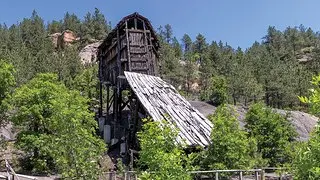
photo by: Denise Hawkins
Near the hamlet of Aladdin, Wyoming, a rare piece of late 1800s mining history is under threat. It’s a coal tipple dating to 1898, one of the only extant 19th-century wooden structures of its kind in the region. Originally built by the Black Hills Coal Company, the tipple operated until 1942. “It sorted coal by [size] using gravity,” says Megan Stanfill, executive director of the Alliance for Historic Wyoming. “It was important to have uniformity in the coal.” Following advocacy by Aladdin residents, the state Department of Environmental Quality’s Abandoned Mine Land Division stabilized the structure in the 1990s.
Since then, Crook County has owned and overseen the site, but without the resources needed for maintenance, the tipple has slowly fallen into disrepair. A 2011 study found that it’s in imminent danger of collapsing, and a 2018 report reiterated these findings. “Our biggest worries are winters, the snow load on the compromised structures,” Stanfill says. “That’s usually when we’re like, ‘OK, next spring, we’re going to have to go out and make sure it’s still standing.’”
The Alliance, which placed the tipple on its watchlist in 2024, plans to pursue a feasibility study in the coming months to see what it would take to restore the structure. “We’re trying to determine if it’s something that we can just stabilize in place,” says Stanfill. “Or if we [need] to pursue something bigger, like pulling it all down, building it back up.”
Saved: J.J. Walser House
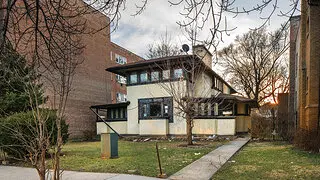
photo by: Paul Morgan
Chicago boasts the highest concentration of Frank Lloyd Wright architecture in the world. Yet the city’s West Side contains only one single-family house known to be by Wright: the J.J. Walser House, located in the Austin neighborhood. Built for printing executive Joseph Jacob Walser Jr. and his wife, Grace, in 1903, the Prairie Style house fell into disrepair after longtime owner and caretaker Anne Teague died in 2019. With major structural issues and holes in its roof, the stucco and wood-trimmed residence has sustained water damage and deterioration.
But now it has a new steward. In June 2026, the community-based organization Austin Coming Together (ACT) acquired the historic property for $125,000. (A grant from the nonprofit Community Investment Corporation funded nearly half of the sale.) ACT announced plans to stabilize and eventually restore the building. While its exact use is still to be determined, ACT executive director Darnell Shields says the J.J. Walser House will be a public-facing space.
“Within a 24- to-30-month timespan, we’d like to be able to stabilize the property, go through a process with our community to [determine] what those purposes can be, and be in a position to actually have a development plan either in progress or in place,” says Shields. ACT plans to raise project funds through a combination of donations, grants, and, potentially, historic tax credits. “When word got out that we were able to acquire it, there was a huge sigh of relief,” Shields says. “We built up trust in our community that we will finish what we start.”
Threatened: Syrene Missionary Baptist Church
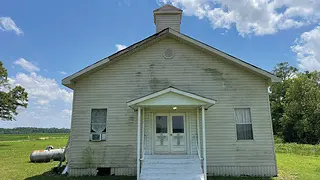
photo by: Preserve Arkansas
In the rural community of Pickens, Arkansas, miles of farmland surround Syrene Missionary Baptist Church. For decades, congregation members have gathered at the white clapboard structure on the fourth Sunday of each month to worship. Unpaved roads are the only way to reach Syrene, but in recent years, rainstorms have increasingly rendered the route impassable, threatening the congregation’s ability to access and keep up the building.
Dedicated circa 1939 and designed with a simple, one-room layout and central bell tower, the church is steps away from Bayou Bartholomew, believed to be the longest bayou in the world. Until the 1970s, Syrene performed its baptisms in the bayou, says Melvin C. Ray, whose family has attended the church for generations. Ray and his fellow congregation members hope to add HVAC, update the plumbing, and complete a conditions assessment. “But if we can’t get out there, it’s kind of tough,” says Ray. He estimates that about half of the church’s monthly services are relocated due to road conditions.
“The building itself is endangered because of a lack of resources,” adds Rachel Patton, executive director of Preserve Arkansas, which included Syrene on its 2025 Most Endangered Places list. “Somebody who has expertise with historic properties [needs] to come and look at it.” In the meantime, Ray says, Syrene’s loyal churchgoers will keep showing up whenever they’re able to. “It’s as if you’re going back into the past,” he says. “You can imagine your ancestors worshipping there. It’s just so special.”
Save Historic Places That Tell Our Full American Story
When you join the National Trust, you help save historic and culturally significant places nationwide.