For The People of Edenton, North Carolina, Reviving an Important Church Was a Matter of Faith
On the morning of September 18, 2003, Sadie Drew Riddick watched in horror as winds from Hurricane Isabel ravaged Kadesh A.M.E. Zion Church in Edenton, North Carolina. The picturesque town of 4,500 sits near the mouth of the Chowan River, where it enters the Albemarle Sound off the Atlantic Coast. Riddick had been sheltering nearby at her sister’s house when the wind picked up, and she stepped outside to check on her beloved second home. The towering walls of the white frame church creaked. The wind pried up parts of the metal roof and the vinyl siding that had been added over the original heart pine, and sent them sailing. It snapped tree limbs and blasted the church, shattering some of the century-old stained glass windows.
After the storm passed, Riddick and her sister, Barbara Drew, assessed the damage. Drew broke down in tears. “I looked at the church and said, ‘We’re not going back in there,’” she says. “It felt like losing my best friend.”
“I had a sad, empty feeling. Then I got angry,” says Riddick, who is now 75. “It was the first time I ever got angry at God: ‘Why? Why did this happen to us?’”
Soon, the sisters joined others from the congregation and the Edenton community in the Kadesh churchyard. They had no water or power, but they set up grills. For days on end, people brought food from freezers that had stopped working. They cooked, feeding neighbors.
“As a community, we began to pull together,” Riddick says. “I said, ‘Lord, you allowed this for a reason. I’m not going to question you.’”
As Drew predicted, local inspectors declared the building unsafe. In subsequent weeks and months, the congregation raised enough money to shore up the walls and replace the roof, but it did not have the funds to restore the church. Instead, it hired a crew to remove and crate up the window frames and cover the gaping Gothic arch–shaped holes with plywood. Riddick helped pick up colorful shards of glass. The group stored the windows and buckets of shards, along with decorative woodwork, pulpit furniture, and other items from the church in steel shipping containers in the yard.
For the next two decades, Kadesh Church sat empty and “mothballed” in preservation parlance, looking more like a ruin with each passing season. The paint faded. The smaller tower’s metal roof rusted. Bats and pigeons moved in. Over the years, as Sunday services continued in a converted gym on the other side of town, efforts to raise restoration funds came up short, a plight common in small communities across the country.
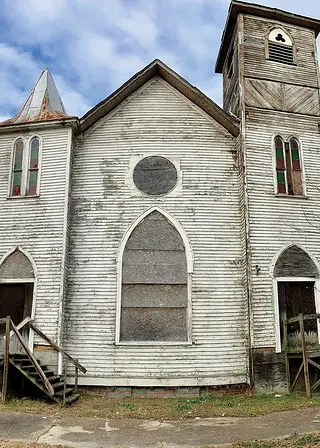
photo by: Edenton Historical Commission
Kadesh A.M.E. Zion Church in 2021, before the restoration.
Riddick dreamed of returning to the church of her childhood. She never lost hope, even during her lowest point, in 2013, when she was undergoing chemotherapy to treat breast cancer. Exhausted and wracked by nausea, she would sit on her porch and gaze across the street at Kadesh and those shipping containers, recalling happier times—counting panes of stained glass as a child during the 1950s, summer evenings playing in the churchyard, baptisms, church dinners. She especially missed the singing, the way the vast sanctuary seemed to magnify the songs of praise.
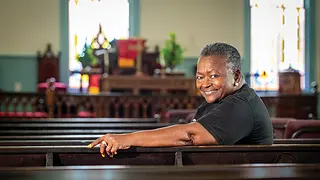
photo by: Kate Medley
Sadie Riddick inside the church.
Kadesh, built circa 1897, is considered a “mother church,” one of the oldest and most prominent in the A.M.E. Zion Church’s Edenton District of the Albemarle Conference. The double-towered frame building in the Gothic Revival style was a proud and important upgrade for the Kadesh congregation, officially established in 1866, just after the Civil War’s end. Its builder and most likely its designer, Hannibal Badham Sr., was enslaved until roughly age 20. He and other generations of Badham family carpenters ranked among the best Edenton builders of the late 19th and early 20th centuries. They erected community buildings and residences, including their own houses, which still stand on the same block of East Gale Street as Kadesh Church. The church, the Badhams’ finest creation, was the tallest structure in Edenton.
“Kadesh Church is one of the most remarkable buildings I’ve had the privilege of getting to know,” said Reid Thomas, restoration specialist and regional supervisor for the Eastern Office of the North Carolina State Historic Preservation Office, in a 2018 film about the need to preserve Kadesh Church and its neighbors. One reason, he said, is the church’s unique structure. Its 28-foot-high balloon-frame walls are topped by scissor trusses that allow for a wide, soaring span unbroken by interior beams. Picture an inverted ship’s hull made of dense-grained, heart pine lumber. “That is why the building is still standing, because of the engineering genius of the builder,” Thomas added. (Steel cables installed around the 2000s also play a role.)
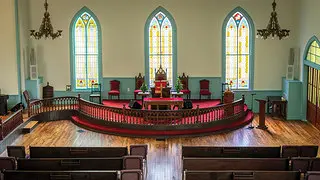
photo by: Kate Medley
Down East Preservation restored and rebuilt the interior woodwork and furniture.
Beyond the structure, Kadesh also served as an important hub for Edenton’s Black community. Named after an oasis described in the Hebrew Bible, where the Israelites sheltered while wandering the desert, the church brought congregants refuge during their own journey to freedom, justice, and equality.
Yes, Kadesh was still standing after Hurricane Isabel, but the building needed a lot of work. It was designed to hold 400 people; Riddick remembers pews full of families during her youth. But by 2003, membership had dwindled to about 150, following a downward trend among churches in the United States. The congregation simply didn’t have funds to pay for a seven-figure renovation.
The church sat empty.
When Sam Dixon, a town council member and a former trustee of the National Trust, heard about a proposal to demolish Kadesh, he says he “went berserk.” A local attorney and diehard preservationist with deep family roots in Edenton, Dixon recruited members of the larger Edenton community to join forces with Kadesh members to help save the church.
“I don’t think any of us knew a route to save it, but the church was just so spectacular that I couldn’t imagine it being gone,” Dixon says. “It meant so much to the congregation, but it also meant so much to everybody else here.”
In 2014, the town government launched the North Oakum Street Redevelopment Project, a multifaceted effort to preserve and revitalize a 2.5-block area anchored by Kadesh Church and many Badham family–built homes.
Around the same time, community and congregation members launched the Kadesh Restoration Committee. Audrey Bond, a Kadesh member who lived a few doors down from the church, chaired the campaign. Riddick and Grace Bean, a now-retired public-school teacher, were also heavily involved.
“There were bake sales and chicken dinners. There was a box in the back of the church,” says Bean.
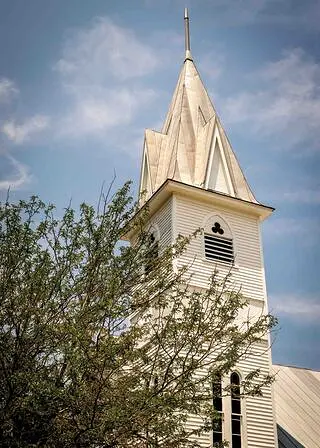
photo by: Kate Medley
The reinstalled bell tower steeple.
Meanwhile, Sunday services continued at the temporary space, located coincidentally on Badham Road. The arrangement was beginning to feel permanent.
A turning point came in 2016, when Kadesh received a $250,000 matching grant from the National Fund for Sacred Places, a program of Partners for Sacred Places in collaboration with the National Trust for Historic Preservation. (The grant would end up covering stabilization work and the restoration of the windows.) The Edenton Historical Commission stepped up to act as the financial agent for the restoration effort.
Bond, Bean, Riddick, and other volunteers received training from a now-retired fundraising professional named David Cooper, who was so moved by the community effort that he offered to work pro bono after a couple of months. They developed a strategy, tactics, and lists of potential donors. The goal was to raise enough money to support making the building safe and functional, as well as paying for finishes and interior furnishings.
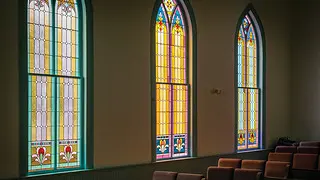
photo by: Kate Medley
The restored stained-glass windows are a highlight.
“We wrote letters, and people started giving,” says Riddick, who took over as co-chair with Bean after Bond retired and moved to Florida. Bond died in January 2026.
“Everybody contributed whatever they could to save this building. It was probably the hardest thing I’ve ever done, and I taught four-year-olds for a long time,” says Bean. But it still wasn’t enough.
Riddick never lost faith.
“When I was growing up, I’d take my 50 cents and put it in the Piccolo,” she says, referring to a jukebox at a local cafe. “I’d push the button and play that Sam Cooke song ‘A Change Is Gonna Come,’ seven times. When we were working to restore Kadesh, I listened to that song all the time. I’d turn up the volume and listen to every word.”
Ed Goodwin, who lives a few miles from Edenton in rural Chowan County, says that any time he drove through town, he detoured off Broad Street, the main drag, to pass by Kadesh Church.
“Seeing that church boarded up and empty hurt my heart,” says Goodwin, who since 2018 has represented District 1, which includes Edenton, in the North Carolina House of Representatives. Goodwin’s own house of worship, the Macedonia Baptist Church, took a hit from Isabel, too. About Kadesh, he says: “There’s a church that existed for all those years, and now it’s falling apart? I figured I’d go to Raleigh and put in a request for state money.”
Goodwin, 74 and a former school classmate of Riddick’s late sister Mary, met with state budget writers. He showed them photos of Kadesh’s sad state. He worked quietly behind the scenes, not wanting to raise people’s hopes. Later, he took metal spikes pulled from Kadesh’s 120-year-old timbers and gave them to his fellow legislators—something old they could hold and display in their offices.
Riddick remembers the day in 2021 when Goodwin came to a Sunday service at Kadesh to announce the news.
“He said, ‘I got y’all some money.’ I thought he might be talking about $50,000,” Riddick says.
He was talking about $2.1 million. Those funds, added to the roughly half million dollars already raised, allowed for a full and rigorous restoration of Kadesh Church. The total funding raised for the project exceeded $4 million, which also covered the restoration of the parsonage next door, a two-story, circa 1900 house built by the Badhams in the Queen Anne style.
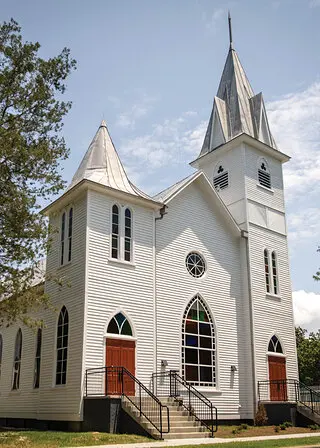
photo by: Kate Medley
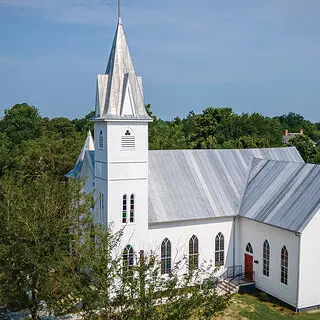
The Gothic Revival church is the tallest building in Edenton, North Carolina.
“The legislature’s investment speaks volumes,” says Robert Leath, executive director of the Edenton Historical Commission. “It says that the Kadesh story is important to the state as a whole.”
One of the first issues facing the restoration teams was the bat and pigeon infestations and the corrosive guano—calf deep in places—deposited over the years in the church’s two towers. While that threat was being mitigated, crews from Edenton-based Down East Preservation tackled other challenges: straightening and securing walls that had been shoved out of plumb by Isabel’s nearly 100-mile-per-hour winds, replastering crumbling interior walls, and replacing exterior siding with lumber milled from Chowan County yellow pine trees. MidSouth Roofing & Construction installed a metal roof system made by the Austrian company Roofinox to mimic the old terne metal roof.
Down East Preservation’s carpenters repaired the windows made from colored glass, keeping to the A.M.E. Zion color palette. Stained Glass Associates in Knightdale, North Carolina, repaired the leaded glass window panels.
“Once the windows were restored, the question became, ‘Where do they go?’” remembers Down East founder Dawson Tyler. “Sadie [Riddick] was our guide. After growing up in those pews, she had memorized the order.”
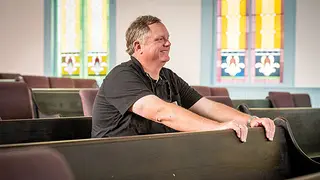
photo by: Kate Medley
Dawson Tyler, founder of Down East Preservation.
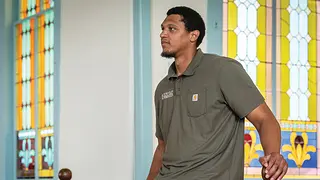
photo by: Kate Medley
DeAndre Wilkins, senior project manager with Down East Preservation.
For decades, Kadesh had a drop ceiling. Once the ceiling was removed, a close look at those inverted boat-hull roof trusses turned up evidence that the beadboard ceiling had once arced more than 35 feet above the sanctuary. Carpenters restored the ceiling, matching the bead detail of the narrow tongue-in-groove boards as well as the direction of the angled sections. Then crews painted the ceiling, wood trim, and beadboard wainscoting a robin’s egg blue, based on findings by conservator and paint analyst Susan Buck. She reached her conclusions by studying samples taken throughout the building, as well as brushstrokes discovered in a closet under a stairwell, where the early church’s painters might have cleaned their brushes.
“When they showed us the original color, I said, ‘Blue? Churches are supposed to be white inside,’” says Riddick, who avidly followed the restoration work, relishing the daily noise. “After they painted it, I saw the sun shining through those windows on the blue walls, and it looked just like heaven.”
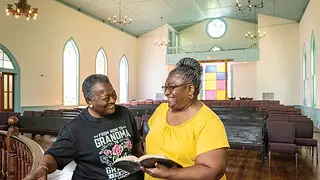
photo by: Kate Medley
Sadie Riddick (left) and her sister Barbara Drew, both lifelong congregation members.
To involve the Kadesh members during the long restoration period, Tyler would invite the congregation to the Down East woodshop after church. He and his co–project manager, DeAndre Wilkins, also attended Sunday services at the temporary church to provide updates and get the congregants’ input.
“Most of them had not seen the windows in two decades,” Tyler says. “They were nervous about the damage but excited to see the progress.”
Stay connected with us via email. Sign up today.
Perhaps the project’s biggest challenge—and greatest preservation mystery—was the design of the steeple atop the bell tower, which no one had seen in at least 75 years. Sometime before or during the 1950s, it was destroyed by a lightning strike and never replaced.
“[DeAndre] and I went to the congregation and asked for wedding photos, anything that might show the bell tower,” says Tyler. At the local library archives, they found a circa-1910 photo of nearby Edenton Academy and there, above the shoulders of the students, rose the Kadesh steeple. A postcard with a drawing of the steeple provided more clues, as did an article written by Hannibal Badham Sr.’s wife, Evalina Badham, a teacher of Black children in Edenton. She wrote that the height of the spire was 96 feet when the church opened. That gave the team evidence that helped them to scale and build a replacement.
Hordes of people came to watch the day in April 2025 when a massive crane hoisted the reconstructed, 8.5-ton spire to the top of the tower. Once again, Kadesh Church was the tallest structure in Edenton.
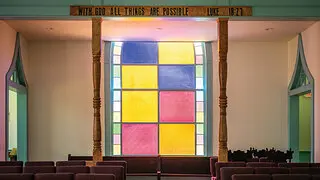
photo by: Kate Medley
Pieces of colored glass were salvaged and repaired.
“This wasn’t just a building restoration. You have a community, a church, a preservation project all rising up together,” says Tyler. “Seeing how this project crossed racial lines and political lines was a testament to what faith and love for one’s community can accomplish. I haven’t been involved in anything like that before. I hope I’m lucky enough to experience it again.”
Wilkins, who was three when Hurricane Isabel struck, spent most of his life seeing Kadesh Church as a ruin.
“It was an abandoned old building. I thought, ‘Why don’t they just knock it down?’” says Wilkins. “Once the windows started coming back in, seeing the light pouring through the colored glass, with the walls once again shored up, that’s when it clicked for me. This building has another 100 years to go. Now, when I see old, dilapidated buildings, I think, ‘They still have some life left.’”
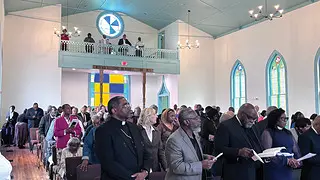
photo by: Edenton Social Light
Inside the church on the day of its reconsecration and dedication in April 2026.
On Sunday, April 26, 2026, nearly 23 years after Hurricane Isabel, Kadesh Church held its grand reconsecration and dedication service. It was led by its pastor, the Rev. Haywood Dillahunt, along with the Rev. Fondella Leigh, presiding elder of the Edenton District, and the Eastern North Carolina Episcopal District of The A.M.E. Zion Church’s presiding bishop, the Rt. Rev. W. Darin Moore. By all accounts, the day was long, joyful, and tear-filled.
“My heart was overwhelmed. Tears just rolled,” says Riddick. “It felt so good to be home. I don’t have a trace of cancer. God said, ‘I kept you with me for a reason. I wanted you to see this church restored.’”
Once again, Kadesh is a place for not only worship but also regional and local gatherings. On the afternoon of July 5, the church hosted a free public concert featuring the multi-congregational Edenton District Choir Plus, guest choirs the United Women of Praise and the United Men of Praise, and a gospel group, the Southern Jubilaires of Elizabeth City. The place was packed, including the interior balcony, below which hung a wooden sign with a famous Bible verse: “With God all things are possible.”
Anticipation built with every warm-up beat of the kick drum, every bass thump, every electric-guitar lick. Once the pews filled, ushers hustled to add chairs along the aisles. Latecomers had to stand in back. Soon, a chorus of voices filled the vast space. Sun streamed through the windows, bathing the original pine floor in shades of lavender, green, and yellow. Audience members leapt to their feet, lifting hands and eyes to the ceiling, singing and shouting praises. And the voices rose and rose, as if determined to be heard in heaven.
Save Historic Places That Tell Our Full American Story
When you join the National Trust, you help save historic and culturally significant places nationwide.