Places Restored, Threatened, Saved, and Lost in Preservation Magazine's Spring 2026 Issue
In each Transitions section of Preservation magazine, we highlight places of local and national importance that have recently been restored, are currently threatened, have been saved from demolition or neglect, or have been lost. Here are five from Spring 2026.
Lost: Sutton Hall
Conceived in the 1920s as one of the state’s first planned golf course communities, Temple Terrace, Florida, featured a notable collection of Mediterranean Revival–style structures. Architect M. Leo Elliott designed many of them, including the home of the Temple Terrace Country Club, completed in 1922. Florida College acquired the building in the 1940s and renamed it Sutton Hall, using it primarily as a women’s dormitory. For decades, it was a focal point on campus—the structure’s clay tile–roofed central tower is even integrated into the college logo. But in October 2024, Florida College announced plans to demolish Sutton Hall, citing severe structural issues that would make restoration “financially impractical,” according to a statement released by the school.
Grant Rimbey, past president of the now-defunct Temple Terrace Preservation Society, says it “was basically demolition by neglect.” Upon learning about the threat, Temple Terrace resident Juan Carlos Pérez-Duthie joined the city’s historic preservation board and started a campaign to save Sutton Hall. “The building withstood the fury of numerous hurricanes, but obviously you have to maintain [structures] that are mostly wood and stucco,” says Pérez-Duthie, who gathered more than 1,000 supporters of the building on a “Save Sutton Hall” Facebook page. “If you don’t do that, even a well-built structure such as this one is going to fall into disrepair.” Florida College razed Sutton Hall in July 2025.
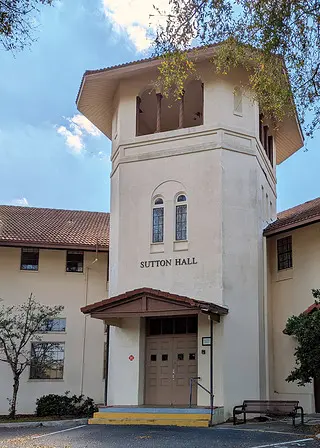
photo by: Juan Carlos Pérez-Duthie
Sutton Hall

photo by: Frank Graziano
Capilla de San Antonio
Restored: Capilla de San Antonio
In October 2025, Nuevo Mexico Profundo, a nonprofit dedicated primarily to preserving historic religious buildings throughout New Mexico, helped restore Capilla de San Antonio, a 200-plus-year-old adobe chapel in a small community near Santa Fe. “They were able to raise the funds for us to get that done, [largely from] donors,” says Larie Mora, one of the site’s owners. “It was just a godsend.” Archdiocese of Santa Fe archives show that the Catholic Church granted a license to build the small chapel on April 28, 1818, and Capilla de San Antonio was completed circa 1820. Named for St. Anthony of Padua, the chapel sits on land owned by the Mora family for generations. Over time, the structure’s stucco exterior began to crack, allowing water to infiltrate and threaten the adobe behind it.
Michael Roybal and his team at Southwest Plastering Co. stabilized the exterior with fiberglass stucco mesh. Then they covered the chapel in a breathable stucco. “You need to have permeable material over adobe so it will breathe,” says Roybal. The chapel opens to the community annually in June for the Feast of St. Anthony, and the tradition will continue this year. Frank Graziano, director of Nuevo Mexico Profundo, says the $9,150 raised for the restoration came mostly from locals. “People have strong emotional attachments to these chapels,” he says.
Stay connected with us via email. Sign up today.
Saved: Char House
The Imperial Sugar Company’s cane sugar refinery opened in Southeast Texas in 1843, more than a century before the city of Sugar Land was established there. Since ceasing operations in 2003, the plant’s most iconic building, the Char House, has sat vacant. Now, it has renewed hope: The city acquired the former industrial site in June 2025 and is slated to break ground on the first phase of the building’s rehabilitation later this year. Constructed in 1925, the Char House once contained machinery that used bone char to remove impurities from liquid sugar. A 1970s renovation of the redbrick structure replaced many of its original steel windows, but the north facade remained untouched and will serve as a reference point for the team to replace the non-historical windows.
“It really will turn it back to what it once looked like,” says Laura Carrera, a partner at Urbano Architects, the firm selected to lead the work. The first phase of the project also will include stabilizing the structure, improving ventilation, and restoring the “Imperial Sugar” signs crowning the roofline. The city is seeking a developer partner to help determine the Char House’s future use. “We are restoring the most authentic place in our community,” says Jessica Huble, the city’s assistant director of redevelopment. “This is where our legacy started.”
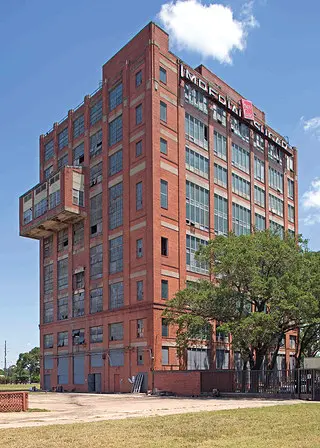
photo by: Gerald Moorhead
Char House
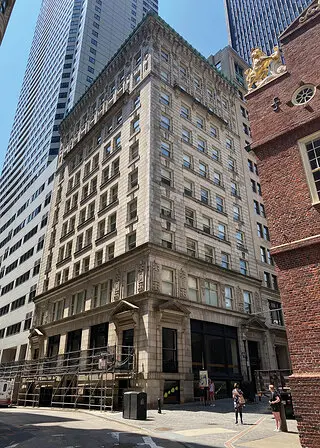
photo by: Stone & Lime Historic Restoration Services
Easton Building
Restored: Easton Building
Each year, millions of people pass by the historic Easton Building, situated along Boston’s Freedom Trail. Now, they can marvel at the 11-story Beaux-Arts structure in all its original glory following a restoration completed in November 2025. When built in 1902, the Easton Building’s steel-frame construction was “considered pretty cutting-edge,” says Chris Dabek of Stone & Lime Historic Restoration Services. “What they didn’t realize is, if you build the masonry really tight up to the steel, over time, once water gets in, the steel starts rusting and [damages] the granite.” The National Park Service, which has owned and used the Easton Building as office space since the 1970s, hired Stone & Lime to oversee the $21.5 million project.
The team also included architecture firm Page (now Stantec) and engineers from Simpson Gumpertz & Heger. Crews remediated the steel and repaired and replaced the building’s exterior Milford pink granite as needed. They also implemented a cathodic protection system—“a low-voltage current that actually runs through all the metal components,” says Dabek—that will prevent the steel from corroding in the future. As of press time, the park service has not announced how it plans to utilize the Easton Building, but those who pass by daily seem to have enjoyed seeing the scaffolding come down after the four-year-long restoration. “I’ve been getting a lot of feedback from commuters,” Dabek says. “It’s been very positive.”
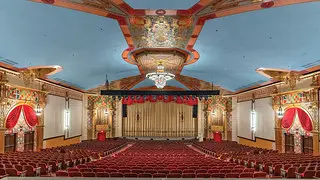
photo by: Todd Murray
Landsdowne Theater
Restored: Lansdowne Theater
The Lansdowne Theater’s revival was nearly 20 years in the making. After purchasing the historic cinema in 2007, the nonprofit Historic Lansdowne Theater Corporation began steadily raising funds for its preservation. A $21 million rehabilitation completed in August 2025 took the southeastern Pennsylvania gem back to its original grandeur.
Designed by architect William Harold Lee in the Spanish Colonial Revival style, the Lansdowne Theater opened in 1927 and became an anchor of the community. But with the rise of VHS tapes and multiplex theaters in the 1980s, single-screen cinemas like the Lansdowne took a hit. The already struggling theater shuttered after an electrical fire in 1987.
“We decided early on that we wanted to keep the auditorium intact, because it had been a single-screen movie theater from when it opened [to] when it closed,” says Matt Schultz, executive director of Historic Lansdowne Theater Corporation. To achieve this while also making the project financially viable, the nonprofit decided to transform the Lansdowne Theater into a live music venue. Atkin Olshin Schade Architects designed the rehabilitation, and EverGreene Architectural Arts brought back original interior detailing such as the intricately painted arched balconettes that flank the stage. Federal historic tax credits and other public funding, donations from individuals and private foundations, and multiple grants (including two from the National Trust for Historic Preservation) made the project possible.
Save Historic Places That Tell Our Full American Story
When you join the National Trust, you help save historic and culturally significant places nationwide.
.webp)