Places Restored, Threatened, Saved, and Lost in Preservation Magazine's Winter 2026 Issue
In each Transitions section of Preservation magazine, we highlight places of local and national importance that have recently been restored, are currently threatened, have been saved from demolition or neglect, or have been lost. Here are five from Winter 2026.
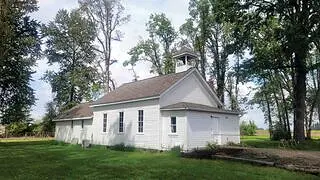
photo by: Peggy Sigler
Restored: Mark Prairie Schoolhouse
When two oak trees fell on a 19th-century schoolhouse during a February 2021 storm in Clackamas County, Oregon, there was never a question as to whether the structure would be saved. “Everyone jumped on board quickly,” says Peggy Sigler, a longtime preservationist and former National Trust employee who managed the restoration. The Mark Prairie Schoolhouse is named for John and Mary Francis “Fanny” Mark, who arrived in Clackamas County in 1847 via the Oregon Trail and settled on the land where the schoolhouse was later completed. After the school closed in 1946, the Mark Prairie Community Club (today the Mark Prairie Historical Society) assumed ownership and maintained the wood-framed structure as a community gathering space for decades.
When the trees fell, they destroyed the 1879 building’s roof and parts of its walls, but many other original features, like its old-growth Douglas fir floors, survived. Led by the Mark Prairie Historical Society, a group of local volunteers assembled to start rebuilding. They had new Douglas fir milled to match the damaged interior paneling and used salvaged materials whenever possible—including white oak from the very trees that caused the destruction. The project received funding from 24 grants, including two from the National Trust for Historic Preservation. The 1,600-square-foot schoolhouse, which reopened in May 2025, now serves as an event venue in addition to a community gathering space.
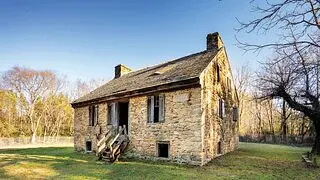
photo by: Connor Franklin Leland
Threatened: Rock House
The Rock House in McDuffie County, Georgia, is believed to be the oldest surviving stone house in the state, with dendrochronology dating it to circa 1795. It’s one of the few extant remnants of Wrightsboro, founded as a Quaker community in the 18th century. Despite its historical significance, the structure is slipping into disrepair, prompting its addition to the Georgia Trust for Historic Preservation’s 2025 Places in Peril list. Historian and retired professor Robert S. Davis, who has spent years researching the site, believes the house’s first owner was someone connected to Thomas Ansley, who held the deed to the land around the time it was built. The builder may have used enslaved labor, but there are no records of the Rock House’s provenance.
President Jimmy Carter was a descendant of Ansley, adding to the site’s historical value. The county took over stewardship from the previous owner, a nonprofit focused on Wrightsboro’s history, in 2016. A 2022 master plan prepared by Ethos Preservation states that threats include neglect, vandalism, water intrusion, and structural issues. The county earmarked $750,000 for the Rock House’s restoration, but the 2022 report estimates that restoring the structure—and turning it into a publicly accessible historic site, the county’s end goal—will cost more than $1.4 million. “It would be a nice tourist attraction,” says Chase Beggs, chairman of the McDuffie County Board of Commissioners. “The county just doesn’t have funds for the restoration.”
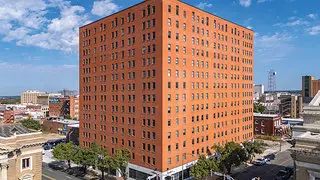
photo by: BOLD Photography
Restored: Town House Apartments
Once on its way to becoming uninhabitable, Fairmont Tower in Shreveport, Louisiana, is now filling a need for affordable housing. New Orleans architect Rene F. Gelpi designed the 14-story, L-shaped building, originally called the Town House Apartments and completed in 1952. The Midcentury Modern tower’s reinforced concrete frame is faced with marble on portions of the ground level and brick on the upper stories. By the time developer Midland Residence purchased it in 2023, the 200,217-square-foot apartment complex “was in pretty tough condition,” says Midland Principal Michael Packard, particularly the interior finishes. Plaster was coming off the corridor walls due to water intrusion, and the front doors to the units were falling apart. Crews repaired the exterior marble, repointed the brickwork, replaced the leaking roof, and replicated original interior details in the lobby and corridors.
Low-Income Housing Tax Credits, as well as federal and state historic tax credits, helped fund the $22 million project. Midland unveiled the resulting 254 units of low- and moderate-income housing, designed by architecture firm DNA Workshop, in May 2025. “I’m always drawn to places like this that are well built,” says Packard. “Utilizing these existing buildings, that are frankly more durable than any new stuff that would be built, makes for a better project.”
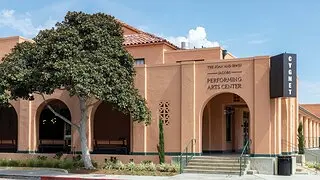
photo by: Karli Cadel Photography
Restored: Naval Training Center San Diego, Building 178
When the United States Navy decommissioned Naval Training Center San Diego in the 1990s, the sprawling 565-acre site—and the dozens of historic buildings it contains—presented a massive opportunity for adaptive reuse. As the city of San Diego developed plans for the property, today known as Liberty Station, it set aside 26 buildings for an arts and culture district. The NTC Foundation (now Arts District Liberty Station) formed in 2000 to realize this vision. In September 2025, the nonprofit unveiled its 18th successful adaptive reuse project: the $43.5 million transformation of Building 178, a former naval recreation space, into The Joan and Irwin Jacobs Performing Arts Center, a 42,000-square-foot venue designed by obr Architecture.
Constructed in 1942, the Spanish Revival–style building saw some alterations over time, notably when its arched arcade and colonnades were enclosed in 1960. “We chose to take it back [by] opening up those beautiful breezeways surrounding the building,” says Lisa Johnson, Arts District president and CEO. Before repairing the roof, crews removed and catalogued the original red clay tiles. “When they were ready to put the roof back on, they actually put historic tiles back into the same spot where they took them off,” says Johnson. The Joan’s fully renovated interior—featuring two state-of-the-art theaters designed by Fisher Dachs Associates—is the new permanent home to local theater company Cygnet Theatre, which partnered with Arts District on the project.
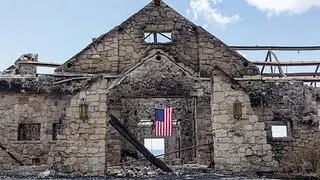
photo by: Matt Jenkins/NPS
Lost: Grand Canyon Lodge
The original Grand Canyon Lodge burned down just four years after its 1928 completion, so architect Gilbert Stanley Underwood designed his second iteration with fire resistance in mind. “They tried to construct it very closely to what the old one was, but they made a lot of improvements to try to make it last a little longer,” says Davy Crockett, vice president of the Grand Canyon Historical Society. “They used a lot more stone this time. Instead of log supports in the roof, they had metal supports.”
Despite these safeguards, the 1937 lodge on Grand Canyon National Park’s North Rim was no match for the Dragon Bravo Fire, which first ignited during a July 2025 lightning storm. The blaze severely damaged or destroyed more than 100 structures—the Grand Canyon Lodge being the most historically significant among them. “It was a very unique structure in that it kind of hung on the rim of the Grand Canyon,” says Crockett. “It looked like it was almost part of the rocks, growing out of the cliffs, and had a magnificent view [from its] giant windows.”
The lodge served as a key vista point and visitors’ hub at the Arizona park for more than 85 years. “So many people, in many different ways, had a connection with the North Rim and the lodge in particular,” says Crockett. “There’s a lot of grief.”
Save Historic Places That Tell Our Full American Story
When you join the National Trust, you help save historic and culturally significant places nationwide.
.webp)