Scenes from New York's Lower East Side, Where Newcomers Became Neighbors
As we commemorate the 250th anniversary of the United States, we honor its history as a place of opportunity for people from all over the world. One of the best ways to experience that history is to visit New York City’s Tenement Museum, a National Trust Historic Site. Along with its intricately detailed re-creations of apartment dwellings from various time periods and its digital archive of more than 18,000 (and counting) personal stories, the Tenement Museum also holds a 15,000-item collection that includes a trove of historical photos. These images, taken from the 1860s onward, help us understand the daily lives of immigrants and migrants to the Lower East Side neighborhood.
Two of the best-known photographers represented in the collection are Arnold Eagle, a Hungarian immigrant who captured 1930s scenes on the Lower East Side for the Works Progress Administration, and Edmund V. Gillon Jr., an architectural writer who trained his camera on buildings and street scenes in the 1970s and ’80s. With the Tenement Museum’s help, we’ve pulled some of our favorite images by Eagle and Gillon to share with you here.
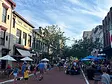
Shown at top: The corner of Orchard and Rivington streets on New York's Lower East Side during the 1970s. Image has been cropped.

photo by: Arnold Eagle/Tenement Museum Collection
The photo above shows a Lower East Side street scene in the 1930s. At that point in time, the neighborhood’s once-swelling population had declined because of strict national limits on immigration. But it still bustled with tenement dwellers, mostly of Jewish and Italian heritage. Image has been cropped.

photo by: Arnold Eagle/Tenement Museum Collection
A toddler in a neighborhood tenement apartment during the 1930s. Storage was scarce, so tenement dwellers had to use any available surface and create makeshift solutions like the string holding kitchen towels above the coal-fired potbelly stove. Tenement Museum Collections Manager Lana Dubin says this interior resembles apartments that existed at the time at 97 Orchard Street, where the museum is now located. Image has been cropped.

photo by: Arnold Eagle/Tenement Museum Collection

photo by: Arnold Eagle/Tenement Museum Collection
A photo showing a woman and four children inside the doorway of a 1930s tenement apartment was used as a reference when the Tenement Museum was re-creating pre–World War II interiors at 97 Orchard Street. The museum later purchased another building at 103 Orchard Street, which gave it the space to interpret the lives of postwar Lower East Side residents as well.
Southern Italian immigrants, including a girl wearing a communion dress, gather in front of an Italian grocery store in the 1930s. This photo echoes the themes explored in the museum’s current “Lived Religion” initiative, which examines the historical role of religion in the lives of immigrant and migrant families. Images like this are “not just about visual culture,” Dubin says. “We also get conceptual ideas, and it helps us understand the neighborhood.”
Stay connected with us via email. Sign up today.

photo by: Edmund V. Gillon Jr./Tenement Museum Collection
A group of Italian American men play bocce on the Lower East Side during the 1970s. Italian immigrants helped popularize bocce in the United States starting in the 1880s, and the sport is still enjoyed around the country today. Image has been cropped.

photo by: Arnold Eagle/Tenement Museum Collection
An Ashkenazi Jewish woman and girls perform a folk dance in a playground near 97 Orchard Street. The 1930s-era photo conveys the desire of immigrants and their children to learn about their culture of origin while living in a diverse neighborhood and nation. Image has been cropped.

photo by: Edmund V. Gillon Jr./Tenement Museum Collection
By the 1970s, a less-populated Lower East Side reflected the downturn in the local and national economies. But a post-1965 wave of Chinese immigrants was helping to keep the area going, and the classic tenement units upstairs still provided an affordable housing option. Image has been cropped.

photo by: Edmund V. Gillon Jr./Tenement Museum Collection

photo by: Edmund V. Gillon Jr./Tenement Museum Collection
A 1970s photo depicts a group of men playing cards at a table set up on the sidewalk. During this time period, many Puerto Ricans and Black Americans, as well as immigrants from China, moved to the Lower East Side. A Chinese restaurant in the background highlights the neighborhood’s changing demographics.
The first floor at 97 Orchard Street was occupied by a hat shop called Feltly Hats, and the basement level by Sidney Undergarments. Apparel stores and garment manufacturing served as mainstays of the neighborhood economy during the 1970s.
To learn more about what life was like for immigrants and migrants to the Lower East Side during various time periods, visit the Tenement Museum.
Save Historic Places That Tell Our Full American Story
When you join the National Trust, you help save historic and culturally significant places nationwide.