Not One Size Fits All: 6 Lessons on Interpretation at Historic Sites
Takeaways from the Interpretation and Education Social Innovation Lab.
What happens when 45 museum educators, interpreters, tour guides, curators, and public historians gather in one place? The answer: More collaboration, energy, and innovation.
In March 2026, representatives from 25 of the 27 National Trust Historic Sites gathered in New York City to explore and learn from other storytellers and institutions as part of the Interpretation and Education Social Innovation Lab. The Lab was supported by the Marder-Vaughn Center for Interpretation and Education and the Historic Sites Department’s I&E Training Fund.
Over the course of three days, the group visited historic sites across the city while also hearing from thought leaders and participating in hands-on workshops. We asked them to share some of the key lessons and takeaways from the experience.
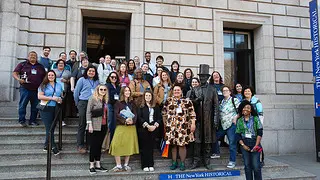
photo by: Brian Palmer
Attendees of the 2026 Interpretation and Education Social Innovation Lab at the New York Historical Society (with a special guest!).
Do not shy away from the messy or speculative aspects of history
Nicolas S. | Visitor Services and Interpretation Assistant
Cooper-Molera Adobe (Monterey, California)
[During the retreat] I got to see that tours discussing things such as family tragedies or how members of a family may have reacted to the news, politics, and events of the time were very engaging to visitors. Even if we don’t know exactly how particular people reacted to events, we can still invite guests to wonder how they may have, allowing for a more open engagement with the period being interpreted.
At Cooper-Molera Adobe, we’ve been working to incorporate more of that mindset into our programming, though it’s certainly going to be a long process. A recent success was an event we ran during Women’s History Month, which in part discussed the women in the Cooper and Molera families that had ownership of the property for most of its history. As part of this event, we discussed some of the reasons they may have chosen to pass the property to other women in the family.
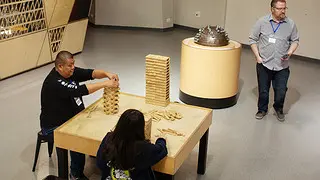
photo by: Brian Palmer
I&E attendees explore hands-on activities at the New York Hall of Science.
Interpretation and storytelling are things you are constantly learning and honing your craft.
Carolyn W. | Education Director
Cliveden (Germantown, Pennsylvania)
The Innovation Lab included workshops on dialogic interpretation and storytelling. By participating in these workshops, I learned not only from the facilitators but from the staff at other sites within the National Trust portfolio. Our workshop with The Moth, a nonprofit dedicated to the art and craft of storytelling, helped me hone my skills as a storyteller and shared practices I will use with the interpretive staff at Cliveden. After several opportunities over the years to participate in convenings with interpretation and education leaders across the portfolio, each time I am grateful to meet and learn from others within the National Trust and to be reminded that methods of interpretation and storytelling are a craft that you continually cultivate.
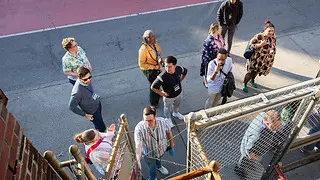
photo by: Brian Palmer
One of the sites the group visited was The Tenement Museum in the Lower East Side of Manhattan which is an affiliate site of the National Trust. Here they are looking at the rear of the building.
Dialogic interpretation is the future!
Elizabeth R. | Senior Manager of Public Programs & Interpretation
Woodlawn & Pope Leighey House (Alexandria, Virginia)
I believe historic house museums are one of the last places in our society where strangers can come together to have conversations about difficult and pressing topics. There is a particular intimacy in house museums that can be hard to find in gallery spaces. Developing dialogic tours that lean less on the lecture-style “look at how much I know” and leaning into conversation that encourages learning together, we have the ability to break down the barriers dividing us.
Stay connected with us via email. Sign up today.
Our ability to tap into our empathy, personal stories, and individual creativity is vital to us being good stewards and educators.
Valerie B. | Director
Historic Artists’ Homes and Studios
So much of our work is centered in storytelling: to bring forward the voices of individuals who are in the distant past and relating their experiences and contributions to our contemporary visitors. Often, we become too focused on making sure our facts are correct and that we feel we are sharing accurate information. It is easy to forget that any experience at a museum or historic site is ultimately centered in people—past and present—and all the wonderful complexity and contradictions of what it means to be human.
During our experience working with producers at The Moth, we were all asked to present to each other a deeply personal story in a creative and engaging way. Each of us had to be willing to be vulnerable, but also able to tap into our empathy as we listened to our colleagues’ compelling and, at times, traumatic stories. This collective experience was one of the most powerful of my 30+ year career. It reminded me that bringing forward our own uniqueness and openness in dialogue with that of the historic legacies we steward—and the individuals who engage with our sitesis some of the most potent work we can do.
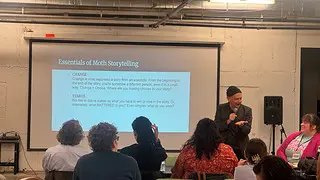
photo by: Elon Cook Lee
The Social Innovation Lab had a variety of speakers, one of which was representatives from the storytelling podcast "The Moth."
There is no "one-size fits all" method, but you can take ideas from multiple sites to incorporate them into your own.
Clint C. | Manager of Public Programs
Gaylord Building Historic Site (Lockport, Illinois)
Even though we're all in the same field, everyone has to deal with site-specific challenges when it comes to interpretation. It’s also important to understand that not every idea will work at every site, but it's still interesting to see how other sites are doing it.
Exploring other historic sites as models can provide solutions for challenges at your own historic site.
Kevin K. | Executive Director
Hotel de Paris (Georgetown, Colorado)
One of the sites the group visited was Fraunces Tavern. Their model incorporated a museum component (period room, artifact exhibits, interpretation) of the property, while other parts continued to embrace the DNA of the site by providing a place to socialize over food and drink.
In 1954, a house museum model replaced the original use of Louis Dupuy's Hotel de Paris. Yet, the setting calls to visitors who want more than a tour. Oftentimes, they wish to become guests at the hotel, instead of just visitors to the museum.
Now that I've had the opportunity to see how museum and tavern operations can coexist, with the support of The National Society of The Colonial Dames of America in the State of Colorado, we are launching Landmark 12, a pop-up wine bar at Hotel de Paris Museum, which will take place during times of peak visitation to Georgetown, Colorado.
Save Historic Places That Tell Our Full American Story
When you join the National Trust, you help save historic and culturally significant places nationwide.