The Shape of Water: Six Historic American Fountains
Fountains serve as architectural celebrations of water and its life-giving, shape-shifting power. Many early examples were largely functional, providing drinking water, while others served spiritual and ritualistic purposes. The fountains gracing historic places across the United States still sustain us, if not as directly, through their soothing sounds, cooling mists, and mesmerizing flow.
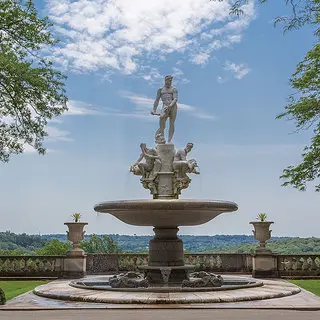
“It’s awe-inspiring, the way the water overflows the basin and then falls like rain,” says Katrina London, curator at The Pocantico Center, referring to the Oceanus Fountain at Kykuit, the Rockefeller estate and National Trust Historic Site 30 miles north of Manhattan. “There are benches beneath the basin where the family once sat under the falling water.”
Conceived by Kykuit’s landscape designer, architect William Welles Bosworth, the roughly 30-foot-tall stone wonder (shown above) contains a larger-than-scale replica of Giambologna’s Oceanus and the Three Rivers, commissioned in the 16th century for the Pitti Palace in Florence, Italy. In the 1913–14 version at Kykuit, 10-foot-tall Oceanus, father of the river gods in Titan mythology, towers over three seated figures—the gods of the Nile, Euphrates, and Ganges rivers—who pour water from ewers into a 35-ton granite bowl. The design implies that the nearby Hudson deserves a spot among the great rivers of the Old World.
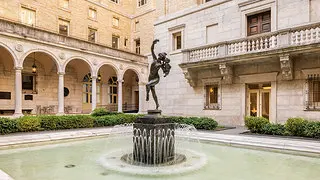
photo by: Raj Das
Frederick William MacMonnies’ "Bacchante and Infant Faun" sculpture atop the courtyard fountain at the Boston Public Library.
Though lovely to see, feel, and hear, water poses a challenge to historic structures, including those expressly designed for its display. A decade ago, the Oceanus Fountain underwent a major restoration: Crews relined it and replaced 54 deteriorating marble paving stones with Alabama limestone. “The big basin, which had tilted slightly, was leveled so the water falls properly,” London says. Each winter, the fountain is covered to protect it from freeze-thaw cycles.
Farther north, a restoration of the Boston Public Library courtyard fountain was completed in 2021. The project included replacing tiles damaged by freezing and thawing water, and updating the plumbing and lighting. The fountain remains the centerpiece of the library’s open plaza, an oasis in the bustling city.
Stay connected with us via email. Sign up today.
During the work, the bronze sculpture at the fountain’s center, Frederick William MacMonnies’ Bacchante and Infant Faun, had to be lifted out by crane—not the first time it was removed. An 1896 gift from the sculptor to the building’s architect, Charles Follen McKim, the piece features a nude pagan reveler holding a baby in her left arm and dangling grapes from her right hand. After a public outcry over the figure’s nudity and perceived portrayal of immoral behavior, the sculpture was given to New York’s Metropolitan Museum of Art. More than a century later, during the 1990s, the library made a copy and returned Bacchante to her original watery perch.
“In the courtyard, with this beautiful fountain in the middle, the sound of the water is so peaceful,” says Finegold Alexander Architects Principal Ellen Anselone, who oversaw the 2021 project. “And then at night, when the lights are on, it’s gorgeous.”
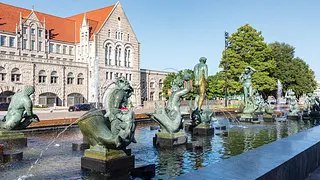
photo by: Barrett Doherty Images
The Meeting of the Waters Fountain in St. Louis’s Aloe Plaza in front of Union Station was designed by the Swedish sculptor Carl Milles and completed in 1939.
Another water feature paying homage to mighty rivers is the monumental Meeting of the Waters Fountain in St. Louis’s Aloe Plaza in front of Union Station. Designed by the Swedish sculptor Carl Milles and completed in 1939, the fountain presents an allegory celebrating the nearby meeting of the Mississippi and Missouri rivers. A male figure representing the Mississippi and female figure meant to be the Missouri are surrounded by water sprites, mermaids, and fish symbolizing the river systems’ main tributaries. Named a city landmark in 1971, the fountain gained a new lighting scheme in 2010 and was resurfaced in 2024.
“Meeting of the Waters is one of this former steamboat city’s most important visual landmarks. Everyone knows the fountain. If it’s a special moment in your life, you go down to Aloe Plaza to get a shot in front of the fountain,” says Bob Bettis, director of the St. Louis Cultural Resources Office, the city’s preservation agency. “It’s important to native St. Louisans, but also to people who pass through Union Station. When you’re a visitor and you stay at the hotel across the street, the first thing you see is this really cool fountain.” (The St. Louis Union Station Hotel is a member of the National Trust program Historic Hotels of America.)
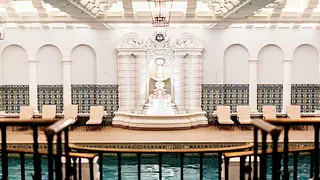
photo by: Intercontinental Chicago
The Neptune Fountain at the InterContinental Chicago Magnificent Mile, which was built in 1929 as the Medinah Athletic Club.
It’s no surprise that Neptune, the Roman god of the sea and fresh water, graces fountains around the world, including the Neptune Fountain at the InterContinental Chicago Magnificent Mile, built in 1929 as the Medinah Athletic Club. What sets this one apart is that it’s indoors and 14 stories above Michigan Avenue. Made from terra cotta and set against a wall of blue Spanish majolica tiles, the fountain faces a junior Olympic-size pool that was once one of the world’s highest indoor swimming pools. Olympic gold medalist and actor Johnny Weissmuller famously trained there.
“The terra-cotta fountain of Neptune on the east wall is one of the hotel’s remaining original features that, to this day, remains virtually untouched,” says Mae Van Beest, marketing manager at the InterContinental Chicago, which is also a Historic Hotels of America member.
The iconic Thompson Elk Fountain in Portland, Oregon, is back as of April 2026 after being damaged during protests in the summer of 2020. Originally commissioned circa 1900, the fountain was named for its benefactor, David P. Thompson, who drove a herd of sheep from Ohio to the Portland area in 1853 at age 19. He went on to become a successful banker, mayor of Portland, and founder of the Oregon Humane Society, to which he dedicated the fountain. To sculpt the 9-foot-tall, one-and-a-half-ton elk—a tribute to the wildlife that once roamed the city—Thompson chose Paris-educated New York City artist Roland Hinton Perry, who also co-created the Court of Neptune Fountain for the Library of Congress’s Thomas Jefferson Building.
Because the Thompson Elk Fountain is a city historic landmark, the publicly and privately funded $2 million-plus restoration followed the Secretary of the Interior’s Standards for the Treatment of Historic Properties. Nine of the roughly 50 stone elements that make up the fountain’s base were beyond repair. Under the guidance of Architectural Resources Group, the project’s preservation architect, they were replaced with granite from the same Vermont quarry as the originals.
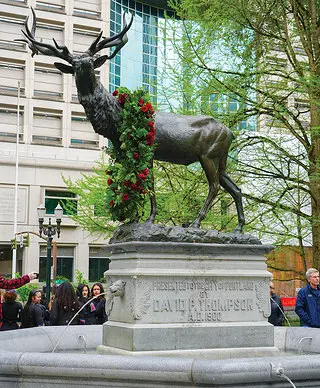
photo by: Portland Water Bureau
Portland, Oregon’s restored Thompson Elk Fountain.
The restored fountain has a sacrificial coating to prevent graffiti, and a new, reinforced concrete foundation that meets current seismic codes. While the original channeled fresh drinking water for humans and horses, the restoration features a recirculating pump that saves up to 18,720 gallons of water per day.
“The Thompson Elk Fountain has been here 120-some years by now. It’s connected to people and concerns of our past,” says Keith Eggener, Marion D. Ross Distinguished Professor of Architectural History at the University of Oregon. “It’s part of what makes Portland a distinct place.”

photo by: The Fountain People
The restored Horace E. Dodge and Son Memorial Fountain in Detroit sprays a cooling mist.
For more than four decades, Detroit’s Horace E. Dodge and Son Memorial Fountain at Hart Plaza, which was completed in 1981, cooled and delighted people of all ages and served as a cultural gathering spot, creating indelible memories. Over a decade ago, however, the fountain fell into neglect and disuse, becoming “just one more thing Detroiters felt was taken from them,” said former Detroit Mayor Mike Duggan.
Duggan was speaking at a June 2024 unveiling of a meticulous $6.7 million fountain restoration paid for with American Rescue Plan Act (ARPA) funds. During Detroit’s hot summers, water once again pours from a massive horizontal stainless-steel ring suspended 30 feet above the plaza hardscape by two diagonal legs. Streams plunge into an 8-foot-tall granite basin, sending water cascading over the sides. Thanks to around 200 spray and mist jets, a vapor cloud hovers around the futuristic ring. Detroiters owe this wonder and excitement to the fountain’s creator, the legendary artist and designer Isamu Noguchi, who called the plaza fronting the Detroit River a “horizon for the people.” Noguchi experimented with programmed spray patterns and complex lighting schemes, some of which were enhanced in the restoration with new LED fixtures and automated operational systems for precision control.
“Noguchi really wanted this fountain and plaza to serve as a public space for Detroiters,” says Rhea Bautista, capital planning manager for the city’s Construction and Demolition Department. “It’s an honor to keep that intent moving forward, to see a new generation enjoy this fountain. I love hearing the stories from Detroiters of when they were kids running through the fountains, and now you’re seeing a new generation enjoying it.”
Save Historic Places That Tell Our Full American Story
When you join the National Trust, you help save historic and culturally significant places nationwide.