Passing the Torch at the Century-Old St. Adalbert Catholic Church in South Bend, Indiana
The neighborhood around St. Adalbert Catholic Church in South Bend, Indiana, has undergone dramatic change since the parish was founded 116 years ago. But in many ways the church remains largely unchanged, as does its mission: to provide a welcoming spiritual home for immigrants as they find their place in America. The current building with its soaring towers, designed by the Chicago firm of Worthmann & Steinbach in the Neo-Gothic style, is undergoing exterior restoration with the aid of a $250,000 grant from the National Fund for Sacred Places, a program of Partners for Sacred Places in collaboration with the National Trust. We visited with the Rev. Ryan Pietrocarlo, pastor of St. Adalbert’s and its sister church, St. Casimir, about the building’s history and its restoration.
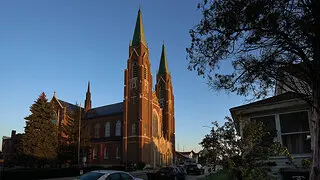
photo by: Matthew Gilson
St. Adalbert’s is currently undergoing exterior repairs and stabilization.
Tell us about the founding of St. Adalbert’s.
The parish was founded in 1910, and it was mostly immigrants from Kraków, Poland. They started to arrive in the late 19th century to work in factories in South Bend, and as the community grew, there was the need for a new parish. The parishioners themselves got together around 1905 to begin planning [a church]. It got approved by the diocese in 1909, and they began building the first church, which today is our school.
But the community kept growing. They grew out of that building, and they decided to build a bigger church. They started in 1923 and they finished it in 1926. They came together, they fundraised, they asked the businesses in South Bend—many were owned by Polish immigrants—to help. Many parishioners donated their skills. They’d work in the factories during the day, they’d come in at night and work, they’d work on weekends, and over a period of three years, they built a marvel.
Stay connected with us via email. Sign up today.
The community started out heavily Polish, but it’s changed dramatically.
Yes, the first immigrants from Mexico came in the 1950s to work in farming. They were just here for the summers. In the ’70s, some begin to stay and have their families here. Other parishes took them in at first. The most recent was a parish called St. Stephen’s, in downtown South Bend. The diocese had to close that church in 2003 due to the building’s structural instability, and it moved the [congregation] to St. Adalbert’s. That was when the Hispanic community really [took hold] at St. Adalbert’s, and [it’s] grown tremendously in the past 22 years.
It’s often a challenge when a community changes that quickly. How was it at St. Adalbert’s?
It was difficult when the Hispanic population first moved over. It happened fast, [and] there was some resistance from longtime parishioners, but over the years, they have really jelled together. There’s lots of similarities between the cultures. One is actually music. Polka and mariachi have similar rhythms. We’ve had parish festivals where we have a Polish couple dancing a polka to the mariachi. Both groups also have a devotion to Mary, the Blessed Mother, and we have a lot of images of her in the church, so they bond there. The Polish parishioners see that [the Hispanic parishioners] are the next generation, and they see they’ll keep the parish going.
One of the church’s interior highlights is a mural by John A. Mallin that tells the early story of the church.
It’s a neat mural. It depicts the Polish immigrants arriving in South Bend and the three areas they worked in; there’s construction—they’re actually building St. Adalbert’s church—there’s farming, and in the background are the factories.
But their life is difficult, and so in the mural they’re talking to their parish priest (thought to be the founding pastor of St. Adalbert’s) and they’re asking him, why is our life so hard?
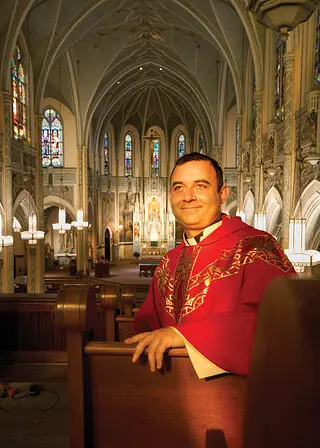
photo by: Matthew Gilson
The Rev. Ryan Pietrocarlo inside the church, with stained-glass windows visible.
And he’s pointing them to an image of Jesus, who’s on the cross in the half-sun, and there‘s a Polish [inscription] around that half-sun, and it translates to: “By the sweat of your brow, you will win the bread of life.” Meaning all your work is leading you to salvation; this is not in vain. So it’s a mural of hope, and our Hispanic immigrants find the same hope in it because they came for the same reasons.
Tell us about the ongoing restoration.
We started about three years ago. For the longest time, there were never enough funds to do the maintenance necessary on the church. We have a parishioner, Donald Popielarz, who’s a retired lawyer, and he had some time and he loved the parish. He said, “I want to help you find a way to preserve this,” because it’s an important spiritual center, of course, but also a center for a lot of social services. It’s a cultural center, social center, economic center for the Hispanic community.
We began a fundraising campaign and we got a lot of support from businesses, people from the area that see the value in the church. And the grants from the National Fund for Sacred Places and Sacred Places Indiana were a big help. We have enough to do the exterior, which we’re working on right now. We have a new roof. Now it’s a lot of brick repair. So it’s tuckpointing, but also there are parts of the church, especially near the top, where the bricks are [unstable], so those sections have to be rebuilt.
Additionally, the east towers have lasted 100 years, but now we need to add more steel reinforcement. The cost of the whole exterior project is around $3.4 million. We’ve raised enough to finish it. It’s beautiful to see how it’s come together.
What’s ahead for St. Adalbert’s?
After the exterior’s done, we have to update our heating system, which is from 1957. And then [add] some new bathrooms. Then it will be the artistic restoration of the interior. The murals [by John A. Mallin], we’ll get those cleaned up and brighter again. We’re looking at repainting the ceiling and the columns.
St. Adalbert’s is a very special place, not just for the history. People have come here to get an education, to get healthcare for the first time, social services for the first time, to kind of find their life. It’s just a hub of life and friendship. The key is to keep that alive. That’s our goal in this whole project.
Save Historic Places That Tell Our Full American Story
When you join the National Trust, you help save historic and culturally significant places nationwide.