Bricks and Books: Students and Locals Cross Paths in These Five Historic College Towns
What makes a college town? Perhaps it’s when campus boundaries creep past official ones, into historic main streets where students can be found taking your order at a decades-old pub or browsing produce alongside locals at the farmers’ market. Maybe it’s when longtime residents know the exact dates of summer break—their annual reprieve from the youthful chaos—and students call locals “townies” or some other mildly pejorative nickname. Or maybe it’s the ineffable feeling that this is a place where ideals and identities are taking shape.
More than anything, it takes time to become a college town, with the school’s history often stretching back nearly as far as the place it calls home. Such is the case with Oregon State University (OSU) in Corvallis, Oregon.
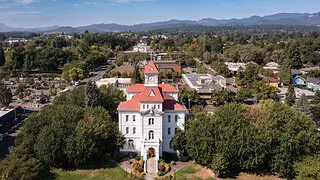
photo by: Manuela Durson/Alamy
The 1880s Benton County Courthouse in Corvallis, Oregon.
Chartered as an agricultural school in 1868, just over a decade after Corvallis became an incorporated city, OSU acquired 35 acres for a college farm in the early 1870s. It wasn’t until the late 1880s that the school completed its first structure there, an Italianate administration building today known as Community Hall. “That was the beginning of the campus as we know it,” says Larry Landis, a retired OSU archivist who helped get the university’s core campus designated as a National Historic District in 2008.
Much of that district’s architectural significance can be attributed to a 1909 campus plan by John Olmsted, a relative of famed landscape architect Frederick Law Olmsted. Many of the redbrick and terra-cotta trimmed structures from that era remain standing today, some “adaptively reused [as] 21st century academic buildings, but maintaining a lot of the historic character,” says Landis.
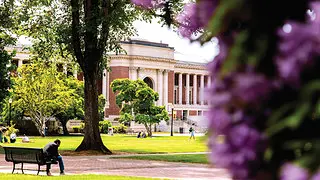
photo by: Kai Casey
OSU’s 1920s Memorial Union building.
About eight blocks from campus, students and the local community cross paths at the Corvallis farmers’ market, which crops up seasonally in the historic riverfront area. In a 1927 Italian Renaissance–style former hotel downtown, students can be found celebrating their 21st birthdays at Treebeerd’s Taphouse or hiding behind laptops at Futura Coffee Roasters. When frequenting downtown businesses, Landis says, he “can’t go anywhere without running into an OSU colleague.”
Across the country, The Pennsylvania State University was established in 1855, more than four decades before the borough of State College, Pennsylvania, was formally incorporated. The school completed its first significant structure, the Main Building, in 1863. In 1929, it was razed and replaced with the now-iconic Old Main, built in 1930 using limestone from the original building. On warm days, the lawn that stretches out in front of the Federal Revival edifice is a popular student gathering spot.
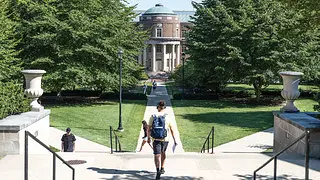
photo by: Penn State Creative Commons
Penn State’s historic Steidle Building.
Off campus, Penn State’s fraternity district is filled with grand, century-old Gothic and Tudor Revival houses that still host Greek life. Downtown on College Avenue, the circa-1855 Hotel State College maintains its original use, but the other businesses on the property—a 100-year-old restaurant, a gay bar, and a pub with live music—are what attract students.
“If you were to come to the center of town, you would find the sidewalks continually packed with people—students, by and large,” says Roger L. Williams, a former Penn State staff member and current president of Centre County Historical Society. “It’s wonderful to be around young people who are really trying to carve out their own futures.”
With its mild climate and plenty of sunny days, that youthful vibrancy is in the air year-round in Boulder, Colorado. University of Colorado Boulder students and town residents can be found enjoying the tens of thousands of acres of open space that form a buffer around the city, settled in 1858.
“While we [often] focus on what occurred starting in the 1800s, there’s been thousands of years of people living here,” says Leonard Segel, former executive director of Historic Boulder and a former architecture instructor at the university. After gold prospectors arrived in the late 1850s and word spread about Boulder’s bounty, white settlers forced Native Americans out of the area.
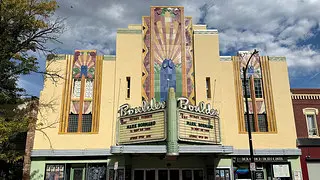
photo by: Leonard Segel
The Boulder Theater.
In its early years, Boulder looked like something out of a Wild West film—“dusty streets with saloons and gunfights,” says Segel—until the university was established in 1876. The school completed its Gothic Revival Old Main building the same year. Despite a plan to tear it down in the 1920s, Old Main persisted and remains a campus centerpiece following a major restoration completed in 2025.
Other parts of campus feel like an Italian village, thanks to architect Charles Klauder, who completed the master plan design in 1919. “The rural hill towns of Tuscany inspired him,” says Segel. “He proposed that new buildings be designed using local sandstone, Indiana limestone trim, and also red clay tile roofs.”
Stay connected with us via email. Sign up today.
A quick bike ride from campus, Pearl Street Mall is a four-block pedestrian stretch of shops and restaurants, with buildings from the 1880s to 1930s. One block up, a 1906 opera house, now a music and event venue called the Boulder Theater, attracts both students and locals. In partnership with Historic Boulder, the theater recently completed a restoration of its dramatic Art Deco facade.
At Hampton University, a historically Black school in Hampton, Virginia, students had a hand in building some of the campus’ oldest structures—and that learn-by-doing approach continues in some ways today.
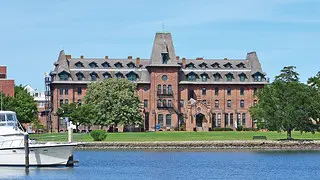
photo by: Calder Loth/Virginia Department of Historic Resources
Virginia-Cleveland Hall at Hampton University.
The city now called Hampton was settled by British colonists in 1610 and had grown into a thriving port town. “In August 1861, a Confederate force destroyed Hampton by fire to prevent its occupation by people escaping slavery,” says Beth Austin of the local Hampton History Museum. But enslaved people continued to take refuge at nearby Union-held Fort Monroe and within the burned ruins of Hampton. Members of this community eventually began gathering beneath an oak tree to learn from a local teacher, and the tree came to symbolize the association between freedom and education. Today known as Emancipation Oak, the tree is a landmark on Hampton University’s campus.
The school first opened in 1868 under the leadership of Civil War Brig. Gen. Samuel Chapman Armstrong, who sought to create an institution that emphasized moral education alongside a learning-by-doing ethos.
Part of that approach meant students participated in campus construction. In 1882, Hampton students helped build Stone Manor, which now serves as an office building and residence hall after a 2008 renovation. Architecture professor Carmina Sánchez-del-Valle says that architecture students are encouraged to continue Hampton’s hands-on legacy, with a local focus: As part of recent coursework, students imagined ways that a 1938 fire station in the city’s Phoebus Historic District could be adaptively reused.
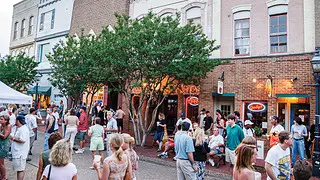
photo by: Jeffrey Isaac Greenberg 8+/Alamy
Dining options in downtown Hampton.
In that same historic district, students and city residents can catch a classic movie at The American Theatre, a restored 1908 cinema that reopened in 2000 and is now a beloved arts venue. After the curtains are drawn, showgoers might be found congregating a few doors down at Sly Clyde Ciderworks, a taproom in an early 20th-century brick house.
“When students are away during the summer, the merchants in Hampton cannot wait until they return,” says Robert Watson, history professor at the university. “The economic impact is profound.”
That’s also the case in Wooster, Ohio, where a once struggling downtown now fills with residents and students from The College of Wooster on the weekends. After the town of Wooster joined Main Street America, a partner of the National Trust, in the 1980s, empty historic storefronts gradually filled.
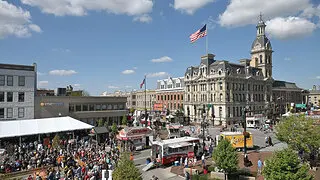
photo by: Matt Dilyard/The College of Wooster
Wooster’s Wayne County Courthouse.
“I see more students downtown now patronizing restaurants and shops than I’ve ever seen, frankly, in almost 30 years,” says Jeff Musselman, College of Wooster alumnus and past president of the Wayne County Historical Society of Ohio.
The city first saw population and economic growth after the arrival of the railroad in 1852. The joint Ohio Presbyterian Synods founded The College of Wooster in 1866, notably welcoming students regardless of race or sex. The school’s original Old Main building burned in a devastating 1901 fire but was swiftly replaced by the Collegiate Gothic–style Kauke Hall, completed in 1903. After a 1960s remodel covered Kauke Hall’s original architectural features, such as its interior brick arches, the college brought them back in a 2006 restoration.
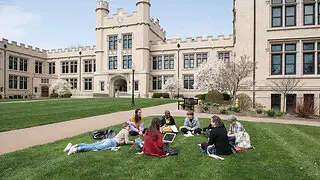
photo by: Matt Dilyard/The College of Wooster
College of Wooster students sit outside Kauke Hall.
The school’s Scot Marching Band is a kilt-clad local favorite that keeps its Scottish Presbyterian heritage alive. The sound of bagpipes fills the air at College of Wooster home football games, where locals often outnumber students in the stands, or downtown at annual events such as Woosterfest.
As a lifelong Wooster resident, Musselman has witnessed the city through its ups and downs—from the days of economic downturn in the 1980s to a thriving downtown that attracts people from all walks of life today. But no matter what a college town is going through, students will always be there, making this place their second home.
“It’s exciting to see somebody who isn’t from here excited about this community,” Musselman says. “I’ll hear them talking in the coffee shops, calling Mom or Dad: ‘We got to bring you here when you’re in town sometime.’ ... It’s an energy.”
Save Historic Places That Tell Our Full American Story
When you join the National Trust, you help save historic and culturally significant places nationwide.
.webp)