Preservation Is Climate Action: Nine Ways to Make a Difference
Historic preservation has an important role to play in addressing climate change. By keeping existing buildings in use, reducing energy consumption, and helping historic places withstand increasingly severe climate impacts, preservationists can help reduce carbon emissions and build more resilient communities.
Preservation advocates in the United States are joining with partners around the globe to promote heritage-informed decarbonization policies and examples of creative resilience projects. This work includes both familiar strategies and new approaches. Here are nine ways to integrate climate action across preservation programs, policies, and practices, including examples to explore from our work here at the National Trust.
Demonstrate Climate Solutions at Historic Sites

photo by: Brucemore
Exterior of Brucemore during the installation of a geothermal heating and cooling system.
Historic sites can serve as laboratories for reducing carbon emissions and improving climate resilience while protecting historic character. At Brucemore, a National Trust historic site in Cedar Rapids, Iowa, an underground geothermal heating and cooling system is tapping the constant temperature of the earth to greatly improve energy efficiency and lower long-term operating costs. Projects like these show visitors how low-carbon solutions can be readily implemented, even at places where conservation of historic fabric is paramount.
Advocate for Historic Places Threatened by Climate Change

photo by: Pat Bonish - Bonish Studio, Cedar Key
Cedar Key in Florida was included on the National Trust's list of America's 11 Most Endangered Historic Places in 2025.
Rising seas, flooding, wildfires, drought, and extreme heat increasingly threaten historic places and the communities that value them. Through advocacy, such as endangered properties lists, preservation advocates can document these threats, increase public awareness, and build support for protective measures. The National Trust's America's 11 Most Endangered Historic Places program has highlighted climate-related threats at numerous historic places across the country, including historic Annapolis, Maryland; Olivewood Cemetery in Houston, Texas; and Cedar Key, Florida. Public attention can help mobilize resources and bring funding to support adaptation and recovery at endangered places, such as historic Jamestown in Virginia.
Stay connected with us via email. Sign up today.
Strengthen Tax Incentives for Building Reuse
Reusing existing buildings avoids much of the carbon pollution associated with demolition and new construction. For decades, federal and state historic rehabilitation tax credits have helped make reuse of historic properties financially feasible. Recent examples, like the reuse of a Brutalist 1960s office building in New Haven, Connecticut, demonstrate how historic tax credit projects can be low-carbon models, incorporating energy efficiency, electrification, and renewable energy. The National Trust and its partners are advocating for improvements to federal incentives through the Historic Tax Credit Growth and Opportunity Act (HTC-GO), while also working to strengthen the use of state tax credit programs for sustainability.
Finance Sustainable Reuse
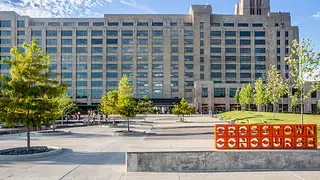
photo by: Selavie Photography
Crosstown Concourse in Memphis, Tennessee.
Access to capital remains a major barrier to sustainable adaptive reuse, especially in under-resourced communities. The National Trust Community Investment Corporation (NTCIC) has helped finance major rehabilitation projects that incorporate sustainable approaches, including Crosstown Concourse in Memphis (the largest LEED Platinum certified adaptive reuse project in the world) and POST Houston (featuring one of the world’s largest rooftop parks and farms). Recently, NTCIC and National Trust Energy Capital, a subsidiary of NTCIC with renewable energy tax credits to promote sustainability, invested in their first ever joint project, Park Synagogue in Cleveland. The National Trust's subsidiary, RePurpose Capital, is bringing investment to adaptive reuse projects that include deep energy retrofits in communities where financing is challenging.
Provide Community Anchors for Resilience and Recovery
When floods, fires, storms, or other climate emergencies strike, the importance of familiar historic landmarks is heightened. In many cases, these historic places can provide both symbolic and practical refuge for impacted communities. Several historic churches that have received grants from the National Fund for Sacred Places—a program of Partners for Sacred Places in collaboration with the National Trust for Historic Preservation—are taking on important roles in recovery and resilience. For example, the St. Peter’s–San Pedro Episcopal Church in Salem, Massachusetts, is adding solar and geothermal energy to create a source of reliable green energy for community members during climate emergencies.

photo by: St. Peters/San Pedro Episcopal
Exterior of St. Peter’s–San Pedro Episcopal Church.
Recognize and Share Successful Projects

photo by: Walsh Construction
Exterior of the Lawson House.
Examples of successful projects can help make ambitious climate goals feel achievable. Preservation awards, publications, and public programs create opportunities to demonstrate how historic buildings can reduce energy and carbon emissions and improve resilience while retaining their character. Several recent recipients of the Richard H. Driehaus Foundation National Preservation Awards offer sustainable preservation models. For example, at the Lawson House, an affordable housing adaptive reuse project in Chicago, project developers added insulation, new heating and cooling systems, and energy-efficient windows to significantly reduce annual energy bills. Practical examples like these can inspire owners and developers to pursue similar approaches for their projects.
Equip Preservationists with Practical Resources
Climate action requires knowledge and skills that preservationists can put to work in their communities. Recent webinars and publications include the Heritage Now! webinar series and Main Street America’s Disaster and Resilience Toolkit, which help stakeholders in historic commercial districts better understand climate risks and develop plans to mitigate the impact of climate disasters. Skilled workers are needed to make our historic places more resilient. Workforce development programs such as the National Trust’s HOPE (Hands-on Preservation Experience) Crew are teaching practical skills that can make historic buildings more resilient, such as how to repair and improve the performance of historic windows.
Map Climate Threats and Opportunities

photo by: Jim Lindberg
A group of future leaders gathered in Miami for the 2023 Aspen Institute’s Future Leaders Climate Summit.
Geographic information systems (GIS) can effectively convey information about the connections between historic resources and climate change. These tools can help advocates communicate complex issues, identify priorities, and make the case for policies and funding that support both preservation and climate action. Story maps can be an efficient way to quickly convey connections between climate action and historic places. For example, the National Trust's GIS team developed interactive story maps to illustrate climate threats to historic places on the 11 Most Endangered List and to highlight adaptive reuse projects supported by historic tax credits.
Build Partnerships Beyond Preservation
Preservationists are used to working across disciplines. Our work can bring diverse partners together. Addressing climate change requires expertise that extends beyond traditional preservation practice. Partnerships with engineers, insurers, climate scientists, community organizations, and sustainability advocates can multiply our capacity and impact. Through the Travelers Across America partnership, the National Trust is helping spotlight approaches to making historic properties more resilient while respecting their distinctive character. Such collaborations can bring technical knowledge and resources to preservation projects while helping other fields recognize the value of existing buildings and historic communities.

photo by: Seri Worden
Travelers Across America in Los Angeles.
No single strategy will address the climate challenges facing historic places and communities. But the work we do every day adds up. By integrating climate action across our projects and programs, preservationists can make a difference, in our communities and around the globe.
Save Historic Places That Tell Our Full American Story
When you join the National Trust, you help save historic and culturally significant places nationwide.