Where History Meets Humanity at Oatlands
If you watch the recordings from "Seeing Our Humanity"—the National Trust for Historic Preservation's signature America 250: Justice for All event, held at Oatlands on July 25, 2026—you'll encounter exactly what we hoped to preserve: thoughtful conversations among descendants, scholars, preservationists, community leaders, and the public exploring memory, justice, belonging, and the unfinished work of telling a fuller American story.
You'll hear Brent Leggs, the National Trust for Historic Preservation's new president and CEO, and Academy Award-nominated actor and humanitarian Djimon Hounsou reflect on history, leadership, and our collective responsibility as our nation commemorates its 250th anniversary. You'll witness moments of challenge, reflection, and hope.
For Omar Eaton-Martinez, senior vice president of historic sites at the National Trust, the anniversary offered an opportunity to consider whose experiences might help us understand the meaning of freedom more fully. As he reflected after the event, “We used the platform of the 250th anniversary of the signing of the Declaration of Independence to lift up the work of the group that most personifies freedom and liberation...the descendants of the enslaved.”
Seeing Our Humanity: A Signature Event of Justice for All
But like every meaningful gathering, the heart of the day was not only confined to the stage. It lived in conversations that unfolded before the first speaker took the microphone and continued long after the final applause had faded. It emerged in unexpected encounters that no run of show could have scripted and in the quiet realization that historic places can do something profound: they create the conditions for people to gather, to listen deeply, and to encounter one another through the stories that have shaped us all.
Seeing the Landscape Through Another Lens
That realization began to take shape early that morning. Before the public arrived, while the summer air was still cool, Oatlands descendant, author, and historian Kevin Grigsby invited a small group to walk the landscape. What unfolded was more than a tour; it was an invitation to see this place differently. Grigsby asked us to imagine Oatlands not as visitors often encounter it today, but as the men, women, and children enslaved by the Carters would have experienced it centuries ago.
Stay connected with us via email. Sign up today.
Standing beneath the shade of towering trees, he reminded us that these were places where his ancestors might have found a few precious moments of relief from the Virginia summer heat. At the greenhouse, the gardens, the laundry, and the garden dependency, he spoke not only about labor, but also ingenuity, family, faith, courage, and the stories that have endured across generations.
As I watched the group move quietly across the property, I noticed tears more than once. They were tears in acknowledgment of the men, women, and children whose names we may never fully know, but whose humanity shaped this landscape.
From Remembrance to Reunion
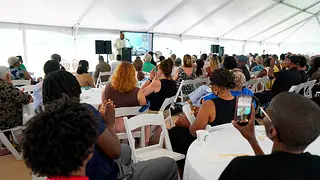
photo by: Larisa Epatko
In July 2026, a group of people gathered for Seeing Our Humanity, an event presented by the National Trust for Historic Preservation at Oatlands, a National Trust Historic Site in Virginia.
That same spirit of acknowledgment of the ancestors carried into the gathering that followed. Beneath the tent, descendants from Oatlands, Woodlawn, Belle Grove, and Montpelier greeted one another as members of an extended community. They exchanged family histories, embraced old friends, welcomed new ones, and settled into conversations that felt like a reunion. These moments reminded us that preservation begins with people, and the same spirit carried into the rest of the day.
As family, friends, neighbors, and members of the broader community joined us beneath the tent, two respected elders, Rev. Larry Walker and Ann Chinn, welcomed everyone through a moving libation ceremony. With prayers, remembrance, and the calling of ancestors' names, they invited us to begin the public gathering grounded in gratitude, reverence, and a shared commitment to honoring those whose lives brought us together.
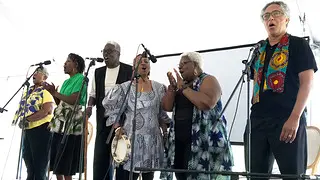
photo by: Larisa Epatko
Washington Revels' Jubilee Voices performed at Seeing Our Humanity.
Throughout the afternoon, the Washington Revels' Jubilee Voices marked each transition with song. Audience members joined in, singing familiar spirituals and freedom songs together. Strangers found themselves standing shoulder to shoulder, smiling, clapping, and sharing a moment that transcended the program itself. There was laughter, joy, and healing.
What Historic Places Make Possible
We often speak about preserving places for future generations. Yet perhaps the greatest responsibility of preservation is creating places now where intergenerational gatherings can help us wrestle with difficult histories, celebrate courage, build relationships, and imagine together what comes next. One attendee later reflected that what stayed with them most was “the sense of hope and healing” and seeing Oatlands honor the lives of those once held in bondage while giving “visibility, hope, and credit” to their descendants. I could not imagine a more meaningful affirmation of the work we aspire to do.
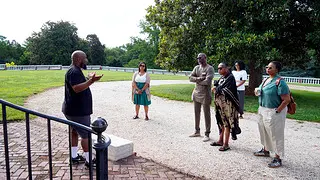
photo by: Larisa Epatko
A small group listened to Oatlands descendant, author, and historian Kevin Grigsby speak about the landscape of the historic site.
The conversations from “Seeing Our Humanity” will live on through the recordings we are proud to share, but the day itself reminds us that some of the most important work of preservation will never appear on a screen. It happens when people choose to gather, to listen with humility, and to recognize themselves in one another. In that sense, perhaps the most enduring thing we preserved that day was a sense of community that continues to grow, conversation by conversation, on a landscape that invites us toward a fuller understanding of our shared humanity.
Save Historic Places That Tell Our Full American Story
When you join the National Trust, you help save historic and culturally significant places nationwide.