The Irresistible Charm of the Restored Hotel del Coronado in Coronado, California
Whether or not you’ve been to the Hotel del Coronado, you’ve probably seen it. You’ve seen it onscreen in the classic 1950s comedy Some Like It Hot, where it towers majestically in the background as Marilyn Monroe cavorts on the beach. You’ve seen it in more than a dozen other movies or television shows, or on a postcard or a sidewalk artist’s painting in San Diego.
Somewhere, somehow, it likely has floated through your vision: an immense, gleaming white, tiered wedding cake of a hotel, topped with dark red towers and turrets and sitting on an endless, powdered-sand beach. It is emblematic of a certain, now somewhat nostalgic Southern California glamour: Hollywood stars and unknown bathing beauties, politicians and famous athletes, all posing for the cameras, feet in the sand, smiling against blue waves and bluer sky. The dream of California that drew millions.
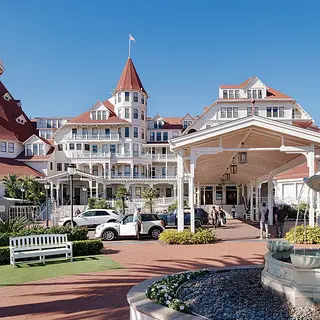
That sort of carefully curated Hollywood myth-making has mostly disappeared, but even if the high age of SoCal glitz has faded, the Hotel del Coronado itself has undergone a major glow-up. A seven-year restoration and renovation of the hotel’s Queen Anne–style Victorian building has returned much of the intricate historical architectural detail that had been lost or covered over, while also making necessary upgrades that still honor its heritage. The completed preservation project—part of a larger, $550 million overhaul of the whole property that included new construction and non-historic renovation—has taken a 138-year-old hotel that never stopped being jaw-dropping in its sheer size and unique presence and brought it and its history even more vividly to life.
I first remember seeing The Del, as the hotel is commonly known, in the 1980 movie The Stunt Man. The hotel plays a big role in the movie, and it struck me strongly enough that during my first visit to San Diego as a young man I made a pilgrimage to Coronado to see it.
The day was cloudy and cold, sometime in winter in the 1980s, and much of the development that now runs along the beach on both sides of the hotel was absent. I arrived late in the afternoon and I recall the long, golden arch of beach, often listed as one of the most beautiful in the world, as deserted. The Del had been designated a National Historic Landmark in 1977, but I didn’t know that. What I knew was that there, looming as if some living tribute to another era, stood a massive building with startling red turrets, ornate balconies, and row upon row of windows facing the sea. It was larger, stranger, more surprising than I expected. I felt I had stumbled upon something outside the flow of time, an enduring treasure. The hotel’s stately eminence has never ceased to fascinate me, and in this I know I’m not alone. Everyone from L. Frank Baum (the author of The Wonderful Wizard of Oz) to a child guest in 1892 whose letters are in The Del’s archives has testified to its ability to enchant.
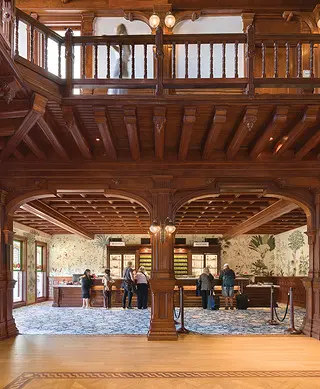
photo by: Brian Doll
A new, marble-topped reception desk references original details.
After my wife and I and our young daughter moved to Arizona, a trip to Coronado became a regular part of our summers. We usually stayed in more modest hotels, but The Del was a magnet around which our days revolved. Escaping the sun, we explored its twisting hallways, dotted with historic black-and-white photos—Babe Ruth proudly holding a stringer of fish, the future Duke of Windsor, presidents including Taft and FDR, nameless World War II men in uniform gathered with forced gaiety in the bar. Our days often concluded with a drink at Babcock & Story, the hotel bar named after The Del’s founders, Elisha Babcock Jr. and Hampton L. Story.
Stay connected with us via email. Sign up today.
They had careers in business and industry, but when it came to the hotel they were land developers trying to cash in on a late 19th-century land boom in Southern California, which in 1885 had just been connected to the rest of the nation by railroad. They bought not just the land for The Del, but all of Coronado Island, which isn’t really an island but rather a pork chop–shaped, roughly mile-long knob of land at the end of an isthmus connecting it to the mainland. In 1885, it was an undeveloped patch of sand and scrub where Babcock and Story planned a grand resort hotel and laid out and sold plots for what would become the town of Coronado.
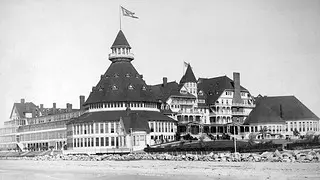
photo by: Hotel Del Coronado
The Del in 1888, the year it was completed.
They brought in architect James Reid of the Reid Brothers firm, whom Babcock had worked with in Indiana. Reid designed a five-story building that was intended, from the beginning, to attract national attention both in size and opulence. “Babcock needed to convince people in the East to spend five days by train to come here,” says Gina Petrone, Hotel del Coronado heritage manager. “‘Don’t go to Saratoga Springs, New York, or White Sulphur Springs, West Virginia. Come out here instead.’”
Work began on The Del in 1887. With a reported peak of 2,000 workers toiling away, principal construction was completed—amazingly—in less than a year. Perhaps even more amazingly, the hotel was built almost completely of wood, more wood than could be had in the greater San Diego area. Douglas fir, California redwood, hemlock, and cedar were all carted in. Illinois white oak appeared throughout the main lobby. Oregon sugar pine graced the upper walls and ceiling of the Crown Room, which could seat up to 1,000 guests and stretched 160 feet by 60 feet with an arched ceiling reaching 33 feet in height. Baum, a frequent visitor, would later design crown-shaped chandeliers that lit the soaring open space. In all, the Hotel del Coronado cost $1 million to complete: $600,000 for construction and $400,000 for furnishings. That’s roughly $34 million today.
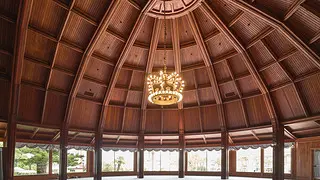
photo by: Brian Doll
L. Frank Baum, author of The Wonderful Wizard of Oz, designed the fanciful chandeliers in the Coronet Room (shown) and Crown Room.
The 450-room hotel opened its doors in 1888 as an architectural and engineering marvel. The Del featured indoor plumbing, early oil-fueled furnaces, and both gas and electrical lighting. “It was a combination of gas and electric because electric was brand new, and they didn’t know if it was a fad or not,” says David Marshall, who served as lead architect and lead preservation architect in different phases of the restoration. The hotel had an automatic fire sprinkler installed in 1918 to deal with a constant worry in large wooden buildings filled with men smoking cigars. Reid also had a multi-chambered cistern built to hold rainwater, ostensibly for firefighting, but it was never filled.
The hotel’s amenities were equally impressive. Many rooms looked into an internal courtyard filled with lush and exotic vegetation. The Venus statue that graced the fountain at the center of the courtyard was dubbed “Miss Few Clothes” by a reporter at the time, Petrone told me. Two billiard rooms, tennis courts, bowling alleys, a bathhouse, and a boathouse were all designed to attract visitors from near and far.
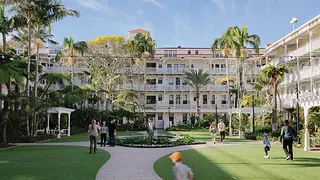
photo by: Brian Doll
Burton Landscape Architecture Studio designed the historic courtyard restoration.
But if the newly opened Hotel del Coronado seemed to stand at the pinnacle of Gilded Age extravagance, the land boom that led Babcock and Story to dream so big was already crumbling beneath them. “In 1885, San Diego had 40,000 people,” says Petrone. “There was a bust and by 1889, it was down to 14,000.”
Just two years after the property opened, Story sold his interest in it to John D. Spreckels, a wealthy industrialist whose interests included railroads, sugar refining, and real estate. Babcock sold to Spreckels 14 years later. The struggles of the two original owners to stay afloat foreshadowed what would be the financial challenges of maintaining a 19th-century wooden building the size of a cruise ship over the next 138 years.
The Hotel del Coronado is a member of Historic Hotels of America, a program of the National Trust for Historic Preservation.
Still, the Hotel del Coronado had its heyday under Spreckels’s ownership, becoming a magnet for the Hollywood A-list and other luminaries. But Spreckels died in 1926, and the hotel’s ownership passed from his family in 1948. As with many large hotels at the time, subsequent owners sometimes struggled to keep the white beacon on the sand from becoming their white elephant. “It had its ups and downs with the economy,” says Bruce Coons, executive director of Save Our Heritage Organisation (SOHO), San Diego’s oldest preservation nonprofit.
Piecemeal alterations took place as owners made fixes and remodeled to adjust to shifting consumer expectations. The Del never lost its essential character and continued to be a popular attraction, but by the start of the 21st century key historical features had been lost or covered over, and the hotel needed significant upgrades.
In 2011, Blackstone Real Estate acquired part of The Del, and in 2015 the company gained full ownership. A couple of years later, the hotel joined Hilton’s Curio Collection, and it continues to be managed by Hilton. Blackstone Real Estate, which still owns The Del, was willing to undertake the significant restoration and renovation that concluded last summer.
As old photos and historical documents were consulted and alterations were peeled away, The Del revealed architectural treasures it had been holding onto all these years. “We didn’t realize how much we’d discover,” says Petrone.
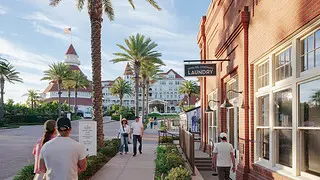
photo by: Brian Doll
The Del's original 1919 laundry was transformed for new use as an event venue.
On the kind of perfect midwinter day—flawless blue skies, temperature in the 70s—that brings visitors streaming to Southern California, David Marshall, who heads Heritage Architecture & Planning in San Diego, took me around the hotel and grounds. We started on the restored front porch, which had been lost in earlier alterations.
“All we had was black-and-white photos and original ink-on-linen drawings,” Marshall told me, but working from those and paint scrapings that revealed the original colors, “the whole front porch has been brought back to the original period.” The ceiling of the porch, workers discovered during restoration, had been a pastel blue-green shade known as haint blue and associated with the Gullah Geechee people of the coastal South.
During a visit to The Del the previous spring, I had whiled away a rainy afternoon reading in one of the wicker chairs on the porch, wondering how I hadn’t noticed that they were there before—a testament to how organic the restoration felt. That feeling held for all the changes I saw. They were made to bring the hotel back to the period of historic significance determined for the restoration: 1888 to 1948.
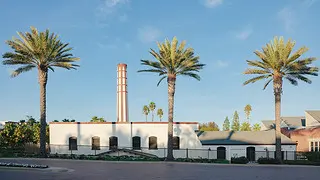
photo by: Brian Doll
The conversion of the 1887 Power Plant into office space for the hotel was designed by obr Architecture.
Smaller details, like the Japanese-inspired wood spindle railings that had been largely replaced, were restored. (Too short now to meet safety code, they are backed by unobtrusive frameless glass at the proper height.) Lead phase two architect GSB, Inc., and general contractor Swinerton worked with Marshall’s team to restore intact siding, which differed on various floors, and re-create missing siding to match the original. Window sashes were returned to their original color, identified by carefully scraping away years of paint. “There are 1,600 original and replica windows in this building,” says Marshall, “and they all now have red sashes.”
Stay connected with us via email. Sign up today.
Some historical features had to be re-created. Over the decades, few original windows remained on the south facade. More than 90 replicas were made and installed. Many of the original five-panel doors to the guest rooms were also long gone, but new ones were fashioned based on photographs. Though the Venus fountain statue by French sculptor Charles Cordier was removed from the garden courtyard in 1912, landscape architect Reid Katkov located an identical one in Port Townsend, Washington. Conservation firm Carapace Arts used it to make a mold so a new copy could be cast.
Discoveries of lost treasures came as work progressed. Outside the circular ballroom underneath the turret, a hand-painted ceiling fresco from the hotel’s first years was uncovered. Plans were quickly changed to make sure it remained visible. It turned out original doors to the Crown Room and the Coronet Room (another historic event space) were hidden beneath plywood laminate, Petrone says, and they, too, were restored. Wood in the Crown Room and lobby was also returned to its original beauty.
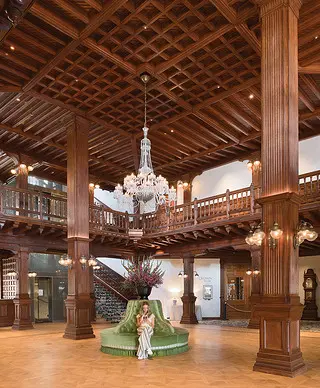
photo by: Brian Doll
Restored white oak woodwork encases the lobby, which was designed by Wimberly Interiors with WATG.
The Del’s south facade originally had 25 stained-glass windows; most had been lost over time, and limited photographic evidence did not allow for perfect replicas. Twenty-one new ones were made in the style of the originals. The crown jewel in the hotel’s stained-glass collection, an allegorical representation of the town of Coronado that depicts a maiden with a crown held high above her head before a stylized sun, had survived, although it had been moved to various locations over the years. It was carefully restored and now sits in its proper place of honor on the second floor, above the hotel entrance.
These are just a few examples of the work that’s been done to revitalize the property. Blackstone Real Estate spent $174 million on the restoration of the Victorian building and courtyard alone, Marshall says. Work on the rest of the grounds and supporting facilities included turning the old laundry into a space for special events and converting the ice house to a small museum, both led by obr Architecture.
Marshall, who grew up in San Diego and has memories of the Hotel del Coronado going back to childhood, has been working in preservation architecture for 35 years. When asked what The Del’s restoration meant personally, he had a simple answer: “These are the kind of buildings you always hope to work on. It was the project of a lifetime for me.”
In Petrone’s office a metal bookcase is stacked with heavy leather ledgers recording the names of thousands upon thousands of visitors from The Del’s long history. Near the end of our time together, she handed me the very first ledger. I opened it to the names of Mr. and Mrs. Nelson Morris, the first guests to sign in at the Hotel del Coronado on January 29, 1888, followed by the names of their two children and a final member of their party identified simply as “maid.”
The handwritten signatures on the yellowing page were ornate and beautiful, a sign of a time when handwriting mattered. That and the casual addition of a servant who apparently didn’t warrant further identification all spoke to the Victorian age in which the Hotel Del Coronado opened. It is a long journey from there to here, and the guests strolling the grounds in shorts and T-shirts today couldn’t seem farther distant from the frock-coated and bustle-skirted guests in the earliest photos. Yet in the magnetic attraction I am sure it had for them and still has, the Hotel del Coronado is as fine an argument I know for the value of preservation, proof that the best of the past matters because it connects us across the ages in wonder and awe.
Coons, like Marshall, has known The Del since he was young. He remembers visiting with a date on New Year’s Eve when he was a teenager. He couldn’t afford the private party in the Crown Room, he says, but as the clock struck midnight, the partiers spilled out into the main part of the hotel, and everyone celebrated together. Afterward, he says, he and his date took a walk on the beach, the hotel behind them lit up against the night sky as it has been for more than a century. “It’s always been a special place in the hearts of San Diegans,” Coons says, “and for the world, too. … It is an icon.”
Save Historic Places That Tell Our Full American Story
When you join the National Trust, you help save historic and culturally significant places nationwide.
This page contains affiliate links. If you make a purchase through these links, the National Trust may earn a small commission. Check out other ways you can support preservation as you shop, travel, and play.