The Amana Church: Bringing Food to the Community
The Amana Colonies, a National Historic Landmark in Iowa since 1965, and one of America’s longest-lived communal societies, trace their beginning to German villages and the Pietist movement in the early 1700s. Persecution and economic depression forced the community to leave Germany in the early 1840s, where they first settled in New York before migrating to in Iowa in 1855. The community eventually established seven villages and communal life continued for almost a century, until the upheaval of the Great Depression led to a change: the establishment of the Amana Society, Inc., which would manage the farmland, mills, etc., as a profit-sharing corporation.
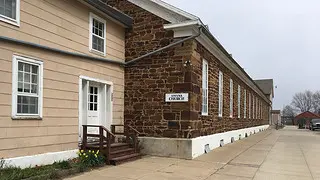
photo by: Elly Hoehnle
Exterior view of the Amana Meeting House looking east before the restoration. The west annex is left, with the 150 foot sandstone sanctuary section at middle and two and a half story east annex at end. Tan panel siding on annexes installed in 1950s. c. March 2020
The Amana Church Society in Middle Amana, Iowa, entered the National Fund for Sacred Places program in 2021. The National Fund for Sacred Places (National Fund) is a program of Partners for Sacred Places in collaboration with the National Trust for Historic Preservation, providing financial and technical support for community-serving historic houses of worship across America. The church society received a $70,000 grant and raised $347,742 in matching funds to complete urgent repairs on two of its buildings: the Amana meeting house (1864) and the kinderschule (c. 1880), which became the new home of its community-serving food pantry.
Society member Peter Hoehnle spoke with National Fund Manager, Dawn Ellis about the project.
How did you first get involved with the church?
Peter Hoehnle: I am a lifelong member and a descendant of lifelong members going back many generations to almost the beginning of the sect in Germany in the 1720s. My wife was heavily involved in this project before as administrator, and I've taken over from her as administrator of the church as well. I am a church elder, which in our faith community means that we conduct church services. We actually do the preaching and make a commentary every couple weeks.
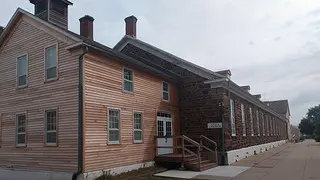
photo by: Peter Hoehnle
The Amana Meeting House after restoration.
The Amana Colonies are an example of communal living- can you share more about how that worked?
Hoehnle: [The community members] farmed on the open field style of agriculture, which meant that the people lived in the village and went out and worked the land. People ate in communal kitchens. Men worked in craft shops. At the factories, a few women worked in the woolen mill and on the farms. Each village had its own blacksmith shop, wagon shop, carpentry shop, and so forth, and its own meeting house or church. The Sunday morning service was the one that was held in what we now think of as the church, the main building in the center of town. In communal living, nobody received wages, but they did have a credit line at the general store for things that were not automatically provided for them, like clothing and household items. But other than that, everything was provided for you.
Can you talk about the food pantry? Is there a garden associated with it?
Stay connected with us via email. Sign up today.
Hoehnle: I think it's been around about 10 years, and we have about half a dozen volunteers every time that it is open. They serve on the second Wednesday and the last Sunday of each month. They serve about 20 different families right now. It's been down in the basement, there are freezers and refrigerators and all that down there, and they tromp up the steps with these bags of stuff and do the distribution on our main floor.
No [garden]. We did that in the past. We're a lot like everywhere else in rural Iowa now, as far as not being as self-sufficient as we could possibly be.
We work with a local social service agency and they provide some food at cost. We get food donations and then we get financial contributions, but it is donation-driven. It's kind of a community building thing as far as people coming in that we normally wouldn't interact with because they're not church members. There've been some friendships and some bonds that have formed with the volunteers, which has been great.
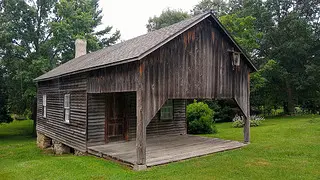
photo by: Emilie Hoppe
The south and west sides of the Kinderschule in July 2021 before the restoration.
For this project, there was a decision to restore. What went into that decision to not just repair, but to restore? Did (being a rural congregation) impact your ability to complete this project, to find the tradespeople that could do the work?
Hoehnle: We had a hard time finding a general contractor, especially for the Amana building. There were some challenges in the early days, also in fundraising.
Being in a historic community and being a national historic landmark, we're looking towards trying to set a good example for the residents and the homeowners. We wanted to set a good example of continued historic preservation because it's hard. We have a land use district around here. We're not incorporated, and they enforce certain guidelines for historic preservation and renovation in the homes. Sometimes you have to make people very unhappy. Other times, you make somebody who's not really thrilled, follow the guidelines and they come back to us and they say, oh, I'm so glad you had these guidelines because the house looks so much better or the business looks so much better with true historic qualities.
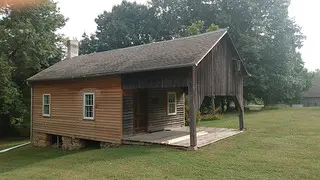
photo by: Peter Hoehnle
The Kinderschule following critical repairs.
What has been the response to the aesthetic changes?
Hoehnle: Right away when the siding went up, even when it was in process, we got a lot of nice comments. The little kindershule, the old daycare building behind the building in middle, which is now the food pantry, was looking pretty ragged. It's not as visible, but it's a very sentimental structure for the community. It's one of only two of the original communal daycares that are still standing, and so it's important that we preserve that.
We looked at it as a positive revitalization. We call it this restore, revive, renew, and that it would generate some positive feelings about the church going forward
As a rural congregation, did you feel like [the National Fund] was a good program for you or did you feel like this is mostly for urban churches?
Hoehnle: We felt it was a good fit. St. John's Lafayette Square [in Washington DC] and Washington National Cathedral were the same year, and we were like, wow, to be in such company. We've always had the sense that this community is unique and so it fit.
I think rural congregations should realize that they're each unique in their own way and that they serve a community and that this program helps them better serve that community and better celebrate their heritage and their uniqueness, and the tools are there to definitely help them be successful.
Save Historic Places That Tell Our Full American Story
When you join the National Trust, you help save historic and culturally significant places nationwide.
.webp)
_mr.webp)